

The Intermediate-Range Nuclear Forces treaty was one of those agreements and is set to expire in the next two years. The 1987 pact helps protect the security of the US and its allies in Europe and the Far East.
The move came as the United States and its European allies are believed to have faced resistance in pushing their case for referring Iran's nuclear activities to the United Nations Security Council.
Pakistani officials claimed the missile can carry any type of warhead.
The government has been pushing ahead with the programme while claiming that no decision has been made on a successor to Britain's Trident nuclear deterrent, The Sunday Times reported.
Highly placed sources said the test firing could take place any time this month.
The missile was fired from INS Rajput, stationed in the Bay of Bengal off the coast of Orrisa.

'Pyongyang's strategy seems to be a cry to be treated as equal with the US and Beijing and this aspiration is premised on equipping itself with weapons as devastating as theirs,' says Rajaram Panda.
Nearly 380 tonnes of deadly explosives, powerful enough to shatter air planes, demolish buildings, make missile warheads and detonate nuclear weapons, are missing from one of Iraq's most sensitive former military installations.

The surface-to-surface Prithvi-II missile is capable of carrying 500 kilogram to 1,000 kg of warheads and is thrusted by liquid propulsion twine engines
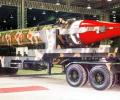
For the world and India, one of the most enduring challenges of the times is for Pakistan's nukes to be neutralised, before they are ever used by the State, their sponsored non-State actors or any rogue elements from the many terror tanzeems dotting Pakistan's unstable landscape, says Lieutenant General Kamal Davar (retd).

United States president-elect Donald Trump's tweet for strengthening and expansion of country's nuclear arsenal is indicating a major policy change as against the Obama Administration which had pushed for reduction and ultimately elimination of nuclear weapons.
India must re-negotiate its nuclear deal with the US in order to save its strategic interests, former national security adviser Brajesh Mishra said Tuesday night.

The term, 'pro-Pakistani', is helpful for the BJP to depict its opponents as anti-nationals while the sedition law is handy for locking up or harassing the government's critics, points out Amulya Ganguli.
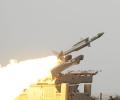
The missile targeted a floating object supported by the pilot-less target aircraft 'Lakshya', defence officials said.
Pillai said the exports and induction of the missile in the armed forces would be carried out simultaneously.
The supersonic anti-ship cruise missile was jointly developed by India and Russia.
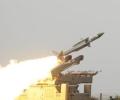
India today successfully test fired indigenously-developed surface-to-air Akash missile with a strike range of 25 km and capability to carry warhead of 60 kg from the Integrated Test Range at Chandipur as part of a user-trial.
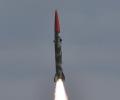
Pakistan on Tuesday successfully test-fired a short-range surface-to-surface ballistic missile Hatf III (Ghaznavi), capable of carrying nuclear and conventional warheads to a range of 290 kilometres, that could cover parts of India.
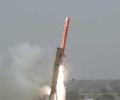
The flight test of the Air Launched Cruise Missile, Ra'ad, which is also known as Hatf VIII, was the seventh since it was first tested in 2007.

The development and trials will continue and the rocket is expected to enter service any time now.

There were reports that there was was dissent in the US President's regime over North Korea.

India on Monday successfully test-fired its indigenously developed nuclear capable Prithvi-II missile, which has a strike range of 350 km, as part of a user trial for the defence forces.
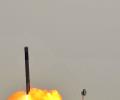
India on Tuesday test-fired an advanced version of the 290-km range BrahMos supersonic cruise missile from the Odisha coast. The missile was test-fired from a mobile launcher from the Integrated Test Range at Chandipur at about 10.40 am, Defence Research and Development Organisation said.
'The test-firing of Agni-III is overdue and we feel the need for that long-range missile as part of our policy of deterrence,' he said.

Inducted into Indian armed forces in 2003, the nine-metre-tall, single-stage liquid-fueled Prithvi II is the first missile to be developed by DRDO under India's prestigious Integrated Guided Missile Development Program.

With this new induction, the country has the capability to launch nukes from land, air and sea.

India on Thursday successfully test-fired its indigenously developed nuclear capable Prithvi-II surface-to-surface missile with a strike range of 350 km as part of a user trial by the army from a test range at Chandipur in Odisha.

The missile, Babur-3, was fired from an underwater, mobile platform and hit its target with precise accuracy,

Describing the trial as "fully successful", the sources said, the sophisticated missile travelled for 19 minutes and covered 4,900 km.

Many new technologies developed indigenously were successfully tested in the Agni-5 trial.
 © 2026 Rediff.com - Investor Information - Advertise with us - Disclaimer - Privacy Policy - Sitemap - Feedback - About us - Terms of use - Grievances