
'Pakistan's leaders have made a serious mistake in describing India as an existential threat and a permanent enemy. If there are no permanent friends or permanent enemies in international relations, then neither Afghanistan nor India should be Pakistan's permanent enemies either,' Husain Haqqani, former Pakistani ambassador envoy to the United States, tells Rediff.com's Aziz Haniffa in a fascinating interview.

Kirby's remark comes a day after Saeed had reportedly said that the United States is the real enemy of Pakistan.

US Navy SEALs were able to sneak into Pakistan covertly to kill Osama bin Laden because of advanced American stealth technology and the Pakistani military's obsession with India.
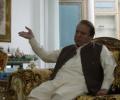
Cameron Munter, former United States ambassador to Pakistan, is optimistic that under the new leadership of Nawaz Sharif, a rapprochement between New Delhi and Islamabad may be on the cards.
Pakistan's Ambassador to the United States Sherry Rehman believes trade and people-to-people interactions between India and Pakistan can contain the fall-out of "flare-ups" like the recent killing and beheading of two Indian soldiers near the Line of Control in Kashmir.

The reaction by the State Department came after Pakistan Premier Shahid Khaqan Abbasi, during an interview to Geo TV on Tuesday, referred to Saeed as 'sahib' or 'sir'.

'Platinum grade support from Washington has not been forthcoming, the christening of the US-Indian ties as a 'defining partnership' notwithstanding,' says A,bassador M K Bhadrakumar.

The comparisons were available for 12 countries.
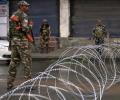
All things taken into consideration, the Taliban statement on Kashmir portends trouble ahead. The Taliban is notorious for doublespeak and when it says there is no link between the Kashmir issue and the Afghan settlement, the opposite must be taken into account as well, points out Ambassador M K Bhadrakumar.

What does the Taliban chief's death means for various stakeholders?
Pakistan's decision to reopen transit routes for Nato convoys holds big implications for the future trajectory of the US-Pakistan relationship and regional security -- and for Pakistan's domestic politics, says MK Bhadrakumar
The United States on Tuesday agreed to step up efforts to provide defence equipment needed by Pakistan to maintain security along its border with war-torn Afghanistan and to continue discussions on the provision of military aid to Islamabad.
The dreaded Haqqani network has emerged as the 'most ominous threat' to the already fragile US-Pakistan ties as American officials believe the terror group has an 'ongoing relationship' with the ISI and the two were doing more than just talking, a media report has said.
In foreign affairs, reform and the Kashmir valley, is New Delhi is ignoring chances for long-term advantage? Asks Shyam Saran
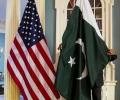
The relations between Pakistan and the US nosedived this January after US President Donald Trump accused Islamabad of giving nothing to Washington but "lies and deceit" and providing "safe haven" to terrorists.
With the most recent nosedive in United States-Pakistan relations in the aftermath of the North Atlantic Treaty Organisation strike that killed 24 Pakistani soldiers, ironically, India-Pakistan relations seem to be on a more solid footing than the so-called US-Pakistan strategic partnership, said Thomas Donnelly, resident scholar at the American Enterprise Institute, who specialises in defence and security policy.

'The US appears to think that Pakistan is highly vulnerable today due to its economic crisis and one more turn of the screw may bring about desired results,' says Ambassador M K Bhadrakumar.
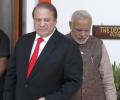
"The government's position for bilateral redressal of all India-Pakistan issues in an environment free of terror and violence hasn't changed."
Welcoming the strategic partnership agreement between India and Afghanistan, the United States on Wednesday asserted that there was no reason for uneasiness or apprehension by Pakistan's leadership on this.
United States Secretary of State Hillary Clinton in major diplomatic mode, trying to save the US-Pakistan relationship; White House adopts same tack; meanwhile, the pro-Pakistan lobby is on an overdrive. Aziz Haniffa reports.
Army chief General V K Singh has spoken recently of Chinese troops in Pakistan occupied Kashmir. The impending American withdrawal from Afghanistan and the US-Pakistan divorce has the potential to destabilise the region. China may become more assertive in South Asia, feels Colonel Anil Athale (retd).
The United States said it was in early stages of investigation into the cross-border North Atlantic Treaty Organisation air raid that killed 24 Pakistani soldiers and was not apologising to Islamabad, as of now.
US intelligence agencies had been tracking the hostages and shared their location when they were shifted to Pakistan.

'Is Trump going to play a mediating role? Can he play a mediating role? It's out of the question.' 'Kashmir is an Indian responsibility.'
United States is safer today because of the cooperation it has received from Pakistan, a top White House official said, maintaining that Washington's relationship with Islamabad is important but complicated.

Pakistan's military on Monday deployed an indigenously-made armed drone to attack a militant compound, killing at least three "high-profile" terrorists.
'While US officials understand and accept India's desire for retaliation, they still don't want to encourage steps that would likely lead to war.'
United States Secretary of State Hillary Clinton on Friday arrived in Pakistan on a surprise visit amid severe strains in bilateral ties following the American raid that killed Al Qaeda chief Osama bin Laden earlier this month.
Notwithstanding India's protests, the Obama administration is readying itself to provide Pakistan with even more massive doses of military largesse, as senior United States officials acknowledged that Pakistan's request for additional security assistance would be a top priority on the agenda of the US-Pakistan Strategic Dialogue that begins on Wednesday.
'The US does not want Pakistan either to break up or fall into the hands of fundamentalists. The US has been saying for long that India should work with those in power in Pakistan, because those who came after them would have longer beards!'
Security Expert B Raman wonders whether the operation in Abbotabad, which finally killed Osama Bin Laden was an exclusive United States operation or in collaboration with Pakistan.

A White House official said the US is prepared to take actions on its own to safeguard its personnel in Afghanistan.
A top United States military commander has warned that it would be "dangerous" to abandon Pakistan now as he feared this would lead to instability in the region witnessed in the 1990s. Admitting that US-Pakistan relations were going through "pretty rough times", Admiral Mike Mullen, chairman of the Joint Chiefs of Staff, said, "I think the worst thing we could do would be cut them off," BBC reported. Mullen feared it would be a repeat of the instability in the 1990s.
In the wake of the United States covert operation by an elite squad of the Navy SEALs that killed Al Qaeda lynchpin Osama bin Laden, Richard N Haass, president of the influential Council on Foreign Relations, said it's d
The third round of US-Pakistan Strategic Dialogue will be held in Washington on October 22, special Af-Pak envoy Richard Holbrooke said on Monday as he lauded international efforts, especially by India, in providing support to Pakistan flood victims.

'As far as acquisition of Russian equipment is concerned, with about 70% of Indian military equipment being of Russian origin, a sudden decision to abandon imports from Russia is not feasible,' points out Brigadier S K Chatterji (retd).

In a fresh anti-India tirade, Pakistan's Defence Minister Khawaja Asif has alleged that the assault on an Indian army base in Uri that killed 18 soldiers was a "plan devised by India itself".

Secretary of State Hillary Clinton on told the Pakistani leadership that the United States wants the continuation of dialogue between New Delhi and Islamabad so that the two sides can resolve their outstanding problems amicably, diplomatic sources said on Monday.
'We're paying them nothing because that's what they've done to help us. Nothing'

'Here in Delhi, the Modi government is supposedly looking at 'options' to hit back at Pakistan in any whichever way it can, while in Washington, the Obama administration is looking for ways to strengthen US military cooperation with Pakistan,' says Ambassador M K Bhadrakumar.
 © 2026 Rediff.com - Investor Information - Advertise with us - Disclaimer - Privacy Policy - Sitemap - Feedback - About us - Terms of use - Grievances