
There's still little indication of forward movement in Indo-US defence relations.

'I could see it not having any impact whatsoever,' says Stephen P Cohen on Obama's India visit.

Two US lawmakers write to the House Speaker asking to extend an invitation
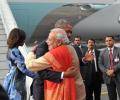
'A three generation US-Pakistan relationship is not likely to be snapped any time soon. All this presents an irritant to an India that wishes to concentrate on economic development,' says Colonel Anil A Athale (retd).

'The height of irony is that Bobby Jindal will always be known as the first Indian-American Governor, the second Indian-American Congressman and the first Indian-American Presidential candidate, regardless of his claim to be just American. Given the situation in the US, no one will be able to erase his identity in relation to his origin.'
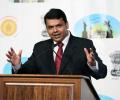
If it was true that Maharashtra Chief Minister Devendra Fadnavis held up the flight to Newark to ensure that Praveen Singh Pardeshi, the state principal secretary, was on board, he had at least one excuse...

The investigations into and actions being taken by the US State Department's Diplomatic Security Service against Devyani Khobragade were not shared with Secretary of State John F Kerry, Deputy Secretary of State William Burns, or Assistant Secretary of State for South Asia Nisha Desai Biswal, reveals Rediff.com's Aziz Haniffa from Washington, DC.

'They don't always agree with our governments, their teachers or their parents, but it is the conviction of their ideas, and their determination to share them with the world that, I believe, is one of the greatest sources of hope for our planet.' 'The colonisation of space, understanding the very building blocks of matter and the universe, utilising our understanding of the human genome to conquer disease -- these are the tasks waiting for a fellowship of minds to realise new triumphs in our collective destiny.'
'We don't want confrontation; we are trying to build a cooperative relationship in which both sides have stakes in producing an improving climate of relations and responsible behaviour.' What does Shiv Shankar Menon, one of India's most brilliant diplomats and the former National Security Advisor, think of the Modi visit to the US, the Chinese stand-off in Ladakh and the situation on the LoC?
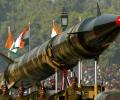
'We have worked to create road blocks in the path of those who thought that there was space for conventional war despite Pakistan's nuclear weapons.' 'Pakistan's nuclear weapons programme is not open-ended and aligned with India only.' 'In this unstable regional environment, one nuclear power is trying to teach lessons to another nuclear power through the medium of small arms and mortar shells on the Line of Control, and bluster.' 'A historic opportunity of a lifetime beckons the leaderships of India and Pakistan to grasp, sit together and explore the possibilities of conflict resolution.'

'In the past the US has been reluctant to name Pakistan directly in an US-India joint statement.'

'I believe one of the most critical issues is the common threat we face from Islamist radicals and the continuing and unimpaired financing of Al Qaeda, the 'D' Company, the Haqqani network, the LeT and the Jaish-e-Muhammed.'

'Demonetisation, is in principal, a mistake, because it involves a theft -- a taking of private property by the State.' 'It is one of those bad Indian ideas that has been tried twice in the past, with two failures for the record books.' 'This cloud over the economy will probably remain as long as Modi is in power.'

India has a 'natural global partnership' with US, says PM.

The Bombay High Court on Thursday handed over to CBI the probe into Bollywood actress Jiah Khan's death, five months after Mumbai police concluded it was a case of suicide and charged her live-in partner Suraj Pancholi with abetting it.

While the Indian Government was aware of it, it tried to play it down and instead referred to it as genocide against the Bengali community in Bangladesh so as to avoid an outcry from the leaders of the then Jan Sangh, the predecessor of the today's main opposition Bharatiya Janata Party, says Gary J Bass, author of the book The Blood Telegram: Nixon Kissinger and a Forgotten Genocide, which recently hit the book stores.

Top security experts of India and the US met in New Delhi on Wednesday to discuss various measures, including exchange of technologies, to help each other face challenges like terrorism, cyber crime and ensuring safety of major cities.

Council on Foreign Relations Senior Fellow Daniel Markey Tuesday said that the raising of the issue of American intervention in Jammu and Kashmir by visiting Pakistani Prime Minister Nawaz Sharif at the United States Institute of Peace in Washington was not 'especially constructive' and was motivated by political expediency.

'Patel was more in tune with the popular mood than Jawaharlal Nehru. While the principle that Hindus and Muslims should be able to live together remained central to Nehru's vision for India, the Sardar was less sentimental.' 'Nehru would angrily face down mobs himself, rushing from trouble spot to trouble spot. A veritable tent city, filled with Muslim refugees, sprouted on the lawns of his bungalow... Mountbatten feared Nehru's impulsiveness would get him killed, and assigned soldiers to watch over him.' Nisid Hajari's Midnight's Furies: The Deadly Legacy of India's Partition casts fresh light on the events and personalities behind the horrific division of the subcontinent which haunts the India and Pakistan to this day.

'The Senators were playing safe, not angering either the pro-India lobby or the pro-Pakistan lobby, but perhaps more importantly, the military-industrial complex -- the most powerful lobby of all -- which the majority of Senators are beholden to in terms of largesse to their campaign coffers.'
The two countries that will be most affected by the internal developments in Pakistan are India and the United States, says Bob Blackwill. Aziz Haniffa reports
Humanitarian intervention has little meaning unless the international community is willing to engage in the aftermath, says Shyam Saran.
Declassified US documents of the era indicate.

The external affairs ministry's files, as distinct from those of the ministry of defence or the agencies, at least from before 1974 should be declassified. And if select files that are more than 40 years old are not to be declassified, the ministry should follow explicit guidelines to justify taking such a view, says Jaimini Bhagwat.

The US needs to do three things to help the newly elected Nawaz Sharif government in Pakistan, says Stanley A Weiss
'What we have heard from the Sri Lankans is their desire to have a foreign policy that allows Sri Lanka to best advance its own interests rather than a foreign policy that relied solely on one relationship.' 'We think this is an attitude that makes a lot of sense. India and Sri Lanka have many areas of shared interests, and it's certainly welcomed by us to see that deepening of those ties.'
The West has always preferred a timid, half intelligent and a dependent India rather than a decisively independent and self-reliant one. A pliable Indian leadership suits the West best, says Tarun Vijay.

'The US-India relationship is in a different league altogether,' Obama administration officials tell Aziz Haniffa/Rediff.com in Washington, DC.
Delhi's inability to open up a new canvas with Pakistan and Sharif is symptomatic of its sluggish thinking. Jyoti Malhotra analyses

'The Indian government has accepted and is a party to international agreements, standards and conventions on religious freedom.' 'We did not force it on them. We are not trying to impose something on them that they haven't already agreed to...' 'India has never allowed us to visit, which is very disappointing for such a wonderful country with such a rich democratic tradition. They seem to be afraid to let us in.'
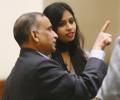
'A senior US diplomat last week asked me when things will go back to normal. I had to tell her that if normalcy meant getting back these perks, it is not going to happen for a very long time, if ever at all,' says Mohan Guruswamy. 'For the Indian public now is outraged that US diplomats have enjoyed all these winking at the rulebook.'
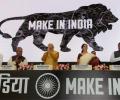
'India is going to maintain its ties to China, India is going to develop a strong relationship with the United States. It means that India is going to have the flexibility to pick and choose its friends.' 'That's traditional Indian foreign policy, and it's smart.' Former US ambassador to India Frank Wisner, one of America's sharpest minds on South Asia, tells Aziz Haniffa/Rediff.com what Washington can expect from Narendra Modi's visit.

'Foreign policy-making cannot be shifted out of Delhi and the regional satraps, who do not have a national perspective, should not be allowed to dominate foreign policy. But regional inputs should be integral to foreign policy-making at every step of the way,' says Ambassador T P Sreenivasan.

'It is important to note that American officials were trying their best to use the Taliban for their oil games till December 1997 when Mullah Ghous was invited to America. State Department officials did not show any interest in capturing or killing Osama bin Laden even at that time.'

'India was in no position to wage another war in 1965, having suffered a morale-shattering defeat in 1962. The three services were in the middle of a modernisation and expansion phase and therefore not fully trained or battle-ready.'
 © 2026 Rediff.com - Investor Information - Advertise with us - Disclaimer - Privacy Policy - Sitemap - Feedback - About us - Terms of use - Grievances