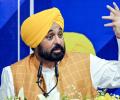
Punjab Chief Minister Bhagwant Mann took a jibe at the Bharatiya Janata Party over Operation Sindoor on Wednesday, saying this is the first time that Indian representatives have been sent abroad to convey about the country's victory in an armed conflict.

Defence Minister Rajnath Singh stated India's readiness to assist Pakistan in combating terrorism if it cannot act on its own, highlighting Operation Sindoor as a demonstration of India's capabilities. He also criticized Pakistan's appointment to a UN counter-terrorism committee.

Gandhi urged the prime minister to speak out "clearly, boldly and forthrightly" on behalf of the legacy that India has long represented.

Modi, who visited Cyprus in the first leg of his three-nation visit, reiterated India's support for Cyprus's unity and for a peaceful resolution of the Cyprus Question based on UN Security Council resolutions, international law, and the EU Acquis.

India's Foreign Secretary Vikram Misri said on Thursday that the choice of de-escalation is with Pakistan, as India only responded to the April 22 Pahalgam terror attack, which killed 26 people. He added that Pakistan has been escalating the situation with cross-border terrorism against India for decades.
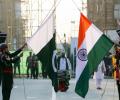
The UN Security Council will hold closed consultations on Monday on the situation between India and Pakistan after Islamabad sought an emergency meeting on the issue. Pakistan, which currently sits as a non-permanent member of the council, requested the meeting in light of rising tensions between the two countries following a terror attack in India. The meeting comes after India's foreign minister spoke with all council members except China and Pakistan, emphasizing the need to bring perpetrators of the attack to justice. The Pakistani envoy has argued that the situation in Jammu and Kashmir poses a threat to regional and international peace and security, justifying the need for a council discussion.
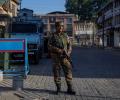
India has reached out to Denmark and other non-permanent members of the UN Security Council to apprise them of the Pahalgam terror attack and its cross-border linkages. External Affairs Minister S Jaishankar has spoken to his counterparts from several nations, conveying India's resolve to bring the perpetrators to justice. The outreach comes as India mulls options for responding to the attack, with Prime Minister Modi assuring the harshest response for the "perpetrators and conspirators." India has also received condolences and condemnations from world leaders, including US President Donald Trump and French President Emmanuel Macron.
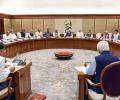
India has reached out to key global powers, including members of the UN Security Council, and apprised them about the reasons behind its military strikes on nine terror targets in Pakistan and Pakistan-occupied-Kashmir in retaliation for the Pahalgam terror attack. New Delhi also conveyed to the countries that it will retaliate if Islamabad escalates the already tense situation.
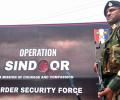
Their shared brief: To assert India's case with clarity, rebut hostile narratives, and secure enduring partnerships for global counter-terror cooperation.
The United Nations Security Council (UNSC) has strongly condemned the terrorist attack in Jammu and Kashmir, urging that those responsible be held accountable and brought to justice. The Council issued a press statement expressing its deepest sympathy to the victims' families and calling for all states to cooperate in combating terrorism. UN Secretary-General Antonio Guterres also expressed concern about the situation, urging India and Pakistan to exercise restraint.
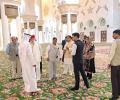
India succeeded in busting the Pakistani narrative on Operation Sindoor, particularly among the Organisation of Islamic Conference (OIC) member nations, where Islamabad sought succour after carrying out terror activities across the border, Shiv Sena leader Shrikant Shinde said.
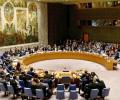
The United Nations Security Council held closed-door consultations on rising tensions between India and Pakistan, with envoys calling for restraint and dialogue. The consultations, requested by Pakistan, lasted for about an hour and a half. UN Secretary-General Antonio Guterres expressed concern over the tensions, urging both countries to avoid a military confrontation. India's former Permanent Representative to the UN, Syed Akbaruddin, said that no consequential outcome could be expected from the discussion.
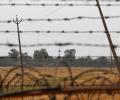
The UN Security Council could meet soon to discuss the situation between India and Pakistan, with the UNSC President expressing concern over rising tensions between the nuclear-armed neighbors. The President, Ambassador Evangelos Sekeris of Greece, said a meeting would provide an opportunity to express views and help diffuse tensions. Sekeris also condemned terrorism in all its forms, including the recent attack in Pahalgam, and called for de-escalation and dialogue between India and Pakistan.
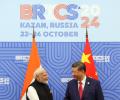
'Don't play the American game... India is too big for a US game.'
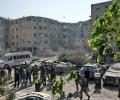
At the end of the day, for many worldwide, the ongoing mutual attacks between Israel and Iran would seem a contest devoid of any moral high ground and only a bout between two ordinary adversaries, one that nevertheless risks spinning out of control into a larger conflagration, notes Shyam G Menon.
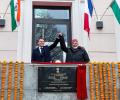
Prime Minister Narendra Modi and French President Emmanuel Macron have called for enhancing trade and investment ties between their countries and committed to further deepening their engagement in the Indo-Pacific. They discussed a full spectrum of bilateral relations, including key global and regional issues, and stressed the urgent need for reform in the United Nations Security Council. The leaders also underscored their commitment to ensuring the global AI sector can drive positive social, economic, and environmental outcomes.

The leaders also noted the "negative impacts" of the war in Ukraine with regard to global food and energy security, especially for developing and least-developed countries.
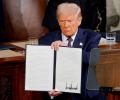
'Decline of the UN did not start with the Trump administration. It has been happening over the last two decades or more.'
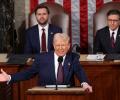
'Trump's desire to withdraw the US from some arenas on the global stage will result in ceding space to China.'

India stressed that it is even more extraordinary for a country with a history of rigged elections to talk about political choices, that too in a democracy.

'China is India's primary strategic challenge, which will not go away.

Ukrainian President Volodymyr Zelenskyy told the United Nations Security Council that 'we have to prepare' the second peace summit to end the Russia-Ukraine war 'altogether' and he has invited India and other countries to join the peace process.

Erdogan said all non-P5 members should have an opportunity to become members of the Security Council by rotation.

The Kashmir issue should be resolved through dialogue and consultation between India and Pakistan, China said on Tuesday while reacting to the Supreme Court judgment on Article 370 upholding the central government's decision on the erstwhile state of Jammu and Kashmir.

'While on the one hand, terrorism continues to be a serious threat to global peace and security, on the other hand, areas such as cyber, maritime and space, are emerging as new theatres of conflict'
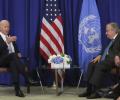
By proposing the addition of six permanent members this year, it may appear that it was a major concession, but in actual fact, it will make no difference to the privilege of the permanent five as the new six will have no veto, ever! points out Ambassador T P Sreenivasan.

Leterme contended that there is a need for the United Nations Security Council to adapt to the realities of the 21st century as it requires representation that goes beyond the structures established in the 20th century.
In retrospect, it appeared that the bitterness of the war was still strong and the Ukrainian success in occupying Russian territory just a few days ago had added to the complexity of the situation. The positive US response to the visit, however, remains a silver lining in the dark clouds, notes Ambassador T P Sreenivasan.

Heaping praise on India, Russian President Vladimir Putin has said that the Indian leadership is 'self-directed' and led by the country's national interests, according to Reuters.

Israel's Permanent Representative to the United Nations, Gilad Erdan, lambasted the United Nations Security Council for failing to condemn the October 7 Hamas terror attacks and the slaughter of unarmed civilians.

External Affairs Minister S Jaishankar on Tuesday targeted Jawaharlal Nehru and claimed that past mistakes were responsible for the problems such as Pakistan Occupied Kashmir (POK) and occupation of some parts of the Indian territory by China.
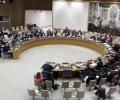
The United Nations Security Council on Monday passed a resolution demanding an immediate ceasefire in Gaza for the month of Ramzan, a breakthrough coming after more than five months since the start of the Israel-Hamas conflict.

In a statement later, the White House said Biden and Netanyahu discussed Israel's military campaign in Gaza, including its "objectives and phasing".

"The responsibilities of member states must be assumed by member states and let's not make the UN the scapegoat of the failures or of the negative actions that are committed by member states," he said.

His comment comes weeks after he met Prime Minister Narendra Modi on the sidelines of the G20 Summit in New Delhi during which both the leaders discussed strengthening trade and infrastructure relations.
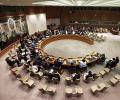
India for the first time on Wednesday voted against Russia during a "procedural vote" at the United Nations Security Council on Ukraine, as the 15-member powerful UN body invited Ukrainian President Volodymyr Zelenskyy to address a meeting through a video tele-conference.

The external affairs minister also recalled how Pandit Nehru was hesitant in taking assistance from the United States following the 1962 war with China as he was unsure how it would be seen.

Prime Minister Narendra Modi on Sunday made a fresh push for reforms in global institutions, including the United Nations, asserting that the world's 'new realities' should be reflected in 'new global structure' as it is nature's law that those who don't change with times lose their relevance.

The United Nations Security Council has called for urgent humanitarian pauses and corridors throughout Gaza to allow unhindered humanitarian access in the strip, finally overcoming deadlock and adopting a resolution in the month-long Israel-Hamas conflict.
Rauf Azhar, born in 1974 in Pakistan, had been sanctioned by the United States in December 2010.
