
The United States and India are on the verge of finalising a landmark bilateral trade deal, aiming to boost trade to USD 500 billion by 2030, according to US Deputy Assistant Secretary of State Bethany Poulos Morrison. The agreement seeks to open India's 1.4 billion-strong market to American goods on reciprocal terms, with ongoing high-level discussions to recalibrate the pact after recent changes in US tariff policy.

A US trade representative described India as a 'tough nut to crack' during trade agreement negotiations in Washington, highlighting India's protection of its agricultural markets and the ongoing discussions on specific commodities.

India is waiting for assurance from the US on comparative advantage over other economies under the deal.
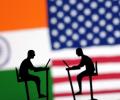
India and the United States have reviewed progress on a proposed interim bilateral trade agreement, discussing market access, digital trade, and non-tariff barriers, as they race to finalise a deal before a temporary 10 per cent US tariff regime expires on July 24.
India may press for an automatic review mechanism in its proposed interim trade deal with the United States (US), mirroring a sunset clause introduced by the European Parliament in its trade agreement with Washington, people aware of the negotiations said. The European Parliament last week approved the EU-US trade deal but inserted a sunset clause requiring the arrangement to expire on December 31, 2029, unless both sides agree to extend it.
Chief negotiators from India and the US are set to begin three-day talks in Washington to recalibrate the bilateral trade agreement (BTA) framework, following significant changes in the US tariff landscape, including a new 10 per cent tariff imposed on all countries.
Commerce and Industry Minister Piyush Goyal announced that a US team is expected to visit India next month for trade talks, following an earlier Indian delegation's visit to Washington, DC, in April to finalise an interim pact and advance negotiations for a broader bilateral trade agreement.

A major political controversy has erupted in Tamil Nadu as the TVK alleges the DMK attempted horse-trading to poach its MLAs, leading to arrests and an ongoing police investigation into the high-stakes political maneuvering.

Indian stock markets are set to be influenced by developments in US-Iran negotiations, crude oil prices, and foreign investor activity in the upcoming holiday-shortened week, according to market analysts.
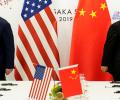
The call lasted approximately one and a half hours, and resulted in a very positive conclusion for both countries.

The BSE benchmark traded 44.43 points up at 76,521.93, and the Nifty quoted 17.20 points higher at 24,048.85. Track Stock markets on May 26.

India anticipates a reduction in the United States' proposed tariffs on Indian goods under the Section 301 investigation, following New Delhi's recent notification to restrict the import of products made with forced labour.
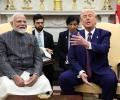
The US Trade Representative has proposed an additional 12.5 per cent duty on goods from 54 countries, including India, citing their failure to prohibit the import of goods produced with forced labour. India has denied the allegations and called for the matter to be resolved through bilateral trade negotiations.

US President Donald Trump lauded Prime Minister Narendra Modi's 'calm, cool, killer' persona at the G7 leaders' lunch in France, underscoring the deeply strategic relationship and formidable diplomatic skills of the Indian leader ahead of their crucial bilateral meeting.

Indian benchmark indices Sensex and Nifty rebounded in early trade, driven by strong buying in blue-chip stocks and positive cues from Asian markets, following a significant selloff in the previous session.

Prime Minister Narendra Modi announced that the India-UK Comprehensive Economic and Trade Agreement (CETA) will come into effect on July 15, 2026, anticipating a significant boost to bilateral trade and investment.

Indian benchmark indices, Sensex and Nifty, experienced a decline in early trade due to uncertainty surrounding the upcoming US-Iran negotiations in Doha. Foreign fund outflows and a dip in major IT stocks further contributed to the market's cautious sentiment, despite mixed performance in global markets.

An Indian-origin diamond businessman, Dhiru Ramani, abducted in Mali in April, has been freed after his family reportedly paid a 4 million euro ransom. Ramani, originally from Gujarat, remains in Mali for questioning by local authorities.

Indian benchmark indices, Sensex and Nifty, saw a significant rebound in early trade, driven by a decline in crude oil prices. This drop followed US President Donald Trump's announcement of progress in negotiations with Iran towards an agreement to end the war, leading to a temporary pause in 'Project Freedom' to escort ships through the Strait of Hormuz. Track Nifty 50 and BSE Sensex performance and key global triggers.

Prime Minister Narendra Modi and US President Donald Trump are set to hold comprehensive talks focusing on a bilateral trade deal, defence cooperation, and energy and critical minerals sectors during the G7 summit in Evian-les-Bains, France.

FPIs have already withdrawn Rs 2.6 trillion from Indian equities in 2026, exceeding the outflows recorded in any previous full calendar year.

The United States has implemented a 10 per cent tariff on goods imported from India and 16 other countries, citing efforts to combat forced labour in production.

US President Donald Trump has lauded India as an 'essential partner' and 'trusted ally' in addressing regional challenges, particularly its 'big role' in West Asia peace efforts, following discussions with Prime Minister Narendra Modi at the G7 Summit.

'There are very few issues and a political call needs to be taken about some of them.'

'The contours of the trade deal need to be reworked now.'

It is plain to see that the US senate bill's real objective is to derail India's time-tested strategic partnership with Russia, points out Ambassador M K Bhadrakumar.
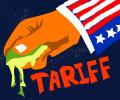
A bipartisan group of US senators has introduced a comprehensive bill imposing extensive sanctions on Russia, with India identified as one of five countries that could incur tariffs for its continued purchase of Russian oil.

Indian farmers staged a significant protest at the Shambhu border against a proposed India-US trade deal, fearing its detrimental effects on the domestic agricultural sector and demanding its immediate abandonment. They later ended their agitation after assurances from the Haryana Agriculture Minister regarding the release of detained farmers and a meeting with the Union Agriculture Minister.

Commerce Minister Piyush Goyal announced that the legal scrubbing of the India-EU Free Trade Agreement (FTA) text is expected to be completed within 10-12 days, with the final deal anticipated to be signed by December 31.

US President Donald Trump received a red carpet welcome in Beijing for talks with Chinese President Xi Jinping on trade, the Iran war, and other key issues. The visit underscores the importance both nations place on their relationship amid ongoing tensions.

American industry groups sought punitive tariffs on Indian goods at USTR hearings, while Indian officials defended the country's manufacturing growth as demand-led and WTO-compliant.

Pre-listing shareholder lock-ins for 53 companies, valued at $11 billion, are set to expire between July and September, according to an analysis by Nuvama Institutional Equities, though not all shares are expected to flood the open market.

India has lodged a 'strong protest' with Iran over recent strikes on commercial vessels in the Strait of Hormuz, which resulted in the death of one Indian sailor and injuries to several others, calling for an immediate cessation of hostilities and a return to diplomatic engagement.

India and the US have decided to reschedule their meeting to finalize the interim trade pact due to recent developments and implications, including changes in US tariffs.

US President Donald Trump met with Chinese President Xi Jinping in Beijing to discuss trade, technology, Taiwan, and the Iran war. Xi Jinping said that 2026 will be a 'historic, landmark year' for China-US relations.

US President Donald Trump lauded Prime Minister Narendra Modi as a "very tough negotiator" and hinted at a future visit to India during their meeting on the sidelines of the G7 Summit, where they discussed trade, defence, and the West Asia crisis.
A trade deal makes sense only if it is fair and reciprocal. If the cost is strategic dependence or loss of policy space, waiting is the wiser option, asserts Ajay Srivastava.

China and India have approached trade negotiations very differently: the former with confidence, the latter in a defensive crouch, says T N Ninan.

In a social media post, former Japanese minister Hideki Makihara blamed the Indian side's approach to the project as being one of 'sheer chaos', of not keeping promises, and of continuously 'pushing their own self-interest'.

Indian benchmark indices Sensex and Nifty surged in early trade, driven by a rally in IT stocks and tempered expectations of US Federal Reserve monetary tightening following softer-than-expected US jobs data. Track Sensex, Nifty on July 3.
