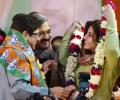
'The boy has remained so simple. Still wearing that sweater and light pants. He doesn't even have a decent pair of shoes! So much like one of us! How can we not give him another chance?' 'And what is Modi Sir doing? He changes clothes three times a day and wears designer clothes. He isn't the son of a simple chaiwallah we voted for.'
.jpg)
'India is doing better than when we took office 17 months ago'.

2015 will be a real test for Modi govt.

Even if they score administratively, state governments ruled by the party suffer from an inability to communicate positively, say observers.

The government is following a path where it will not be irresponsible or profligate with public money but will intervene in the interest of the poor

So let's stop focusing the Modi agenda on India Inc and the capital markets, and let's start focusing on the Modi development agenda for the average Indian.
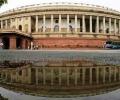
For the past few weeks, the government has been in an overdrive, pushing stuck projects with the larger aim to improve the country's economic growth, which had fallen to a four-year low of 4.4 per cent in the first quarter of this financial year.
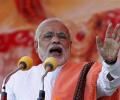
Most top industrialists rate PM's first 100 days in office as 'good', primarily due to his intentions, not concrete policy measures.

This was India's time; with a strong central bank governor and a new decisive government, anything was possible.

Studies suggest net benefits of hydro-power, nuclear energy or natural gas as sources of electricity are greater than those of wind and solar.

The Congress on Thursday dared Narendra Modi to an open debate on his governance model in Gujarat, while rubbishing his attack on the United Progressive Alliance over the economic slowdown.
Majority of 'Bimaru' states register faster fall in rural poverty, while pace mostly other way round for others
The controversial report of the Joint Parliamentary Committee, which gave a clean chit to Prime Minister Manmohan Singh in the 2G spectrum scam saying he was "misled" by the then Telecom Minister A Raja, was on Tuesday submitted to Lok Sabha Speaker Meira Kumar.

The new numbers did not apparently pass consistency checks with production, inputs, or movements in the National Stock Exchange.

Creating many more half-decent jobs for the 10 million plus new entrants to the labour force each year must surely constitute the primary development challenge for India today.

They also voiced concerns over a double penalty being sought to be imposed on them for KG-D6 fields output not matching targets.
The controversial report of the JPC, which gave a clean chit to Prime Minister Manmohan Singh in the 2G spectrum scam saying he was "misled" by the then Telecom Minister A Raja, was on Monday tabled in Lok Sabha amid pandemonium.

Even in this season of political-peeing-on-lampposts, Rahul Gandhi's statement takes the cake (with due apologies to another astute observer of poverty, the much late Mary Antoinette).

'Those who have seen the functioning of the Modi government in Gujarat know that the issues related to Hindutva and issues of economy and growth function simultaneously.' 'Modi's politics are based on the understanding of the middle-class consumer society which is in pursuit of material aspirations.' Sheela Bhatt/Rediff.com reveals the Modi government's economic and political plans for the year ahead.
The UPA Government is trying to push through the second wave of airport privatisation before the elections and the controversial elements of this process threaten to harm the sector.

Jaitley's team presents a quintessential mix of foreign-educated, intellectual technocrats and seasoned bureaucrats

'This is not a Sanjay Baru or Natwar Singh type of book. It's not a memoir. It's not a book to reveal conversations, real or imaginary. This is not a book to position myself at the centre of the world.' Jairam Ramesh on his stint as environment minister.

The prime minister's August 15 address was undoubtedly inspirational and outlined important economic and social objectives, such as making India a global hub for manufacturing, ensuring bank accounts for all poor families, major thrusts in sanitation and cleanliness, and a radical restructuring of the Planning Commission.
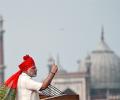
'Independence Day has been India's annual general meeting. For the most part, it has been a forgettable experience of ritual observances. Not so this year... Mr Modi instead presented what I call a moral balance sheet of India,' says Shreekant Sambrani.

The target of $500 billion in bilateral trade by 2020 is doable, feels Anand Sharma.
It is regrettable that the IB has tried to devalue the expertise available both within the concerned ministry and in the scientific community by its allegations. Governments and NGOs in many western nations have not been accused of being 'anti-national' when they put their foot down on questionable practices by cash rich agri-business companies, says Rashme Sehgal.
It, however, lags other states on crucial parameters such as health care and rural poverty.

'Without doubt, Narasimha Rao confronted huge challenges. Yet, in the very brief period I saw him at the closest of quarters, I have to say that he was simply magnificent. A lifetime of circumspection gave way to courage.'

Nitin Gadkari has seven portfolios, but does not seem weighed down at all by the many things on his plate. The minister is brimming with ideas...

'The lack of zeal to serve the country in the mammoth government machinery will be the biggest challenge for Narendra Modi and his government as he tries to change things; there will be not just resistance, but a lack of response to begin with.' If Narendra Modi becomes prime minister, Sheela Bhatt/Rediff.com says the issue of human resources, lack of talent and value system in governance will be his biggest challenge.

'Why should the people of Odisha divert water from the Mahanadhi when 13 out of 32 districts are chronically drought prone?' 'Water is a state subject. Can you really nationalise rivers for which you need drastic amendments in the Constitution?'

Chairman of Manipal Global Education Services says that the government often forgets that its prime duty is to serve the people and not some sick public sector units.

'How many people have been skilled up and thus able to escape from needing to be in NREGA? The true success of NREGA would lie in its irrelevance -- that is, people no longer need it as a crutch.' 'NREGA should enable them to climb out of poverty and stand on their feet.' 'But this is expressly forbidden by NREGA rules. Skill development, which is what India needs more than anything else, appears to be outside the purview of NREGA,' points out Rajeev Srinivasan.

'When he first came to office, my belief is that the PM's reading of the landscape was that, with a vanquished Congress and fragmented Opposition, he was looking at least at two terms in office. This reading perhaps allows for a more cautious, gradual approach.' 'It was only a matter of time before the government was forced to come face-to-face with a serious corruption scandal. This is not a commentary on the BJP, but a statement about India's political economy.' 'There is growing concern about the government's commitment to freedom of expression, religious tolerance, and an independent civil society. Thus far, the positive movement on strategic and economic matters has crowded out these concerns, but they are lingering beneath the surface.'

Implementing the Food Ordinance is the bigger challenge and there are many provisions of the National Food Security Bill which need to be expanded and strengthened.

'Will 'Make in India' be able to harness the demographic dividend so it does not become a disaster?' 'Will 'Digital India' live up to the lofty promises the government and private sector made as part of its recent launch?'

'If Modi arrived like a juggernaut, he left like a jigsaw puzzle whose pieces were being dismantled bit by bit. It was as if India had seceded quietly from him.' Shiv Viswanathan's social science fiction about what India would be like in 2020.

Only reforms that accelerate economic growth can generate the revenues to finance expenditure on social infrastructure for the poor, not the other way round, insists Jagdish Bhagwati.

In a television interview, Union minister Jairam Ramesh claimed that a state of UP's size was ungovernable

'Biometric Aadhaar-based surveillance is not only about violation of privacy, but also about the treasure hunt for unprecedented financial surveillance and economic intelligence in the economic history of mankind,' asks Gopal Krishna.
 © 2026 Rediff.com - Investor Information - Advertise with us - Disclaimer - Privacy Policy - Sitemap - Feedback - About us - Terms of use - Grievances