
HCL Technologies remains under pressure after missing Q4 expectations and issuing cautious FY27 guidance. Analysts highlight weak margins, soft demand, and muted growth outlook.

The Congress has strongly criticised the US government's temporary waiver allowing India to purchase Russian oil, raising concerns about continued 'American blackmail' and its impact on India's energy policy.

After the US Supreme Court struck down President Donald Trump's global tariffs, Congress leader Rahul Gandhi accused Prime Minister Narendra Modi of being "compromised", saying his "betrayal" in the India-US interim trade deal stood exposed.

The Reserve Bank of India (RBI) on Wednesday kept its policy interest rate unchanged at 5.5 per cent for the second consecutive time, citing concerns over tariff uncertainties.
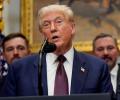
The United States announced a 25 per cent tariff on India as the White House released an expansive list of duties that Washington, DC will impose on exports from countries around the world.

Analysts predict continued volatility in Indian equity markets due to domestic macroeconomic data, F&O expiry, global developments including US tariff policies, and geopolitical tensions.

The statement did not name any country. But the US has often blamed India and China for purchasing Russian oil even when there are no tariffs on Beijing for it.

Financial year 2025-26 (FY26) saw a significant shift in corporate fundraising, with rights issues more than doubling to a multi-decade high of 51, raising 44,290 crore, while qualified institutional placements (QIPs) more than halved to 29 issues, mobilising 62,954 crore, driven by sharp equity market corrections and regulatory changes.
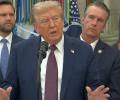
"India was charging us tremendous tariffs, about the highest in the world," Trump said adding that the US was therefore not doing much business with India.
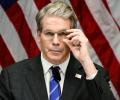
United States Treasury Secretary Scott Bessent has warned that the secondary tariffs on India could go up if 'things don't go well' during talks between President Donald Trump and Russian President Vladimir Putin in Alaska on Friday.

The textile and apparel sector is India's second-largest employment provider, after agriculture, and it is now caught in a wave of uncertainty following the Donald Trump administration's tariff policy.

Uttar Pradesh's leading export hubs are reeling under the impact of a steep 50 per cent tariff imposed by the US on Indian imports, with exporters warning of job losses, stalled orders and shrinking market access. Industry leaders from Noida, Kanpur and Varanasi said the tariff has put years of painstaking market-building at risk, even as protests and demonstrations erupted in several districts last week.

A new poll indicates that President Donald Trump's approval rating is suffering as economic anxieties and the rising cost of living weigh heavily on US voters, revealing deep political divides and widespread dissatisfaction with the government.
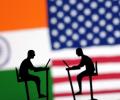
Indian officials will visit the US to finalise the legal text for an interim trade agreement, expected to be signed in March, focusing on duty concessions and reciprocal tariffs.

India should not stay on the margins of this initiative. There should be a serious debate about what would be in India's best interests asserts former foreign secretary Shyam Saran.

Karan Adani of Adani Ports & Special Economic Zone emerged as the top absolute value creator, adding Rs 2.67 trillion as the company's mcap rose from Rs 42,149 crore in March 2020 to Rs 3.09 trillion in March 2026 (7.3x) -- the largest rupee addition on the list.

China's ruling Communist Party is holding its annual leadership conclave to discuss the new five-year plan, the impact of US President Donald Trump's tariff war, and the ongoing anti-corruption crackdown in the military.

The logic of war plus the gathering storms in US politics as the midterms loom large leave him with no real alternative but to negotiate, points out Ambassador M K Bhadrakumar.

'At the first sign of real trouble, that money will move. There will be a run.'

Meeks, a ranking member of the House Foreign Affairs Committee Democrats, on Wednesday (local time) underscored "Congress' support for the US-India partnership," following his meeting with Indian Ambassador to the US Vinay Mohan Kwatra.
There were apprehensions that additional secondary tariffs would have hit India in case the US decided to enforce them.
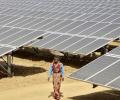
Shares of Waaree Energies and Premier Energies are under pressure after the US imposed initial duties on Indian solar imports. The article examines the impact on green energy stocks and market sentiment.

'The US reciprocal tariff has added another element of uncertainty and the central bank may prefer to wait and get further clarity.'

The Confederation of Indian Industry (CII) has proposed a 20-point policy agenda to the finance ministry, including a conflict-linked emergency credit line guarantee scheme and tax rationalisation on energy inputs, to support MSMEs, exporters, and energy-intensive industries affected by the ongoing West Asia war.

'FPIs are unlikely to return unless there is equilibrium between valuation premium and earnings growth.'

Ukrainian President Volodymyr Zelenskyy has backed the imposition of tariffs on countries maintaining economic ties with Russia, saying it is the 'right idea' in the face of continued aggression by Moscow.
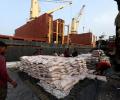
The Federation of Indian Export Organisations (FIEO) has appealed to the Reserve Bank of India (RBI) for liquidity support to Indian exporters, citing a significant increase in freight costs and extended payment cycles due to the ongoing West Asia conflict.

The additional 25 per cent tariff imposed by US President Donald Trump on India is set to deliver a major blow to West Bengal's export-driven economy, with the state's labour-intensive leather, engineering and marine sectors expecting losses ahead of the festive season, stakeholders said. The increased levies on Indian products for the country's purchases of Russian oil came into effect on Wednesday, bringing the total amount of tariff imposed on New Delhi to 50 per cent.
The additional 25 per cent duty will come into effect after 21 days or August 27.
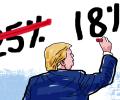
'Trump says India will buy over $500 billion of US goods.' 'At present, India's annual imports of goods and energy from the US are under $50 billion.' 'Reaching $500 billion would likely require more than 20 years, suggesting the figure refers to a long-term aspiration rather than a near-term commitment.'

The Indian rupee depreciated by 32 paise to close at 92.83 against the US dollar, influenced by escalating global tensions, particularly the US-Iran conflict, and the deadline for the RBI's instructions to banks to curb overnight positions.
Chief Economic Advisor V Anantha Nageswaran on Thursday said he expects that a solution to the tariff issues with the US is likely to be arrived in the next eight to ten weeks.
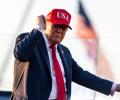
President Trump threatens to impose a 10% tariff on countries aligning with BRICS anti-American policies. This follows BRICS criticism of increased tariffs. Trump also announced tariff letters to various countries.

A senior Russian diplomat has called the US pressure on India for its procurement of Russian crude oil "unjustified," expressing confidence in continued energy cooperation between India and Russia despite external pressures.
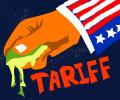
India needs to come together to deal with the 50 per cent punitive US tariffs on Indian products and stand up to any kind of bullying, Maruti Suzuki India chairman R C Bhargava said on Thursday. "It is our duty as Indians to do our very best to promote and maintain our dignity and respect and not give in to any kind of bullying in this matter... the nation has to stand united," Bhargava said at the company's 44th Annaul General Meeting in New Delhi.

The USA's steep 50 per cent tariffs on Indian goods entering America will severely impact exports and job creation in labour-intensive export sectors such as shrimp, apparel, leather and gems and jewellery. Exporters said that the imposition of a 25 per cent penalty on India over and above the 25 per cent tariffs move will disrupt the flow of Indian goods to its largest export market.

As the potential threat of a steep 200 per cent tariff on pharmaceutical imports hangs in the air, analysts and industry insiders feel that focus on exports to non-US regions as well as domestic market will increase as a long-term trend. US President Donald Trump told CNBC's Squawk Box in the first week of August that planned tariffs on import of pharmaceutical products to the US could eventually reach up to 250 per cent.

The Swiss government would not object to tennis legend Roger Federer or FIFA President Gianni Infantino intervening to reduce the country's tariff burden after the US slapped a 39 percent import duty on its goods, President Karin Keller-Sutter said.

Commerce and Industry Minister Piyush Goyal on Sunday said Indian goods will have a competitive advantage in US markets compared to products from China and other competitor countries, which face higher levies, following the reduction in reciprocal tariffs to 18 per cent.

US President Donald Trump's announcement of 25 per cent tariff on all goods coming from India starting August 1, plus an unspecified penalty, is expected to impact Apple's plans to expand iPhone manufacturing in India as well as export of other electronics to the US. The move comes at a time when Indian electronics production is reeling under pressure due to restrictions imposed by China on supply of several critical components, capital goods and even skilled technology professionals.
