
'2019 was fought on delivery. But in 2024, you can see the before and after effects.'

India's net oil import bill could widen to $101-104 billion in current fiscal from $96.1 billion in 2023-24 and any escalation in the Iran-Israel conflict could impart an upward pressure on the value of imports, ICRA said on Tuesday. The domestic rating agency said based on its analysis, lower value of Russian oil imports is estimated to have led to savings of $7.9 billion in 11 months (April-February) of 2023-24, up from $5.1 billion in 2022-23.
The oil industry experienced three upheavals between 1973 and 1991, which seem to be etched in the memory of the industry's decision makers. Naturally, at the sign of a new crisis, the decision makers like to dip into those tumultuous decades to find ways to deal with the new shock, in addition, of course, to expert reports and forecasts. So, the industry bigwigs turned the pages of history to get a peek into the future of oil price movements after Russia invaded Ukraine in 2022, Israel attacked Gaza in 2023, Iran-linked Houthi rebels pounded tankers crossing the Red Sea in support of Palestine the same year, and Iran rained missiles on Israel in 2024.

Gas prices in Texas and elsewhere in the United States have jumped an average 7 cents in recent days after Iran threatened to close the Strait of Hormuz through which 16 million barrels of oil - about a fifth of world's daily oil trade - passes every day.

Iran's seizure of a British-flagged oil tanker was allegedly due to a collision with an Iranian fishing boat, Iran's official news agency IRNA said.
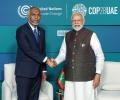
'India should respect Maldivian nationalism and their desire to be not over-dependent on India.' 'India should not behave like a big brother towards Maldives as many times, we tend to behave like that.'
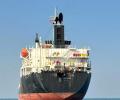
The world needs to wake up to this new dimension of war at sea and be prepared to face the 'unknown enemy' who have the advantage of attacking at their choice of location and time, cautions Commodore Venugopal Menon (retd).

India is busy building up its naval fleet, might add frigates, aircraft carriers, planes, submarines
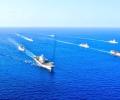
French naval commander expresses concern over China expanding its maritime influence in the region.
United States has moved more warships and fighter aircraft to the Persian Gulf to keep the strategic Straits of Hormuz open and strike deep within Iran if the stand-off over its nuclear programme escalates.
Talking about 'Chinese designs on the Indian Ocean,' Naval cMehta said China had a strategy called `String of Pearls,' as per which it seeks to set up bases and outposts across the globe, strategically located along its energy lines, to monitor and saefeguard energy flows. "Each pearl in the string is a link in a chain of the Chinese maritime presence," he said. "Among other locations, the string moves northwards up to the Gwadar deep sea port on Pakistan's Makran coast.

Gold prices may trade higher in the coming days because of weaker dollar and speculations of US Fed rate cut.
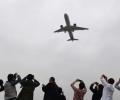
As the majority of Pakistani airspace has remained closed for Indian airlines since the Balakot strike on February 26, the decision to avoid affected Iranian airspace on Saturday is going to further disturb the routes of their international flights towards middle-eastern and European countries, and the US.

Dismissing allegations that it is singling out China in maritime disputes, the United States has said in the last one year it has challenged the maritime territorial claims of 18 countries, including some of friendly nations like India and Brazil.

'Gwadar has the potential to facilitate PLAN's operations in the Arabian Sea and Indian Ocean.' 'Reports of China setting up electronic eavesdropping posts at Gwadar to monitor US and Indian naval activity and shipping traffic through the Straits of Hormuz and the Arabian Sea lend credence to this,' says former RA&W officer Jayadeva Ranade.

'Had a very fruitful meeting with Iranian defence minister Brigadier General Amir Hatami in Tehran. We discussed regional security issues including Afghanistan and the issues of bilateral cooperation,' Singh said in a tweet.

The Global Hawk can carry out surveillance of a stretch of land or ocean for over 30 hours continuously, physically scanning up to 100,000 sq km each day.

China and Pakistan on Friday signed eight agreements, including a whopping $18 billion deal to build a 200 km-long strategic tunnel through the rugged PoK, as the two all-weather allies sought to boost economic ties and supply critical oil to the energy-hungry Communist giant.
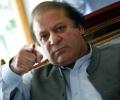
India on Friday said the Nawaz Sharif government in Pakistan has given 'good signals" in normalising bilateral ties but cautioned against expecting "magic overnight".

Chances are any such disruption will not occur on the major shipping lanes but on some edge of the ocean between India and China. Even if there is no actual disruption, the costs of averting one can be punitive. The setting for this is provided by the energy shortage both countries face, says Subhomoy Bhattacharjee.
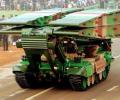
Given the importance of equipment modernisation, the overall defence budget should rise at least at the same pace as salaries and pensions, so that equipment modernisation is not hit.

Pompeo defended the killing of Soleimani saying he was making efforts for an attack on Americans in the region.

'The bigger challenge and dilemma for Pakistan would be if the US and Saudi Arabia go full throttle against Iran and enforce regime change in Tehran.' 'That would be bad news for Pakistan, especially with the current instability in Balochistan,' notes Brigadier Narender Kumar (retd).

'If the almost literally heart-stopping Suez block has any positive outcome, it is to be hoped that it will accelerate the setting up of a fab (perhaps Taiwanese) in India,' asserts Rajeev Srinivasan.
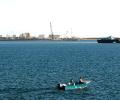
The Modi government's appalling inefficiency and lack of purpose stand exposed, says Ambassador M K Bhadrakumar.

Until Delhi and Beijing resolve outstanding border issues within an accelerated time frame, standoffs like Doklam will be repeated across various peaks along the Himalayas, says Mathew Maavak.
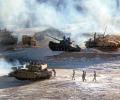
India's national security strategy needs to be revised periodically since the global and regional geopolitical situation is dynamic, points out Commodore Venugopal Menon (retd).

Mere shuffling of resources or cosmetic changes to prove a point would be counterproductive in the long run, observes Commodore Venugoptal Menon (retd).

India and Iran on Monday decided to jointly combat terror, radicalism and cyber crime as the two strategic partners signed 12 agreements including a "milestone" pact on developing the key Chabahar port for which India will provide $500 million.

'When sensitive territory goes into the hands of your enemy. he becomes more powerful in military terms.' 'Assuming the Chinese take over the Doklam Plateau they will not stop at that.' 'They will keep ingressing, and it will be easier for them to further expand their territory.' 'I feel the Chinese will vacate that area in two months after it begins to snow.'
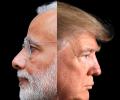
Here's why Rajeev Srinivasan believes there will be nothing particularly positive about the prime minister's US visit.

'Today the Chinese think they can slap India, and there will be no consequences.' 'They must be made to feel the consequences through any and all means,' says Rajeev Srinivasan.

Japan has the capital and needs to pull out of China, which has been its major destination. India, on the other hand, desperately needs capital especially for infrastructure, argues Rajeev Srinivasan.

'As in the Panchatantra tale of the cat and the monkeys, it is possible for the clever swing State to play off the two competing powers.'
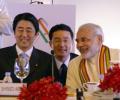
'Both nations have a common problem: A rampaging, jingoistic and hostile China which is making substantial territorial claims. In the long run, Japan and India are going to be the victims of Chinese aggression -- so they might as well hang together to contain China,' argues Rajeev Srinivasan.
 © 2026 Rediff.com - Investor Information - Advertise with us - Disclaimer - Privacy Policy - Sitemap - Feedback - About us - Terms of use - Grievances