
A US Congressman has raised serious concerns regarding India's proposed amendments to the Foreign Contribution Regulation Act (FCRA), warning that these changes could lead to government takeovers of religious charities and strain bilateral relations.

The Supreme Court has agreed to hear a plea on May 29 seeking a direction to the Nagpur Parsi Panchayat to treat a Parsi woman equally with her male counterparts, even after she marries a person of another faith, challenging a rule that allegedly strips Parsi women of their religious identity upon inter-faith marriage.

India's Ambassador to the US, Vinay Mohan Kwatra, has clarified that the recent amendments to the Foreign Contribution (Regulation) Act (FCRA) are primarily aimed at enhancing transparency and ensuring accountability in foreign financial flows.

Of the donations, 48% is in kind -- such as food, clothing, or other household goods -- followed by cash (44%) and volunteering (30%) with non-profits, religious institutions, or community groups.

British Sikh groups are cautioning against calls to ban the kirpan in the UK following the murder conviction of a man who claimed to carry the knife for religious reasons, arguing that it unfairly targets the entire community.

Shi Yongxin, the former head priest of China's Shaolin Temple, has been sentenced to 24 years in prison on graft charges, including embezzlement and bribery.

A 23-year-old British Sikh man has been sentenced to life imprisonment for the murder of a teenage student in Southampton, with the judge highlighting the racial tensions the case has ignited across the UK.
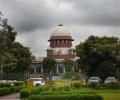
The Supreme Court of India has agreed to examine a constitutional challenge regarding gender discrimination within Parsi personal law, specifically focusing on whether a Parsi woman loses her religious identity upon marrying outside the community.

Lok Sabha takes up FCRA Amendment Bill amid opposition protests.

The Bombay high court has refused to grant relief to taxi and auto-rickshaw drivers seeking to offer namaaz near the Mumbai airport, citing security concerns.

'I cannot imagine that any NSA before Ajit Doval would have given us this kind of time and this kind of engagement. They would have offered slogans, or nothing at all. That, too, tells you something.'

President Vladimir Putin attended an early Wednesday Russian Orthodox Christmas service and hailed his troops' 'holy mission' to defend Russia, pairing the ceremony with a holiday address on unity, charity and support for the armed forces.

The future of India will be shaped and decided by the choices the RSS makes now, argues Colonel Anil A Athale (retd).


Australia can definitely help India to become better at Olympic sports: Steve Waugh
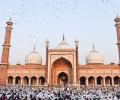
'Only because of the absence of a dedication record in writing, how can such properties be treated as located on misappropriated government land?'
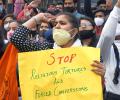
Forced religious conversion may pose a danger to national security and impinge on the religious freedom of citizens, the top court had said recently and asked the Centre to step in and make sincere efforts to tackle the "very serious" issue.
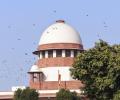
The Indian government defended the Waqf (Amendment) Act, 2025 in the Supreme Court, arguing that waqf, while an Islamic concept, is not an essential part of Islam. Solicitor General Tushar Mehta stated that waqf is essentially charity, which is recognized across religions, and cannot be considered a fundamental tenet of any faith. He also argued that the amended law addresses secular aspects of waqf and activities unrelated to Islam, and that "waqf by user" does not grant ownership of public land. Mehta highlighted the extensive consultations involved in the bill's creation, including feedback from various stakeholders. The hearing will continue on Thursday.

'The nuns were subjected to abusive language and all types of mental torture.'

A special court acquitted seven individuals in the 2008 Malegaon blast case, challenging the prosecution's assertion that the right-wing group Abhinav Bharat was responsible. The court emphasized that the organization remains unbanned by the government.

The Missionaries of Charity is a Catholic religious congregation established in 1950 by Nobel laureate Mother Teresa to help the poor and destitute,

Italian tennis star Jannik Sinner had an audience on Wednesday with the newly elected Pope Leo XIV, himself a keen tennis player, the Vatican said.

The Supreme Court of India has reserved its interim orders on three key issues related to the Waqf (Amendment) Act, 2025, including the power to denotify waqf properties, the composition of waqf boards, and the provision regarding government land. The court heard arguments from both the petitioners, who challenged the validity of the amended law, and the Centre, which defended the Act as a secular concept. The petitioners sought interim orders to prevent the implementation of certain provisions while the court considers the legal challenges.

Yogi said Waqf boards have become a den of selfish interests as well as loot khasot (property grabbing), and have done little for the welfare of Muslims.

Puzzled about the Waqf Bill? Syed Firdaus Ashraf explains how the amended Waqf law will plug loopholes in the existing legislation.

The Ministry of Home Affairs on Monday said the Missionaries of Charity's application for renewal of the Foreign Contribution (Regulation) Act (FCRA) registration was refused on December 25 for not meeting eligibility conditions as some adverse inputs were received.
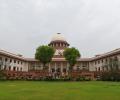
The Indian government has defended the Waqf (Amendment) Act, 2025 in the Supreme Court, arguing that there cannot be a blanket stay on the law as there is a presumption of its constitutionality. The Centre countered the pleas challenging the law's validity, asserting that the amendments were undertaken after a comprehensive study by a parliamentary panel. The government also highlighted the "reported misuse" of earlier provisions and the increase in waqf land, claiming that over 20 lakh hectares were added after 2013.

Superior general of the Missionaries of Charity, sister Mary Joseph, on Saturday said nuns of her order were serving the war-affected people in Kyiv, Ukraine.

Samajwadi Party chief Akhilesh Yadav took a holy dip in the Sangam at Maha Kumbh on Sunday, urging the BJP to bathe with "patience." He criticized the BJP for splashing water on each other after bathing in the Sangam, saying people come to Kumbh for virtue and charity, not for water sports. Yadav, who had earlier taken a dip in the Ganga river in Haridwar on Makar Sankranti, said he had always visited the religious congregation. The latest official figures show that 1.17 crore people took a dip in the Sangam till late Sunday afternoon, bringing the total number of 'snan' (bath) in Maha Kumbh since its start to 11.47 crore.

'The BJP lacks a credible mass leader who matches Mamata Banerjee's popularity.' 'Given the division of votes among Opposition parties, the West Bengal government's dole-giving strategy, and the consolidation of the poor, significant sections of scheduled caste groups and Muslim minorities behind the ruling party, it will be difficult to dislodge the Trinamool from power.'
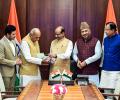
'When voting clause by clause on Waqf came up in the JPC, the TDP and JD-U supported the BJP on each and every clause.'

If Prakash Jha is able to transfer today's social and political reality onto the screen, the future seasons of Aashram might just get a much-needed dose of eyeball-grabbing power, observes Deepa Gahlot.
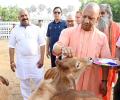
Uttar Pradesh Chief Minister Yogi Adityanath, known for his hardline Hindutva views and 'bulldozer justice' approach, has spoken out about his policies toward Muslims, the Waqf board, and his vision for India. He asserts that Muslims will receive a fair share of development in Uttar Pradesh, but not special concessions. He also criticizes the Waqf board for its alleged appropriation of government properties and calls for its reform. Adityanath defends his 'bulldozer justice' policy, claiming it is necessary for infrastructure development and removal of encroachments. He also discusses his vision for India, emphasizing the importance of Hindi as a national language and the need for unity across different linguistic groups.

Rammu Guru, the head priest of the temple, said, "Sai Baba was being worshiped without proper knowledge, which is forbidden according to scriptures."

Former US President Bill Clinton expresses his doubts about the realization of Mahatma Gandhi's dream for India in his new book, 'Citizen: My Life After the White House'. Reflecting on his experience in the aftermath of the devastating 2001 Gujarat earthquake, Clinton recounts his encounters with the suffering and resilience of the people, questioning the extent to which India has achieved Gandhi's vision of a peaceful haven for all. The book also highlights the establishment of the American India Foundation (AIF), which Clinton helped found to support relief efforts in Gujarat. Clinton's observations on India's internal divisions, particularly between Hindus and Muslims, offer a thought-provoking perspective on the country's progress towards Gandhi's ideals.
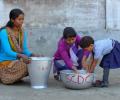
The NGO is said to be shutting down its India operations after allegations that the charity was engaging in religious conversion.

'He was a practical person who ensured that he thought about the common man, animals, the fact that they have a life and they have to be respected.'

After a meeting of its working committee in New Delhi, the board adopted a resolution which stated that the recent judgment of the Supreme Court on the maintenance of Muslim divorcee women is "against the Islamic law (Shariah)".

Indian charitable trusts, including Tata Trusts and top corporate donors, are stumped by a new tax law proposed in the Budget, which reduces tax breaks for the donor organisations. The Finance Bill proposes that if a charitable organisation donates to another charity, then only 85 per cent of the donation will be considered as application of income for the donor organisation. Trust officials say this is a major setback for the donor organisations, including corporate foundations and intermediary organisations, which work with various implementing agencies at the grassroots level.

At least one commentator felt that both the BJP's reach and popularity had been underestimated in Kerala. They have shown systematic gain; one that seems personality-neutral and therefore institutionalised, explains Shyam G Menon.
