
Why is China's supreme leader promoting Han Chauvinism so aggressively, asks Claude Arpi.

It's the inability to take a total view of things which cripples India's economic race with China, not their opposing political systems.


China is engaged in hotly contested territorial disputes in the South and East China Seas. Beijing has also made substantial progress in militarising its man-made islands in the past few years, which it says it has the right to defend.

'Tibetans will participate in future conflicts with India (in all probability, some were already present in Galwan).' 'As nobody in India would like to have a deadly fight with Tibetan soldiers and officers, the issue needs to be closely followed,' observes Claude Arpi.
The intrusions into India were likely carried out by the PLA's better trained and equipped 'mobile operational units'.

The first priority for the new Tibetan administration in Dharamsala should be to look at Tibetan recruitment in the PLA, suggests Claude Arpi.
China on Friday inaugurated its second railway line in Tibet, built at a cost of $2.16 billion, close to Indian border in Sikkim, enhancing mobility of its military in the remote and strategic Himalayan region.

The seventh Tibet Work Forum was held in Beijing on August 28 and 29. Delhi should be deeply concerned, at a time India faces a precarious situation in Ladakh, because the TWF also defines China's western border policies, observes Claude Arpi.
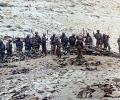
In fact, given the current tensions and massed troops on both sides, there is a danger that the LAC will become more like the Line of Control with Pakistan, a heavily fortified and strongly defended border where weapon fire exchanges regularly occur. Indeed, Stratfor Worldview research has listed a sharp increase in new Chinese facilities along the LAC in 2019-20.

Have a look at these photos taken from the incredible world we live in. These are the winners of the Wildlife Photographer of the Year competition 2020.

India's ambassador to China is on a rare visit to Tibet to make preparations for the opening of a new route through Sikkim for Indian pilgrims to travel to the holy site of Kailash-Manasarovar which was agreed during last month's visit of Chinese President Xi Jinping to India.

General Zhao Zongqi is well known in India for having commanded the Chinese troops during the Dokalam episode. Zhao knows every inch and corner of the Indian border, at least the Eastern and Central sectors, including the Naku La area which witnessed fist-fights between Indian and Chinese troops in April/May. Claude Arpi introduces us to the PLA generals masterminding the Chinese aggression in Ladakh.

China on Tuesday said that the Dalai Lama can improve ties with it only by giving up wish for Tibetan independence and publicly announcing that Tibet is an inalienable part of the country.

Wheeling round, a look of utter shock on its face, a marmot jumps in fright after a young fox sneaks up behind it. The split-second encounter between prey and predator -- called the Moment -- has won the man who captured it the title of Wildlife Photographer of the Year. He was chosen from a longlist of various category winners, all of whom managed to record the oddities, rivalries and beauty of the natural world. Scroll down for some of the winners.

'Either China is building regional transport infrastructure long before it needs it, or this is in a chain of Chinese investments with more strategic than economic intent,' says T N Ninan.

We once again present a special feature on the ten worst earthquakes that had shaken the world and caused immense damage in the past 25 years.

'Lhasa is more than the Unesco World Heritage Sites it boasts of. It is more than a gateway to the mighty Himalayas.' 'It is about the warmth of its people: Unsaid, unspoken, but felt everywhere,' discovers Shruti Bajpai.

China is spending billions of dollars to improve infrastructure in Tibet and other parts of its border with India. Claude Arpi explains why New Delhi can't afford to ignore Beijing's plans.

The chaos on its stock markets, a fierce battle between the old and new guard in the Communist Party and the restive border provinces of Tibet and Xinjiang forebode tough times ahead for China, says Claude Arpi.

'While wishing the Tibetan leader a long and healthy life, one can hope for a 'selection' of the Tibetan leader in the Indian Himalayas.' 'It is vital for Tibetan Buddhism, but it is also in India's political interests,' says Claude Arpi.

Two hundred years after George Stephenson built the steam-powered Blucher, Open Knowledge pays tribute to 200 years of rail transport.

The two countries sealed 10 agreements, including the much-publicised transit trade treaty which will end Nepal's total dependency on Indian sea ports for third-country trade.

'He still has to deal with party norms and traditions and has been careful to follow the order of seniority,' points out Claude Arpi.
China's ruling Communist Party has cracked down on Tibetans who planned to attend the Kalachakra Puja in Bodh Gaya. But the Tibetan people have dared the Communists by listening to the Dalai Lama's sermons on the Internet and sharing videos on social media.

'Why assail the Tibetan leader at a time when many in China realise that the Buddhist monk is the best bet if Beijing is seriously trying to find a solution to the Tibetan issue?' asks Claude Arpi.

Communist China has recently developed a great expertise in 'soul reincarnation', feels Claude Arpi

There is speculation that China released the White Paper on Tibet in a hurry after a Spanish court agreed to hear charges of genocide against former Chinese president Hu Jintao. Ajai Shukla reports

'It is certainly time for New Delhi to open up. Not only should it go ahead at full steam with the roads to the LAC, but the government must also allow tourists to visit these stunningly beautiful areas of Indian territory.'

Can you find a world leader who has met generations of Indian politicians, most US Presidents, European head of States, several Popes, celebrated cricketers, Hollywood and Bollywood stars, some of the greatest scientists and many ordinary people, including what he calls, 'Chinese brothers and sisters?'
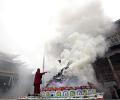
China has been keeping tabs on the restive Tibet province through a 'grid' system and some 600 'convenience police posts' armed with high-tech equipment that monitor the daily life of the citizens of Lhasa and other Tibetan towns. Worse, 'volunteer security groups' known as 'Red Armband Patrols' are roaming around in order to get more information and 'classify' each and every citizen, says Claude Arpi
 © 2026 Rediff.com - Investor Information - Advertise with us - Disclaimer - Privacy Policy - Sitemap - Feedback - About us - Terms of use - Grievances