
Pakistan on Friday announced it will release former Afghan Taliban deputy chief Mullah Abdul Ghani Baradar on Saturday, meeting a long-standing demand of Afghan President Hamid Karzai to advance peace efforts in the war-ravaged country.

India on Friday sought resolute and comprehensive global action against terror infrastructure, saying the challenge must be taken seriously as different "theatres" are getting interconnected through terror networks as well as globalisation of the "supply chain of ideology".

For the first time, China has come out openly backing Pakistan's Inter-Service Intelligence saying the spy agency could not have been involved in the recent attack on an Indian consulate in Afghanistan.

The US special representative for Afghanistan and Pakistan James Dobbins is stepping down, Secretary of State John Kerry today said amid a political crisis in the war-torn country.

Foreign Secretary Sujatha Singh on Saturday met Afghan President Hamid Karzai and the two presidential candidates here during which she was assured that Afghanistan was committed to ensuring full safety for the Indian Embassy in Kabul, four consulates and interests irrespective of the orientation of the new leadership.

Much has been said about Friday's attack on the Indian consulate in Heart and the connection it has with the invitation sent out to Pakistan Prime Minister Nawaz Sharif. While a few believe that the two could be connected, officers who have worked in Afghanistan-Pakistan say the issues are completely different. Vicky Nanjappa reports
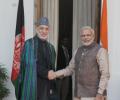
Security will be a consideration, as would protocol, but given Modi's penchant for the unconventional, it should not come as a surprise if he indeed decides to attend the ceremony in Kabul, says Ramesh Ramachandran.
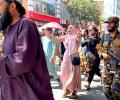
ISI chief Faiz Hameed coerced the Taliban to announce an interim government guaranteed to preserve Pakistan's control over the levers of power in Kabul, observes Ambassador M K Bhadrakumar.
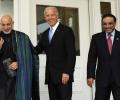
US-Pakistan relations are poised to touch a qualitatively new level under the Biden administration, notes Ambassador M K Bhadrakumar.

Pervez Musharraf said that Pakistan tried to undermine the Afghan government led by ex-president Hamid Karzai for helping "India stab Pakistan in the back".
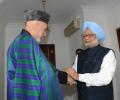
With the United States planning troops withdrawal by next year, Afghan President Hamid Karzai is believed to have pressed India on Friday for stepping up military aid including lethal and non-lethal weapons amid indications that the government was not averse to the Afghan leader's demand which could be met depending on the country's capacity.
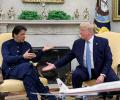
'Pakistan is determined to garner the peace dividends.' 'On the diplomatic front, this will be, principally, in terms of a revival of Pakistan's relations with the US,' notes Ambassador M K Bhadrakumar.
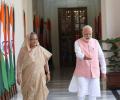
'The curtain is coming down on India's leadership role as a regional power even before the drama of the Asian Century truly began,' warns Ambassador M K Bhadrakumar.

Notwithstanding President Hamid Karzai's reluctance to sign the bilateral security agreement, the United States has said that though it is open to signing of the pact later in the year, the longer it takes the more challenging it will be to execute any mission post 2014 in Afghanistan.

'India could help in Afghanistan, but if it does too much, it will stoke Pakistan's paranoia and risk making the situation worse,' Michael O'Hanlon, one of America's leading experts on international security, tells Rediff.com's Vicky Nanjappa.

Congress leaders were in for a rude shock on Monday when the media sidelined their much-touted Jawaharlal Nehru birth anniversary event, and instead turned its full attention to Prime Minister Narendra Modi, who was addressing thousands of supporters in Sydney's Allphones Arena

Describing India's concerns as legitimate, a top United States official has said that there is no immediate danger of foreign fighters from Afghanistan moving towards the Indian border after 2014, when American troops leave the country.

Hein Kiessling has the kind of access in Pakistan that journalists (and spies) would die for, says Kanika Datta.

Hassan Rouhani, a moderate cleric who was a surprise winner in the recent elections, took oath on Sunday as Iran's seventh president at a ceremony attended by a galaxy of world leaders, including Vice President Hamid Ansari, with which he has pledged to expand ties.

India on Tuesday supported Afghanistan's reconciliation process with the Taliban, but warned that it must not undermine the legitimacy of the Afghan government and should be within the internationally accepted "red lines".

Britain's Prime Minister David Cameron on Sunday promised to "stand together" with Pakistan in the war against terrorism and nudged his counterpart Nawaz Sharif to help clinch a peace deal with Afghanistan before NATO's withdrawal from the war-torn nation next year.

Blackmail on one side and bullying on the other doesn't make for a constructive partnership, says Sunanda K Datta-Ray.
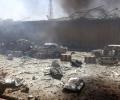
'A couple of more such happenings in the coming weeks can push Kabul into total anarchy, and a Syria-like conflict may ensue,' warns Ambassador M K Bhadrakumar.
Rogue elements in Pakistan's Inter-Services Intelligence worry about India's interference in Afghanistan after the West pullout. The attack was an attempt to send a strong message to New Delhi to keep away, sources in the Intelligence Bureau point out.

After days of speculation, Prime Minister Manmohan Singh confirmed he would meet his Pakistan counterpart Nawaz Sharif in New York, when he is expected to convey concerns over "barbaric" incidents on the LoC and continued terrorism emanating from Pakistan.

Karzai has steadfastly opposed direct talks between the US and the Taliban, wanting Afghan ownership of the "reconciliation process", as the reintegration of the Taliban into the mainstream is referred to.
All the four gunmen, who had stormed the Indian consulate in Afghanistan's Herat province early on Friday, have been gunned down, Indo-Tibetan Border Police chief Subhas Goswami said.

Afghanistan will never allow its territory to be used for any anti-India activity, Afghan ambassador Shaida Mohammad Abdali said here and dismissed apprehensions that withdrawal of NATO forces may allow the Taliban to make a comeback.

Vajpayee's ashes will be immersed in rivers in all the districts in Uttar Pradesh -- his karmabhoomi.

India has sought access to Lashkar-e-Tayiba operative David Headley, the Mumbai terror attack convict now lodged in a US prison, as it insisted on bringing to justice the perpetrators of the 26/11 assault.

Afghan President Hamid Karzai is in Pakistan on a day-long visit to mend frayed ties with Pakistan and to seek the release of high-profile Taliban prisoners, including Mullah Barader, to give a fresh impetus to the reconciliation process in his war-torn country.
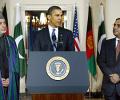
'The real purpose of President Obama writing to President Zardari,' Husain Haqqani tells Rediff.com's Aziz Haniffa, 'was to seek a turnaround on terrorism -- that Pakistan, whatever its grievances, cannot have jihadi groups operating openly on its soil.'

Aziz Haniffa reports from Washignton, DC, on Foreign Secretary Sujatha Singh's three-day visit to the US capital.

Condemning terrorism in all its forms and manifestations, US President Barack Obama and Pakistan Prime Minister Nawaz Sharif on Thursday said that no country's territory should be used to destabilise its neighbours.
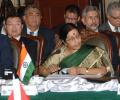
India on Wednesday extended a hand of friendship to Pakistan, saying it was time the two countries display "maturity and self-confidence" to do business with each other.
'Some Pakistani generals are saying -- a little more so now than before -- that the biggest threat to Pakistan is not external -- not India -- but internal.' 'The proof of that will be their change of policies and that is going to be the challenge,' Rakesh Sood, one of India's most distinguished diplomats, tells Aziz Haniffa/Rediff.com in Washington, DC.
'India should think big: About how in a multi-polar world, India can indeed be one of the poles, rather than being a secondary power that has to worry about 'alignment' with one of the poles. A G3 in other words, India should look to getting others to align with itself rather than the US or China,' says Rajeev Srinivasan.
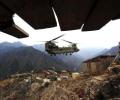
India should not have a large bilateral military training program in Afghanistan in the future because that would predictably exacerbate tensions, says Director of research, Brookings Institution Michael O'Hanlon.
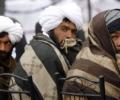
We should be prepared for a phase of increased tensions in India-Pakistan relationship thanks to the evolving situation in Afghanistan, says Shyam Saran.
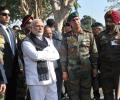
'The attack on the Pathankot base constituted an act of war. Yet Modi's only public comment up until now on that attack has been to blame it on "enemies of humanity".' 'Modi came to power talking tough about Pakistan. But in office, he has pursued a Pakistan policy that has lost both direction and purpose,' argues Brahma Chellaney.
 © 2026 Rediff.com - Advertise with us - Disclaimer - Privacy Policy - Sitemap - Feedback - About us - Terms of use - Grievances