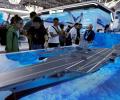
China has commissioned its third aircraft carrier, the Fujian, featuring advanced electromagnetic catapults, amidst rising tensions and military modernization efforts.
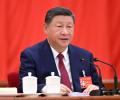
If Xi Jinping is dethroned in the future, the instrument for that may well be embedded within the PLA, notes former foreign secretary Shyam Saran.
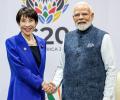
If they act now, they can reshape the strategic map of Asia without firing a shot. If they wait, the next opportunity will come only after a serious Taiwan Strait incident -- by which time the price will be far higher, and the room for boldness far smaller -- the opportunity may well be lost by then. The question is no longer whether this can or should be done, points out Varun Arya.

China displayed a range of new weapons at a military parade, including laser weapons, nuclear ballistic missiles, giant underwater drones, and fifth-generation aircraft.
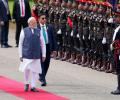
India's concerns over a planned naval exercise between Pakistan and Sri Lanka in the strategically important waters of Trincomalee led to the shelving of the drills weeks ago. The exercise was planned as part of regular engagements between the two navies, but India expressed its apprehensions to the Sri Lankan government. Trincomalee, situated on Sri Lanka's northeastern coast, is considered a significant hub in the Indian Ocean region, particularly for India's maritime security interests. The Pakistani Navy's close cooperation with China's PLA Navy has raised concerns in New Delhi about any Pakistani warship presence in Trincomalee. This incident follows previous diplomatic rows between India and Sri Lanka over the docking of Chinese vessels at Sri Lankan ports. India has been actively supporting Sri Lanka's development of Trincomalee's energy infrastructure and has recently signed a defense pact with the country to boost military cooperation.
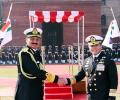
India's Navy Chief Admiral Dinesh K Tripathi has stated that India is fully aware of China's increasing presence in the Indian Ocean Region, with 6-8 Chinese naval ships present at any given time. Admiral Tripathi emphasized that India knows "who goes where", suggesting strong maritime domain awareness, and has not allowed China to operate in areas of Indian interest. He also highlighted China's supply of maritime equipment to Pakistan, including submarines, which India is actively addressing to ensure its maritime security and trade.
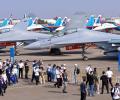
China has announced a 7.2 percent increase in its national defence budget, bringing the total to USD 249 billion for the year. This rise comes amidst China's ongoing efforts to modernize its armed forces, including the development of new warships and fighter jets. The budget increase, exceeding last year's 7.2 percent rise, reflects China's commitment to bolstering its military capabilities. Chinese Premier Li Qiang emphasized the importance of the Communist Party's leadership in guiding the military, with President Xi Jinping at the helm of the Central Military Commission. China's defence spending is now three times that of India's and is viewed by critics as a sign of the country's growing military ambitions.

The government has approved the construction of two indigenously designed nuclear attack submarines and is expected to ink contracts next month to procure 26 naval variant of Rafale jets and three Scorpene submarines, Navy Chief Admiral Dinesh Tripathi said on Monday.

India's Navy has commissioned its new Russian-made guided missile frigate, INS Tushil, in the Russian coastal city of Kaliningrad. The ship, part of a $2.5 billion deal for four stealth frigates, is expected to significantly enhance the Indian Navy's capabilities in the Indian Ocean. The commissioning ceremony was attended by Defence Minister Rajnath Singh, Chief of Naval Staff Admiral Dinesh K Tripathi, and other senior Indian officials. Singh described the commissioning as a testament to India's growing maritime strength and a milestone in its long-standing ties with Russia. The INS Tushil, an upgraded Krivak III class frigate of Project 1135.6, boasts advanced stealth features and stability characteristics, and incorporates 26% indigenous content thanks to collaboration with Indian naval specialists and Severnoye Design Bureau.

China's PLA Navy has deployed a number of platforms including frontline warships and a submarine for the exercise from November 11 to 17.
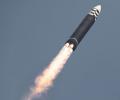
This is the first time in decades that China has made its flight test of an intercontinental ballistic missile public in an apparent show of strategic deterrence, State-run China Daily reported.
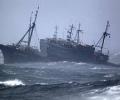
The Indian Navy's P8I maritime patrol aircraft on Thursday located a Chinese fishing vessel that capsized three days ago in the Indian Ocean, officials said.
The Chinese and Pakistani navies at a naval base in Karachi on Saturday kicked off the 'Sea Guardians-3' exercise in the waters and airspace of the northern Arabian Sea in drills that include anti-submarine operations, Dawn News reported on the exercises which will end on Friday.

Reports (not denied by India) that the USA had 'for the first time provided real-time details to their Indian counterparts on the Chinese positions and force strength in advance of a PLA incursion' into Tawang at the LAC in December 2022, helping India thwart China's expansionist designs, show how operationally effective the USA-India friendship has become on the ground. A engaging excerpt from Sreeram Chaulia's must-read new book, Friends: India's Closest Strategic Partners.

During an interaction at a conclave in New Delhi, he also said that the Indian Navy is seized of the docking of various PLA Navy ships at ports in Pakistan, and it is 'keeping a watch on it'.
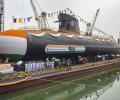
The status of the current submarine force level is alarming and we need to address the threat perceptions expeditiously. Critical decisions pertaining to national security cannot be delayed any further due to the rapidly changing maritime threat perceptions and growing strategic importance of the Indian Ocean region, asserts Commodore Venugopal Menon (retd).

The coming together of the Quad and the Australia-UK-US grouping would be a formidable adversary, moving toward the creation of a 'thousand ship navy' that reins in the PLA navy in the Indo-Pacific.

In a show of strength, China is deploying its aircraft carrier group and a nuclear submarine in large-scale military drills in the Taiwan Strait in response to US House Speaker Nancy Pelosi's high-stakes visit to Taipei which infuriated Beijing as it claims the island as part of its territory.

The American platforms at the exercise 'Cope India' that started off Kalaikunda will also include a fleet of F-15 E fighter jets, C-130 and C-17 transport aircraft.

A Chinese Navy hospital ship arrived in Mumbai on a visit, which saw the first ever interaction between medical services of the Chinese and the Indian Navy

Taiwan had shifted its purchases of large military platforms and systems, like fighter jets and naval vessels, to smaller lethal anti-ship and surface-to-air-missiles, reported The Singapore Post citing local media.
In all likelihood, the next conventional Chinese attack on India would be preceded by a massive cyber attack designed to cripple Indian networks and interfere with our disaster-relief programmes.
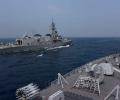
It said that the transit was "ongoing" and that there had been "no interference from foreign military forces so far."
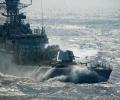
'"I think the message has gone across to them very unambiguously that do not mess with us at sea and also at land for that matter'

Key to China's decision regarding Taiwan will be its leadership's assessment whether the US will come to Taiwan's defence, explains Jayadeva Ranade, the former senior RA&W officer and China expert.
Gen Wang is the fourth commander to head the Western Theatre Command after the eastern Ladakh standoff began in May last year.

With Fujian, China's third and most advanced aircraft carrier, having started sea trials last week, the PLA needed at least 200 qualified carrier-based fighter jet pilots to operate 130 ship-borne aircraft.

Admiral Samuel Locklear, commander of US forces in the Pacific, told the Shangri-La Dialogue, a high-level defence forum in Singapore, that PLA navy had started "reciprocating" US navy's tactics of sending ships and aircraft into the 200-nautical-mile zone off China's coast.

India cannot choose its geography and devise regional strategies to dovetail into the Western Indian Ocean hypothesis conceived in the Pentagon, argues Ambassador M K Bhadrakumar.

To rise quickly in the PLA's hierarchy, you need to be close to Xi Jinping. Retired RA&W officer Jayadeva Ranade on the changes in China's military leadership.

Although the pact would focus mainly on the Pacific and the South China Sea region, any action designed to deter China with or without New Delhi's active participation is a welcome move, notes Commodore Venugopal Menon (retd).

The Chinese military, on the last day of its largest-ever military exercises to vent out its anger over United States House Speaker Nancy Pelosi's visit to Taiwan, carried out island saturation attack drills in the Taiwan Straits, amid global concerns of a full-scale attack to annex the breakaway island which Beijing claims is part of its territory.
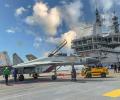
New Delhi's regional partners in restraining a belligerent China -- primarily the US, Japan, Australia and Singapore -- would like the Indian Navy to lock down the Indian Ocean Region, while the other partners can focus on deterring the PLA (navy) in the South China Sea, explains Ajai Shukla.

China will increase its defence spending by "around seven per cent" this year, as it vowed to guard against "outside meddling" in its territorial disputes.

Defence and strategic experts on Monday said that China's posturing in the Indian Ocean will disturb stability and peace in the region.

Amid deepening row with the United States over disputed South China Sea where American ships challenged China's claims of sovereignty, Chinese military has deployed its latest anti-ship cruise missiles which experts say can form a powerful defence line at sea.
'It marks a breakthrough in the country's warship building sector,' said the PLA Daily.

Coming ahead of the transition of power from Donald Trump's administration to President-elect Joe Biden's administration after the November 3 US presidential election, the detailed policy document highlights that China is undermining the security, autonomy and economic interests of many nations in the region.

The navy has significantly expanded its deployment in the Indian Ocean Region deploying a plethora of warships and submarines to create pressure points on China as the maritime space around the Malacca Strait is very critical for its supply chain through sea routes.

At a time when Donald Trump is making belligerent noises, Chinese President Xi Jinping responds by overhauling the People's Liberation Army and restructuring the command of the PLA Navy to emphasise Beijing's resolve to dominate the South China Sea.
 © 2026 Rediff.com - Advertise with us - Disclaimer - Privacy Policy - Sitemap - Feedback - About us - Terms of use - Grievances