
India's crude oil imports from Russia reached a record high of approximately 2.73 million barrels per day (mbpd) in June, driven by discounts of $2-5 a barrel. This surge comes as the West Asia crisis disrupted supplies from traditional sources and China reduced its own purchases, leading Russia to offer more favourable terms to India.

The Petroleum Planning and Analysis Cell (PPAC) has denied an RTI request for data on oil imports from Russia, citing its 'commercial and confidential' nature and exemptions under the RTI Act. The Central Information Commission supported this decision, referencing strategic and economic interests.

India significantly increased its crude oil imports from Russia and the United Arab Emirates in June, securing supplies as the Strait of Hormuz began to reopen, with Russian barrels remaining attractive due to discounts and UAE supplies offsetting earlier uncertainties.

After a three-month slowdown, India's oil imports (already landed) from Russia bounced back in the first 15 days of October to 1.8 million barrels per day.

Indian companies, however, are now paying a premium of $6-$7 a barrel for Russian oil, compared with discounts of $8-$10 a barrel before the start of the conflict.
Indian refiners are recalibrating their crude sourcing strategy due to supply disruptions in West Asia, leading to Venezuela and Brazil emerging as top five suppliers in April, replacing traditional sources like Iraq and the United States.
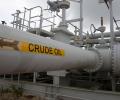
The Kremlin states it has not received confirmation from India regarding a halt to Russian oil purchases, following claims made by former US President Donald Trump. Russia affirms its commitment to strengthening relations with India.

The White House has claimed that India has begun 'scaling back' its oil purchases from Russia at the 'request' of President Donald Trump.

India bought 1.87 million barrels of Russian oil per day in May so far, meeting approximately 40 per cent of its oil imports.

India's crude oil imports from Russia strengthened in the first half of October, reversing a three-month slide in arrivals seen during July-September as refineries were back on full stream to meet festive demand, according to ship tracking data.

India will continue to purchase Russian oil based on commercial viability and energy security needs, irrespective of US sanctions waivers, according to a senior petroleum ministry official.

Monthly gold imports have declined to 25-30 tonnes from 70-80 tonnes while recycling of old jewellery has increased following the recent hike in import duties.

FPIs have already withdrawn Rs 2.6 trillion from Indian equities in 2026, exceeding the outflows recorded in any previous full calendar year.

Indian benchmark indices Sensex and Nifty closed lower, snapping a two-day rally, as a spike in crude oil prices, triggered by reports of fresh US military operations in southern Iran, dampened investor sentiment and reignited fears of renewed energy supply disruptions.

Gwadar is viewed as a critical pearl in China's maritime strategy as it would give a permanent logistical footprint near an important choke point - the Strait of Hormuz and the oil rich Persian Gulf, explains Commodore Venugopal Menon (retd).
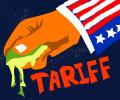
The bill, introduced on Thursday, was conceived by Democrat Senator Richard Blumenthal and late Republican Senator Lindsey Graham and has the support of over 60 lawmakers.

Despite decades of efforts towards energy transition, oil will remain the critical energy source for all nations for some decades. We can hope for peace opening the Strait of Hormuz, but must prepare for war closing it, points out former foreign secretary Ranjan Mathai.

The US Senate has overwhelmingly approved a bill, the Lindsey O. Graham Sanctioning Russia and Iran Act of 2026, which aims to punish Russia and its major petroleum product buyers, including China and India. The legislation allows the US President to impose 100 per cent tariffs on goods from the top five importers of Russian oil and gas, and also extends sanctions on Iran's energy sector. The bill, championed by the late Senator Lindsey Graham, now moves to the House of Representatives for further approval.

Analysts predict that inflation data, the US Federal Reserve's interest rate decision, and crude oil price trends will be the primary factors influencing the movement of Indian stock markets. Geopolitical developments, particularly the US-Iran deal, and foreign investor activity will also play a crucial role.

Indian benchmark indices Sensex and Nifty tumbled nearly 1 per cent for the third consecutive day, driven by a sharp spike in crude oil prices and significant selling in bank stocks, with Brent crude jumping to USD 95.27 per barrel.

Indian stock markets extended their gains for a second consecutive session, with the Sensex closing 736 points higher, driven by a global equity rally and a significant drop in crude oil prices following the finalisation of a peace deal between the US and Iran to end their 107-day conflict and reopen the Strait of Hormuz.

State-run Oil and Natural Gas Corporation (ONGC) has approved the development of a 1.75 million tonnes (mt) strategic petroleum reserve (SPR) in Mangaluru, a project deemed of national importance, with plans for broad commercial utilisation.

India's exports increased by 15.5 per cent to USD 40.41 billion in June, but the trade deficit significantly widened to a record USD 30.43 billion due to a 31 per cent surge in imports.

Indian benchmark indices, Sensex and Nifty, experienced a significant downturn as escalating tensions in West Asia led to a sharp surge in crude oil prices, coupled with fresh foreign fund outflows and a weakening rupee.

A tripartite pact -- amid the promise of removing AFSPA from almost all of the North East -- revives hydrocarbon exploration along the Assam-Nagaland border after decades of dormancy.

Indian refiners are likely to import 2-2.2 million barrels per day of Russian crude oil in June - the highest in the last two years and more than the total volumes bought from Iraq, Saudi Arabia, the UAE and Kuwait, preliminary data by global trade analytics firm Kpler showed.

Prime Minister Narendra Modi on Thursday discussed with a group of senior ministers the prevailing global security situation and how to maintain supply chain uninterrupted despite conflicts in different zones, including the Strait of Hormuz, the Black Sea, the Red Sea, and the Gulf of Aden.

The government has withdrawn most provisions of the emergency natural gas supply regulation order imposed during the West Asia conflict after liquefied natural gas (LNG) shipments through the Strait of Hormuz resumed following a ceasefire.

It, however, conceded that 20 per cent blending of ethanol with petrol leads to 3-5 per cent lower mileage in vehicles than conventional petrol, but said the blend offers a significantly higher octane rating, superior anti-knock properties, faster combustion, better pickup, smoother acceleration, and cleaner engine operation.

Indian stock markets this week will be primarily influenced by a series of corporate Q1 earnings, the evolving geopolitical situation in West Asia, and fluctuations in crude oil prices, according to market analysts.

The reopening of the Strait of Hormuz, following a ceasefire agreement between the US and Iran, is expected to significantly ease India's crude oil supply risks, lower freight costs, and reduce inflationary pressures, as global oil prices have already dropped.

The Indian government has dismissed concerns that the use of E20 fuel could affect the validity of vehicle insurance policies, stating that the ethanol blending programme remains safe, consumer-friendly, and economically beneficial.
Crude oil prices are projected to fall significantly this year, driven by hopes of a peace deal between the US and Iran, which could lead to the reopening of the Strait of Hormuz, and a notable drop in Chinese demand for seaborne crude imports.

The Indian stock market's trajectory this week will be significantly influenced by crude oil prices, global market trends, and the commencement of the corporate earnings season, with IT major TCS set to announce its June-quarter results on July 9.

Iranian Foreign Minister Seyed Abbas Araghchi on Saturday criticised the United States over its stance on Russian oil, claiming Washington was now "begging" countries across the globe, including India, to purchase Russian crude.
India will restrict crude oil purchases from Russia as part of an agreement reached with the US in exchange for lower trade tariffs, sources said, adding imports will continue for now by refiners such as Nayara Energy, which have no other alternative source. US President Donald Trump announced overnight that the United States will cut the reciprocal tariff on imports of Indian goods to 18 per cent from 25 per cent under a broader bilateral understanding.

The Reserve Bank of India's Financial Stability Report indicates that the interim peace deal between the US and Iran has favourably shifted the balance of risks, reducing headwinds from the West Asia conflict. However, it cautions that exchange rate volatility could increase if crude oil prices spike due to delayed normalisation of supply chain disruptions.

Maruti Suzuki India Ltd has launched the Wagon R, India's first flex-fuel car, capable of running on any blend of ethanol and petrol from E20 to E100, aligning with national energy security and sustainability goals.

Russian shipments averaged 1.67 million barrels per day in January compared to 1.48 million bpd in December and 1.53 million bpd a year earlier.

A US-sanctioned tanker carrying Iranian crude oil is heading to India, marking the resumption of oil imports from Iran after seven years.
