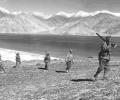
As India and China continue to face off across the Himalayas six decades later, the echoes of that earlier conflict remain unmistakable. The core of China's sensitivity lies not in maps or mountain passes, but in its perception of sovereignty over Tibet, points out Dr Kumar.
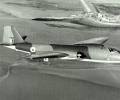
Chief of Defence Staff General Anil Chauhan says the Indian Air Force would have slowed the Chinese offensive considerably during the 1962 War.

India agreed to give up the Poonch salient as well as Uri. To the north India also proposed to give up land in the Gurez sector giving the entire Neelam/Kinshanganga valley to Pakistan. In return India sought control of the post dominating Kargil town, points out Colonel Anil A Athale (retd).
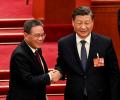
'The real issue between India and China is that the Chinese have transgressed along the Line of Actual Control at multiple points.'

China has long coveted Arunachal Pradesh, which it calls Southern Tibet. But, as Venkataraghavan Subha Srinivasan explains, in 1947, the present state of Arunachal Pradesh constituted the North East Frontier Tract of Assam. When India adopted its Constitution on 26 January 1950, NEFT became 'a separate politico-administrative entity' although it was constitutionally still a part of Assam. Its administration was brought directly under the President of India with the Governor of Assam acting as his agent. A revealing excerpt from his book The Origin Story of India's States.

Today for China to threaten Arunachal Pradesh and demand a slice of Sikkim after assured of its vice-like grip on India, is a natural progression even as New Delhi continues its slumber.
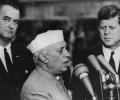
On Jawaharlal Nehru's 134th birth anniversary, Utkarsh Mishra recounts incidents where the first prime minister showed exemplary courage, bravery and integrity.

The answer to Chinese tactics of nibbling territory is not defence of every inch -- a military impossibility -- but instead, nibbling at Chinese territory wherever we are in a stronger position, counsels Colonel Anil A Athale (retd).

Like most army combat uniforms, this one has been designed to serve two requirements: First, protection against harsh climatic conditions, including extreme heat and cold. Second, the need to provide soldiers' outfits with field camouflage, so as to increase his battlefield survivability.
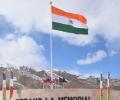
Visiting the Rezang La Memorial, one has a feeling of super-humans defending the Indian territory against the Chinese onslaught, says Claude Arpi on the 60th anniversary of the heroic battle of the 1962 War.

The Chinese admitted that they had suffered the maximum casualties fighting in the first battle on October 20, 1962, and these casualties had been inflicted mostly by 2 Rajput. Claude Arpi salutes Major B K Pant and his fighting force of 112 men, 82 of whom lost their lives in the Battle of Namkha Chu, and whose courage must never ever be forgotten by a grateful country for who they laid down their lives.

Tawang wears its history -- and also its present -- with ease. The flourishing town, with restaurants selling everything from noodles to dosas and locals returning home to new business prospects, shows little sign of the tension building up at the border about 40 km away to the north.
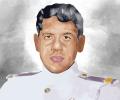
'We airlifted army personnel wearing lungis to generally unused landing grounds.' 'We were told to keep quiet about what we did or saw.'
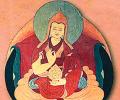
Tawang is very much a part of India, and if the present Dalai Lama decides one day to take rebirth in Tawang, the Indian government will openly welcome him and support him, notes Claude Arpi.

'The numbers of troops on both sides are enormous.' 'They are about 50,000-60,000 soldiers facing each other in that sector -- that's about the total number of troops that both sides had in the 1962 War in all sectors.'

'China wants to change the status quo of India's Northern Border and proves that it can do whatever it wants in what it perceives as its own territory,' states Claude Arpi.

Did Vinod Sehgal die in Tsangdgar or was he taken PoW to Tibet or China? Why has the IAF kept so quiet for all these years, asks Claude Arpi.

Very few today realise that without Brigadier John Dalvi's courage, we would never have known what really happened during those tragic days of October/November 1962, reveals Claude Arpi.
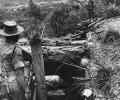
More than half-a-century after humiliation in the 1962 war, India is still not prepared to take on the Chinese dragon. Every now and then, that dragon flexes its muscles, reminding India the threat persists, says Virendra Kapoor.

'When war is thrust on you as in 1962 and 1965 or is tempting as in 1971, ensure that all other fronts are kept quiet, leaving your army free to deal with one,' says Shekhar Gupta.

The Siang is a dramatic river that flows through a beautiful land. Rafting on it is a rare pleasure the state offers tourists, says Ajai Shukla.
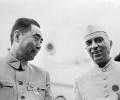
The Indians felt that if they acceded to Chinese claims in Ladakh, Beijing would simply be emboldened to press for further concessions in the future. A revealing excerpt from India And The Cold War.

'The Congress, all these decades, worked on a slow Hindi-isation and Indianisation of Arunachal tribes. The RSS wants rapid Hinduisation,' says Shekhar Gupta.

Though the Chinese find it necessary to oppose the visits of Indian leaders to Arunachal Pradesh, they want to keep the objections at a moderate level lest it cast a shadow on Narendra Modi's visit to China in May, says D S Rajan.

'A participant in many rounds of the border talks with China once told me that China seemed not interested in resolving the border issue as it wanted to keep it as a ready excuse to intervene in the sub-continent,' says Colonel (retd) Anil A Athale.

Glimpses of the final days of the 1965 War, as seen from the diary then defence minister Y B Chavan maintained during the war.

On the title page of the Top Secret Report, Henderson-Brooks quotes the Chinese tactician Sun Tzu: 'Know yourself, know your enemy: A hundred battles, a hundred victories', says Claude Arpi, highlighting where the Indian Army and government failed to counter the Chinese attack in 1962.

'It is a pattern of behaviour of the Chinese that whenever a Chinese leader visits India or an Indian leader visits China, some incidents take place.' 'When Modi visits China, we should look out for some similar demonstration by the Chinese.'
 © 2026 Rediff.com - Investor Information - Advertise with us - Disclaimer - Privacy Policy - Sitemap - Feedback - About us - Terms of use - Grievances