
The government introduced the SHANTI Act, 2025, to support the mission and open the sector to private participation.

India's nuclear energy share in total installed capacity remains limited, fluctuating between 1.9 per cent and 2.9 per cent from FY10 to FY24.

India and Russia are expected to unveil a major nuclear energy partnership during Vladimir Putin's visit, potentially involving Russian small modular reactors and expanded cooperation as India pushes toward its 100-GW nuclear goal by 2047.

Fuel loading at India's first prototype fast-breeder reactor in Kalpakkam is expected to start next week, marking a significant step in the country's nuclear program.
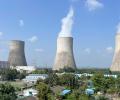
The Bill is likely to pave the way for amending two existing legislations -- the Atomic Energy Act 1962, and the Civil Liability for Nuclear Damage Act 2010.
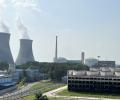
'Attacks on nuclear sites pose significant threats.'

The first unit of Kudankulam Nuclear Power Plant, which attained criticality on July 3 will reach its maximum capacity of 1000 MWe by November end, according to S Sundar, project site director.

'Bharat Small Reactors are essentially similar to the existing 220 MWe Pressurised Heavy Water Reactors. The existing regulations are applicable for BSRs.'

Whether the ambitious targets are achievable is a moot question as India's earlier target was 20,000 MW of nuclear power by 2020.
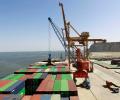
The customs officials, based on an intelligence input, halted a Malta-flagged merchant ship -- CMA CGM Attila -- at the port en route to Karachi on January 23 and inspected the consignment, which included a Computer Numerical Control (CNC) machine, originally manufactured by an Italian company.

Dr Bhabha and Dr Sarabhai didn't feel guilty for their ambitions; it was for those 'mad scientists' that India is a powerhouse -- both at the atomic level and in the vastness of space, observes Kumar Abishek.

Since $4-5 billion (Rs 18,670-23,340 crore) will be needed to set up each nuclear reactor, capital costs alone add up to $200-250 billion (Rs 9,33,600-11,67,000 crore). Then there are fuel costs, nuclear waste disposal, reprocessing, consultants & advisors and, of course, the financial market aspects of raising all that money.

KAPP-3, the country's 23rd nuclear power reactor, is a 700 MW Pressurised Heavy Water Reactor (PHWR) designed indigenously, the NPCIL said in a release. The components and equipment for the reactor have been manufactured by Indian industries, and its construction was undertaken by various Indian contractors, it said.
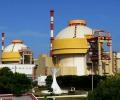
Power generation at the Kudankulam Nuclear Power Plant in Tamil Nadu has been temporarily suspended for the second time in about a week in order to undertake mandatory tests, official sources said on Wednesday.
Government plans to set up more atomic energy plants with latest safeguards available in the international market and construction work on eight reactors is in progress, the Rajya Sabha was informed Thursday.

The government must justify why we need to buy foreign reactors when we have developed up to 700 MWe unit-size pressurised heavy water reactors, a design which can be easily extended to 900 to 1000 MWe unit size. Why can't the 'Make in India' philosophy apply to indigenous nuclear reactors, more than 18 of which have been designed, built, and being operated by Indian engineers, asks Dr A Gopalakrishnan.

India has said it is committed to implementing the highest safety standards at its nuclear power plants as it seeks to harness the benefits of atomic energy to meet its growing energy requirements.
Nuclear power forms a big part of energy production in some countries.
The Bharatiya Janata Party has asserted that no government in Jammu and Kashmir was possible without the party being part of it, even as a two-member party delegation met Governor N N Vohra to discuss the matter and said it would submit a formal proposal to him on January 1.
The attack also refreshed the memories of a virus attack on an Iranian nuclear facility.
Baldev Raj, scientist and director, Indira Gandhi Centre for Atomic Research, Kalpakkam, said the current installed nuclear power generation capacity is likely to increase five-fold to 25,000 Mwe by 2050 from the current 3,900 Mwe. The proposed expansion would require over Rs 125,000 crore. Nuclear power accounts for 3 per cent of India's total electricity generation and is estimated to go up to 25 per cent in 2050.
The first pour of concrete for units three and four was scheduled for December 2007 but failure to sign the agreement for the additional reactors during Prime Minister Manmohan Singh's visit to Moscow last month put a huge question mark over NPCIL's expectation of touching a generating capacity of 20,000 MWe by 2020. Kudamkulam is critical to its calculations.

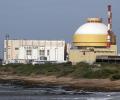
The first unit of the Kudankulam Nuclear Power Plant was synchronised with the southern power grid on Tuesday, marking a major milestone in power generation of the ambitious Indo-Russian nuclear collaboration in Tamil Nadu.
A lowdown on why NSG membership is important for India

The Kundankulam Nuclear Power Plant attained its full generation capacity and became the first nuclear plant in the country to generate 1,000 MW of power on Saturday, its site director R S Sundar said.
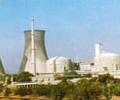
Sustained campaign forces NPCIL to issue statement on Kakrapar fuel leak. But there is still not clarity on what went wrong.
