
She said India was asked to waive diplomatic and consular immunity and cooperate in the investigation but refused.
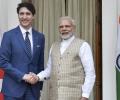
The Canadian Broadcasting Corporation (CBC News) on Friday said Trudeau described the meeting as a "brief exchange" when the two leaders met during the Association of Southeast Asian Nations (ASEAN) Summit in Vientiane, Laos held on Thursday.

'Canada doesn't want to de-escalate and neither does India. There is war when one party wants it, but peace is won by both parties.'

Joly said that Ottawa stands by its decision to inform Canadians about the allegations surrounding the killing of Nijjar, but remains engaged with the Indian government on the issue.

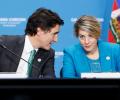
External Affairs Minister S Jaishankar has said that he discussed the 'present state' of bilateral ties and the current global issues with his Canadian counterpart Melanie Joly, amidst a diplomatic row between the two countries over the killing of a Sikh separatist in Canada.

The report by the Financial Times on Tuesday came even as Canada is yet to comply with India's communication to Ottawa to withdraw over three dozen of its 62 diplomats in the country.

'When it comes to India, I have mentioned it many times, I am in close contact with my counterpart, S Jaishankar, and we know this is a difficult moment in a relationship that spanned decades, so therefore I am confident that we will be able to get through this difficult period'
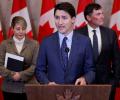
"From the beginning, as of last summer, we've worked closely with our Five Eyes partners, particularly with the United States, where they have gone through a similar pattern of behaviour from India in regards to an attempted extrajudicial killing," Trudeau told reporters at a news conference in Ottawa.

Canada's Prime Minister Justin Trudeau said on Friday that India's decision to revoke the diplomatic immunity of 41 Canadian diplomats is a violation of the Vienna Convention and it should worry all countries, hours after New Delhi rejected Ottawa's attempt to portray the implementation of parity as a violation of international norms.

India has summoned Canadian high commissioner in New Delhi over propaganda material, including posters, containing threats to Indian diplomats being circulated in Canada and has served a demarche to the Justin Trudeau government.

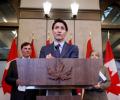
Speaking to reporters, Trudeau said, "The news coming out of the United States further underscores what we've been talking about from the very beginning: which is India needs to take this seriously."
"When it comes to the Canadian matter, we have made clear that the allegations are extremely serious and they need to be taken seriously. We wanted to see the government of India cooperate with Canada in its investigation. Obviously, they have not chosen that path," State Department spokesperson Matthew Miller told reporters at his daily news conference.

The Congress on Tuesday said the country's interests and concerns must be kept paramount and its fight against terrorism has to be uncompromising, amid a row between India and Canada over the killing of a Khalistani separatist leader in that country.

'We have had numerous conversations with India before the Prime Minister went in front of the house and made his declaration. This was not a surprise to the Government of India and through these different conversations, the Indian officials were made aware of the credible allegations'

India and Canada have mutually beneficial political and economic linkages. The two countries should get together and find a solution. The expulsion war should, in the meantime, be a guarantee against any deterioration of the situation, asserts Ambassador T P Sreenivasan, the first Indian head of mission to be ever expelled by any country.
The United States on Friday expressed concern over the departure of Canadian diplomats from India and said that it expects New Delhi to uphold its obligations under the 1961 Vienna Convention on Diplomatic Relations.

"Indians will decide the fate of India, not the foreigners," Verma told the Montreal Council on Foreign Relations, a prominent think-tank.

The US on Tuesday said it was "deeply concerned" about the allegations made by Canadian Prime Minister Justin Trudeau on India's involvement in the killing of a Sikh separatist leader in Surrey, and urged New Delhi to "cooperate" with Ottawa in the investigation of the incident.
Canadian Prime Minister Justin Trudeau on Tuesday said he was not looking to "provoke" India or "escalate" tensions, but urged New Delhi to take the killing of a Sikh separatist leader with the "utmost seriousness".
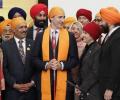
India on Thursday insisted on the need for ensuring "parity" in Canada's diplomatic presence in the country and asserted that its measures are in compliance with the Vienna conventions on diplomatic relations, signalling continuing strain in the bilateral ties over the killing of a Sikh separatist leader in June.

Former Research and Analysis Wing (RAW) chief A S Dulat Tuesday said Canada expelling an Indian diplomat after claiming that New Delhi was potentially linked to the killing of a Khalistani extremist will have a bearing on bilateral relations.

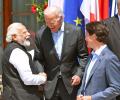
US President Joe Biden attended the Association of Southeast Asian Nations gala dinner in Phnom Penh, Cambodia.

Prime Minister Justin Trudeau on Tuesday said Canada was going through an "extremely challenging time" with India but asserted that Ottawa will continue to have "constructive relations" with New Delhi, amid the diplomatic row between the two countries over the killing of a Khalistani separatist.
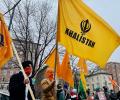
The statement by Canadian Foreign Minister Melanie Joly came a day after External Affairs Minister S Jaishankar said India has asked its partner countries such as Canada, the United Kingdom and the United States not to give space to 'extremist Khalistani ideology' as it is 'not good' for relations.
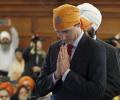
A US expert has termed Canadian Prime Minister Justin Trudeau's claim of a "potential link" between Indian government agents and the killing of a Khalistani leader a "shameless and cynical action" and urged the United States not be part of it.
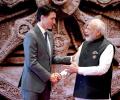
India urged Canada to disallow activities of groups promoting extremism, prevent attacks on places of worship of religious and racial minorities, and enhance measures to address hate crimes and hate speech.

The external affairs minister also said that India is likely to resume issuance of visas to Canadians if it sees progress in the safety of Indian diplomats in Canada.

India on Friday rejected Canada's attempt to 'portray' the withdrawal of 41 of Canadian diplomats from the country as a violation of international norms, and asserted that ensuring two-way diplomatic parity is fully consistent with the provisions of Vienna convention on diplomatic relations.

A day ahead of a crucial G20 meeting, External Affairs Minister S Jaishankar on Wednesday evening hosted a welcome dinner for the foreign ministers attending the deliberations but the reception was missed by his counterparts from the US, China, Germany and France.
'The Americans want to have a good relationship with India. They see it as a counterweight to China. And also American businesses are all trying to get out of China and go to India and Vietnam as well, but India largely.'
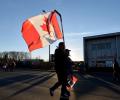
Canada will be pausing all in-person services at the consulates in Chandigarh, Mumbai and Bengaluru and is now directing all Canadians in India to the High Commission in New Delhi.

The Canadian high commissioner to India was summoned to the ministry of external affairs and informed about the decision to expel the senior Canadian diplomat.

'By making it so public in the House of Commons, you know the reaction in India... Mr Modi is not very happy about it; you're kicking out Canadian diplomats; you suspended visa services for Canadians...'

'The world is watching carefully. The choices India makes today have consequences beyond its borders.'
Canada has expelled an Indian diplomat as it was investigating what Prime Minister Justin Trudeau called 'credible allegations' of the involvement of 'agents of the Indian government' in the killing of a Sikh extremist leader in Surrey in June, claims outrightly rejected by New Delhi as 'absurd' and 'motivated'.
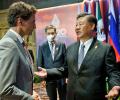
China on Thursday played down what appeared to be a tense conversation between President Xi Jinping and Canadian Prime Minister Justin Trudeau on the sidelines of the G20 summit a day earlier, saying the conversation is "candid, normal" and should not be interpreted as criticism or threat.
 © 2026 Rediff.com - Investor Information - Advertise with us - Disclaimer - Privacy Policy - Sitemap - Feedback - About us - Terms of use - Grievances