
'Its people are either victims of corruption or witnesses to it.'

E-commerce firms Amazon, Flipkart, and others are expected to witness blockbuster festival season sales of around $9 billion this year, surpassing pre-pandemic sales of $5 billion in 2019. The pandemic has accelerated the shift to e-commerce, with more consumers shopping online at a higher frequency than last year, observed analysts. This year's festival sales (gross merchandise value or GMV) are expected to grow 30 per cent year-on-year (YoY) to $4.8 billion during the first week of the season and potentially clock over $9-billion GMV during the whole festival month, revealed consulting firm RedSeer's e-commerce festival season report.

'The focus needs to shift towards the ability to collect payments, particularly in tier-3 to tier-4 areas where acceptance is still lacking.'

Howrah resident Helaram Mallik travelled 235km to Balasore to recover his son alive from a makeshift morgue where he was kept with the bodies of those killed in the triple train accident.

With more than 10,000 stores under the various Reliance retail brands and over 2.5 million kirana stores already tying up with it, Jio's online marketplace would have the biggest hyperlocal logistics network in the country.

Online play is a priority now -- so far unthinkable in a business that's all about a meaningful interface with kirana stores.

'When you do some job for a few hours, you are hardly earning enough to survive.'

The country's Fast-moving consumer goods (FMCG) industry witnessed a consumption slowdown in the December quarter, with an overall "negative" volume growth, as consumers continue to reel under inflationary pressure, says a report. According to the report released by data analytics firm NielsenIQ on Thursday, in October-December, the FMCG industry grew 7.6 per cent in terms of value but its volume growth was (-) 0.3 per cent. "... Overall FMCG volume growth is negative, the absolute values, as well as volumes, continue to be above pre-Covid levels across markets," it said.

Hindustan Unilever is associating with small-format retail through its Super Value Store, Dabur with Parivaar and Marico with Mera. At many shops, the counter has been modified into a U or L shape so that the shopper can move and pick items.
A retailer who does not control the logistic portion of the supply chain in supermkt format is unlikely to have any competitive advantage in the long run, says Prof. Nirmalya Kumar.

Wipro Consumer Care and Lighting on Thursday announced the acquisition of Brahmins - a Kerala-based traditional vegetarian, spice mix and ready-to-cook brand - and it has also drawn up plans to launch its snacks brand targeting the southern market. The company will focus on the southern market and is in the process of launching its own brand in the fast-growing ready-to-eat and snacks segment, Wipro Consumer Care and Lighting and managing director Vineet Agrawal told PTI. He further said Wipro Consumer Care and Lighting would take the acquisition route for expanding in the spices segment.

'Sure, we are teenagers who are doing this part time, but we feel we are making some sort of an impact.'
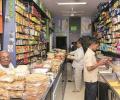
The power of the small neighbourhood retailer can barely be ignored as organised players look to leverage their last-mile connectivity and reach, luring them by promising support in technology, inventory and tax management.
Most MNCs do not deliver their lofty 'customer service' promises in India.

As part of this strategy, the e-commerce major has launched a programme to manage the entire business-to-business inventory supply and management for kirana stores in three cities in Karnataka.

Reserve Bank of India governor Shaktikanta Das on Monday said payments through UPI (unified payment interface) have grown exponentially in the past 12 months with daily transactions crossing 36 crore, which is up 50 per cent from 24 crore in February 2022. In value terms, these transactions are worth Rs 6.27 lakh crore, registering a growth of 17 per cent from Rs 5.36 lakh crore in February 2022, the governor told reporters while launching the Digital Payments Awareness Week at the RBI headquarters in Mumbai this afternoon. He also said the overall monthly digital payment transactions crossed over Rs 1,000-crore-mark each month during the past three months.
Consumer companies have started taking orders via phone calls and are also pushing retailers to order through their B2B applications.

Entrepreneur and podcaster Raj Shamani identifies four most sought after job profiles.

Ajit Balakrishnan offers a thinking man's guide to the state of ecom in a nation of shopkeepers.
A study by economic think-tank Icrier (Indian Council for Research on International Economic Relations) has found that any adverse impact of organised retail on mom-and-pop stores will wear off over a period of time. Organised retail, it has said, will not lead to job losses and will, in fact, raise farmers' earnings.

'The government should act proactively to instil confidence in the private investors, and also boost the purchasing power of people directly or indirectly by ensuring minimum wages.'

Reliance Industries (RIL) has been distilling its investment strategy to meet new goals. The share of the new energy vertical - its key focus area - accounts for more than a fourth (26 per cent) of the total war chest of $6.4 billion, ploughed into acquisitions and picking up stake from 2018 to date, reveals the latest Morgan Stanley data. Nearly half the incremental investments made on deals by RIL between August 2020 and September this year ($3.3 billion) has been spent on new energy - acquiring global companies with technology and expertise.

Thousands of small brands are ruling the consumer market despite the predatory pricing and deep discounting by foreign e-commerce companies and efforts of certain FMCG companies to sideline the distributor network, said the Confederation of All India Traders (CAIT), which represents about 70 million traders in the country. "If the government gives support policies to non-corporate sector and tighten the e-commerce companies to obey the policy and the law both in letter and spirit, the retail trade of the country is bound to blossom in pursuance of the vision of PM Narendra Modi for Make in India and Atmnirbhar Bharat," said CAIT national president BC Bhartia and secretary general Praveen Khandelwal.

Reliance Retail's digital commerce platform JioMart will morph into an e-marketplace offering multiple brands - from electronics, consumer durables, fashion and lifestyle, beauty, home, kitchen, and grocery - as it girds up to take on the likes of Amazon and Flipkart ahead of the festival season sales. India's largest retailer was in the process of onboarding third-party sellers these past few months, further increasing its selection across categories multifold. Its website and application offers general merchandise as well.
With the general insurance penetration at a dismal 0.60 per cent (measured as a percentage of GDP), many companies feel that selling the policies through photo studios, grocery stores and even telephone booths would help improve the figure. "If telecom companies are able to use grocery stores, petty shops and other small outlets, why not insurance companies?" said an Insurance Regulatory and Development Authority official.

Walmart-owned Flipkart on Wednesday said it has set up a new fulfilment centre (warehouse) in West Bengal, its second-largest in the state, that will help in creating nearly 3,500 direct jobs. Spread across an area of over 2.2 lakh sq ft, the new facility in Dankuni will cater to the needs of Flipkart and Myntra customers in the region and bolster the e-commerce major's efforts to ramps up supply chain infrastructure in the eastern part of the country. The facility will also help thousands of sellers offer a wider selection and enable faster deliveries of customer orders within the region and neighbouring states while also helping create national market access, according to a statement.

Categories such as lifestyle, food and electronics accounted for over 1,350 sellers across the country last year.


He said the policy paralysis, which had gripped the country in recent months, was over, and India was back in business.

Campa is set to take on its competition, which pushed it out of the aerated drinks business in the late 1990s, but this time with a new owner - Reliance Industries. Campa's entry comes at a time when aerated drinks as a category is already saturated. But experts say this could give rise to competition in the segment, eventually causing the space to grow.
India's largest traders' association CAIT on Tuesday said few multinational e-commerce giants with a heavy arsenal of funding are attempting to flout foreign investment guidelines for the sector and demanded strict enforcement action. Releasing a whitepaper on the e-commerce policy, the Confederation of All India Traders (CAIT) said e-commerce entities have "structured their relationship as marketplace with sellers in a such a way that they are in a position to control either seller on their platform or the inventory and also escape the scrutiny of the enforcement agencies." "Under the guise of such control or ownership over sellers, the issue also permeates from being a mere FDI policy violation to also being an anti-competitive conduct," it said.
Opposition to FDI in retail is misguided, says Pranab Bardhan, professor of economics in University of California, Berkeley.

Amazon India has decided to shut down 'Amazon Distribution', according to sources. This follows its recent decision to shut its food delivery and edtech offerings. The moves are part of the annual operating planning review process amid global macroeconomic uncertainty. The e-commerce giant is looking to focus on its core businesses, sources said.

The news of his passing is sad and sudden but the body of work he leaves behind will neither fade nor be forgotten.

'The best way to make an impact in this market is by focusing on three things: Unmet customer need, unarticulated customer need, and emerging customer need,' Metro's Arvind Mediratta tells Sangeeta Tanwar and Alokananda Chakraborty.

Sanjiv Mehta, chairman of the country's largest consumer goods company, HUL, believes that the second wave of the Covid-19 pandemic between April and June this year has been a mere pause in India's consumption story, and that it will not change the country's overall growth trajectory. India is poised for growth, especially in the fast-moving consumer goods (FMCG) sector, Mehta told shareholders at the company's annual general meeting on Tuesday. The signs of recovery are becoming evident with many states lifting lockdown restrictions in recent weeks.

Walmart, the world's largest retailer, is tripling its sourcing from India to about $10 billion a year by 2027, said Judith McKenna, president, and chief executive officer of Walmart International, the segment which includes the company's operations outside the US. "To achieve this, we are growing our sourcing team in India," said McKenna, during a fireside chat with YourStory founder Shradha Sharma at Converge@Walmart, the flagship event of Walmart Global Tech India. "Walmart has a 20-year history of sourcing from India and already exports more than $3 billion worth of Made-in-India goods each year to 14 markets worldwide." McKenna said the company has expertise in processes such as international standards and demand forecasting that businesses need to get ready to export.

The new amendment, which came into force on April 21, has been introduced to detect discrepancies between the expenses and incomes of people who do not have to file tax returns.

Udaan - India's largest business-to-business (B2B) e-commerce company - has laid off about 180 employees, or 4-5 per cent of its workforce of 4,000, in a move to drive cost efficiency, revealed sources. They said the layoffs have happened across various department functions. The layoffs have happened at a time when the Bengaluru-based firm is trying to turn into a publicly listed entity in 18-24 months.

At the annual general meeting of Reliance Industries earlier this week, Isha Ambani, director at Reliance Retail Ventures, announced that the company is foraying into the fast-moving consumer goods (FMCG) space. But analysts say that only time will tell if this will lead to a disruption in India's FMCG market. While Reliance Retail's initial strategy is to take its own brands, which it currently sells at its own supermarkets and hypermarkets, to general trade, it is also looking at acquisitions.
