
Syed Firdaus Ashraf/Rediff.com lists 11 Modi flagship schemes that may have been gamechangers in the Lok Sabha election.

'I would want people to have food on their tables and their wages to rise.' 'Will that happen or not is the question that we need to ask and answer.'

Eleven per cent increase in post-monsoon rain and new farm technologies are likely to more than make up for drought-hit kharif crop and result in a bumper grain production of about 220 million tonnes in 2004-05
"Manmohan Singh Ji (former Prime Minister) tried many times but could not do. Today when it is implemented, propaganda is being spread," Tomar said.
Modi said "timing" is very important to deal with any crisis and "decisions taken at the right time have helped a lot in controlling the coronavirus infection in the country".
Agriculture Minister Sharad Pawar said on Thursday onion prices will ease in the next two-three weeks as fresh output arrives from Maharashtra and other states, providing relief to consumers.
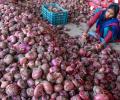
The Reserve Bank of India on Thursday raised its inflation projection to 5.1-4.7 per cent for the second half of the current fiscal on the back of spike in prices of vegetables such as onion and tomatoes.

He said the government would provide meal at Rs 10 to common citizens and build a super-speciality hospital in every district of the state.

According to the Indian Council of Agricultural Research Director General Trilochan Mohapatra, the insects have attacked about 40,000 hectares of land.
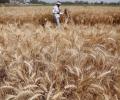
The decision will help farmers earn an additional income of Rs 62,635 crore

On reforms in pipeline, she said the government is for universal right to minimum wages and wants to remove regional disparity through a national floor wage.
Around 40 per cent of the country is staring at drought-like conditions ahead of the monsoon as water levels have receded sharply.
The government on Thursday said based on the current monsoon situation, India's foodgrains output may rise by 29 per cent to 115 million tonnes.
In its Fifth Bi-monthly Monetary Policy Statement, 2017-18, RBI said the second quarter growth was lower than the one that was projected in the October review, and the recent increase in oil prices may have a negative impact on margins of firms and Gross Value Added (GVA) growth.

These five stocks, which have lagged the markets over the last two years, have doubled in value since March 23.

Last month, the agriculture ministry had projected 10 per cent fall in kharif foodgrains production at 117.18 million tonnes in view of poor rains and drought in more than 360 taluks in Karnataka, Maharashtra, Rajasthan and Gujarat.

The rains have so far been four per cent below normal.
The Centre for Monitoring Indian Economy on Tuesday said industrial production growth is likely to decline in the second half of the current fiscal, while the first advanced estimate of kharif crop showed a 10 per cent drop in food production.\n\n\n\n

Scenario is precarious for urad with almost half the crop damaged in major growing states, tur quota of 400,000 tonnes already exhausted.
NCDEX benchmark index up 10% over a month, as expectations on sowing gather pace

The wider NSE Nifty too fell by 20.15 points or 0.19 per cent to end at 10,749.75.

Centre releases Rs1,712cr to TN, Rs 1,234cr to Karnataka for drought.
Shortage of seeds, threat of El Nino expected to restrict sowing.
As the kharif sowing season exceeds two months, no crop has managed to reach the normal area of cultivation (average of the past five years), except for sugarcane, cotton and jute.

As of now, monsoon rains are deficient by 21 per cent across India, affecting sowing of kharif crops. Karnataka, Maharashtra, Gujarat, Haryana, Punjab and West Rajasthan have been the worst-hit regions this year.
Prices of essential commodities, including foodgrains, have surged 8-10 per cent in just three days, because of deficient rains and on concerns that the farm output this kharif season would be hit badly.
Because of late monsoon, arrival of kharif (summer) onion crops would be delayed by a month in key growing areas of Maharashtra, Rajasthan and Madhya Pradesh, threatening to push up prices in the late September and October.
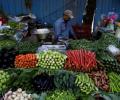
Vegetable arrivals at mandis, especially in Maharashtra, have declined by more than 50 per cent since the beginning of the month.

As the southwest monsoon continues to narrow its overall deficit, the India Meteorological Department (IMD) on Wednesday exuded confidence that the dreaded El Nino weather pattern was unlikely to affect monsoon rains this year.
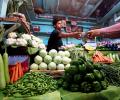
This could be the reason why Prime Minister Narendra Modi mentioned tomato, onion, and potato as his government's 'TOP' priority, in an election rally on February 5 in poll-bound Karnataka.
On one hand Karnataka Agriculture Minister Umesh Katti, Water Resources Minister Basavaraj Bommai and Rural Development Minister Jagadish Shettar are plotting the fall of Chief Minister Sadananda Gowda, while on the other hand the state continues to reel under drought with 123 taluks declared as drought hit.
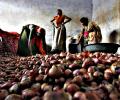
The cost of production of onion is around 800-900 per quintal, while prices are hovering around 500 per quintal across major wholesale markets.
The rains in August have also led to speculation that if the trend continues, rains in September, the terminal month of the four-month monsoon season, could be better, thus aiding production of paddy and other kharif crops.
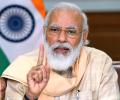
He said the global toy industry is over Rs 7 lakh crore but India's share is very small, as he stressed on the need to work to increase it.
El Nino refers to abnormal warming of surface ocean waters in the Pacific that disrupts weather pattern causing drought and floods in many regions of the world.

Though monsoon risks to overall economic growth could be limited due to small share of agriculture output in GDP, the impact may be significant because it affects the poor through inflation and income, RBI noted in its 'First Quarter Review of Monetary Policy 2012-13'.

The regulator has doubled the deposit money that a trader is required to keep with exchanges for trading in turmeric following unusual price movement.
 © 2026 Rediff.com - Advertise with us - Disclaimer - Privacy Policy - Sitemap - Feedback - About us - Terms of use - Grievances