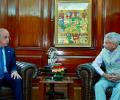
As tensions escalated between India and Pakistan following the deadly Pahalgam terror attack, Iran reached out to both countries, urging de-escalation. Saudi Arabia also expressed concern, with its foreign minister engaging in phone conversations with his Indian and Pakistani counterparts. Iran's foreign minister, Seyed Abbas Araghchi, emphasized the importance of bilateral relations, stating Tehran's willingness to "forge greater understanding" at this critical time. Saudi Arabia's foreign minister, Faisal bin Farhan Al Saud, spoke with both India's External Affairs Minister S Jaishankar and Pakistan's Foreign Minister Mohammad Ishaq Dar. Amidst heightened tensions, India has taken a series of punitive measures against Pakistan, including suspending the Indus Waters Treaty and downgrading diplomatic ties. Pakistan responded by shutting its airspace to Indian airliners and suspending all trade. Both countries exchanged warnings, with Pakistan emphasizing its commitment to "respond firmly to any aggression."
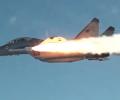
The Directors General of Military Operations of India and Pakistan firmed up the arrangement on stopping military actions on May 10 after four days of fierce offensives between the two sides that triggered fears of a wider conflict.
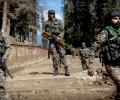
China hopes both sides will remain restrained, move toward each other, and work together to de-escalate the situation.
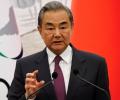
China on Tuesday called for a 'comprehensive and lasting ceasefire' between India and Pakistan, urging both countries to properly handle their differences through dialogue.
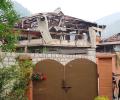
Army spokesman Lt Gen Ahmad Sharif Chaudhry in a media interaction said at least 26 people were killed and 46 injured in the missile strikes on cities in Punjab and PoK. "The six locations that India attacked last night... Pakistan lost 26 people and 46 were injured," he said.
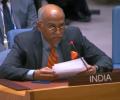
India's Permanent Representative to the UN, Ambassador Parvathaneni Harish, has sharply criticized Pakistan, calling it the "global epicenter of terrorism" and accusing it of providing state support to cross-border terrorism. Harish's remarks came in response to Pakistan's Deputy Prime Minister and Minister of Foreign Affairs Mohammed Ishaq Dar's comments on Jammu and Kashmir during a UN Security Council meeting. India highlighted that Pakistan harbors over 20 UN-listed terrorist entities and has a history of supporting groups like Jaish-e-Mohammed and Harkat Ul Mujahidin. India also emphasized that Jammu and Kashmir is an integral part of India and that Pakistan's misinformation campaign does not change the reality on the ground.
It is important for India to pay close attention to both the tone and substance of authoritative remarks coming out of Pakistan, explains former foreign secretary Shyam Saran.
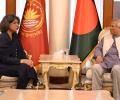
Bangladesh has demanded a public apology and compensation from Pakistan for the 1971 atrocities, raising "historically unresolved issues" during the first foreign secretary-level talks between the two countries in 15 years. Dhaka also asked Islamabad to pay USD 4.3 billion as its share from the combined assets at the time of East Pakistan's split from West Pakistan in 1971 to form an independent Bangladesh.
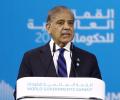
Prime Minister Shehbaz Sharif thanked US President Donald Trump for acknowledging Pakistan's role in counter-terrorism efforts after the country arrested a wanted terrorist. Trump thanked the Pakistani government for helping arrest "Mohammad Shareefullah", also known as Jafar, who supported and conducted activities on behalf of ISIS-K in support of multiple lethal attacks, including the Abbey Gate attack in 2021. Sharif said the terrorist, an Afghan national, had been apprehended in an operation along the border with Afghanistan.

'Fears in Washington began to intensify when it was realised that subsequent Pakistani and Indian attacks on major military facilities -- which were significant in terms of geographic scope and intensity -- could rapidly take both sides to where neither actually wanted to go.' 'The US objective was to stop the fighting as soon as possible. Everything else was secondary.'

Chinese Ambassador to Pakistan Jiang Zaidong urged that the government should launch a crackdown against all anti-China terrorist groups after two deadly attacks took place in Pakistan within only six months, The Express Tribune reported.
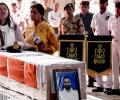
'If Pakistan's army wants to escalate violence in Kashmir, they have an unlimited supply of jihadis they can train and send. That's not an issue for them.'

It is the first time in nearly nine years that India's foreign minister travelled to Pakistan even as the ties between the two neighbours remained tense over the Kashmir issue and cross-border terrorism emanating from Pakistan.

It will be for the first time in nearly nine years India's external affairs minister will travel to Pakistan even as the ties between the two neighbours remained frosty over the Kashmir issue and cross-border terrorism emanating from Pakistan.
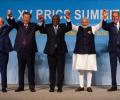
Dar also said Pakistan views Russia as an important player in the West, South and Central Asia, and strengthening mutually beneficial cooperation with Russia remains an important priority for Pakistan's foreign policy.

The brief exchange and handshake between Jaishankar and Sharif took place at a banquet dinner hosted by the Pakistani prime minister at his residence in honour of the delegates attending a summit of the Shanghai Cooperation Organisation.
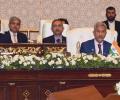
Delivering a thinly veiled message to Pakistan from its soil, External Affairs Minister S Jaishankar on Wednesday said activities across borders characterised by the 'three evils' of terrorism, extremism and separatism are unlikely to encourage trade, energy flows and connectivity.
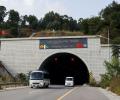
Pakistan's deputy Prime Minister and Foreign Minister Ishaq Dar, who is in China on a four-day visit, and Chinese Foreign Minister Wang Yi co-chaired the fifth round of the foreign minister-level China-Pakistan Strategic Dialogue.

Several candidates, including Taranjit Singh Sandhu, the BJP's Amritsar candidate, are promising resumption of India-Pakistan trade via the Attari-Wagah land route.
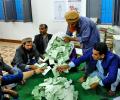
The PML-N, however, rejected the demand and claimed that it was winning Thursday's elections.
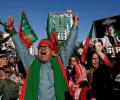
There was no progress in the formation of a new coalition government in Pakistan on Tuesday as top leaders of the Pakistan Muslim League-Nawaz (PML-N) and the Pakistan Peoples Party (PPP) failed to agree on a power-sharing deal in their latest round of talks, indicating deepening fissures in the country's political landscape.
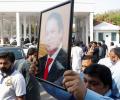
Pakistan's former prime minister Nawaz Sharif is set to arrive in Islamabad on Saturday after a four-year self-imposed exile in the United Kingdom, months ahead of general elections.

Sharif, the three-time former premier, said that there is a need for all the political parties to sit together and form a government to pull Pakistan out of its difficulties.

In a breakthrough that could end the political uncertainty in Pakistan, the Pakistan Muslim League-Nawaz and the Pakistan Peoples Party have agreed on a power-sharing deal to form a new coalition government after intense negotiations following a fractured poll verdict.
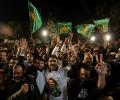
The result is a big blow to the military establishment, revealing the limits of 'political engineering'. It reflected the anger of the electorate, especially its younger voters, who have spoken decisively against the persistent harassment and victimisation of Imran Khan's political party, asserts Rana Banerji, who headed the Pakistan desk at RA&W.

Jailed ex-Pakistan premier Imran Khan's party-backed independent candidates on Friday sprang a surprise by winning 86 seats out of the 201 results declared following unusual delays and allegations of rigging, as the country appeared heading towards a hung assembly.

Latif claimed that 72-year-old Nawaz will face the cases as per the law and the Constitution, reiterating that PML-N believes in court and will accept its verdict.

Finance Minister Ishaq Dar, who presented the budget in the National Assembly, the lower house of parliament, said the government will target a growth rate of 3.5 per cent in the coming fiscal year.

Pakistan has raised a 25,000-strong special force and put in place extensive measures to protect and manage its strategic assets, including its nuclear arsenal, Finance Minister Ishaq Dar has said.

Pakistan Muslim League-Nawaz president and Leader of Opposition in National Assembly Shehbaz Sharif, 70, who is the Opposition's candidate for the new prime minister, will announce his possible government priorities after taking the oath.
Opposition parties allege the visit was aimed at 'capping' the country's nuclear programme ahead of President Musharraf's visit to the US.

Misbah-ul-Haq's misfortunes with the Federal Board of Revenue and Taxation continued when his SUV vehicle was confiscated by authorities for non payment of taxes and duty.

When Pakistan Prime Minister Nawaz Sharif was meeting his Indian counterpart for ice-breaking talks in Russia, back home his confidante and Finance Minister Ishaq Dar warned India of a "befitting response" in case of any aggression.

At the meeting the Sharif said that all concerned ministries should ensure 'seamless coordination' to ensure steady supply of petrol in all parts of the country.

Cash-strapped Pakistan on Tuesday moved closer to securing a massive $11 billion economic bailout package from international donor agencies including the IMF, to revive the ailing national economy.

If General Asim Munir, Pakistan's new army chief, wants to help defuse the current polarised atmosphere and shepherd civilian politicians towards negotiations on an acceptable date for elections, he may need to distance himself from any perception of needless hostility to Imran Khan, explains Rana Banerji, who headed the Pakistan desk at RA&W, India's external intelligence agency.
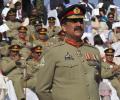
Sharif's younger brother and Punjab Chief Minister Shahbaz Sharif, Interior Minister Chaudhry Nisar Ali Khan and Finance Minister Ishaq Dar met army chief on Thursday evening.

According to Pakistani media reports, other names that have been doing rounds are for interim prime minister are: National Assembly Speaker Sardar Ayaz Sadiq and Petroleum Minister Shahid Khaqan Abbasi.

Pakistan should not buy electricity from India, Jamaat-ud-Dawah chief Hafiz Saeed has told the government, days after Prime Minister Nawaz Sharif directed his power minister to visit India to address the severe energy crisis facing the country.

Pakistan has briefed the United States on the progress it made during military operations against terrorists in North Waziristan costing $1.3 billion (Rs 8080 crore) and sought America's help in defraying part of it.
 © 2026 Rediff.com - Investor Information - Advertise with us - Disclaimer - Privacy Policy - Sitemap - Feedback - About us - Terms of use - Grievances