
An e-mail, purportedly sent by the Indian Mujahideen, has threatened to kill senior Bharatiya Janata Party leader L K Advani during his visit to Shillong on September 29.
'Generally people say the terrorists come from madrasas or slums. But that is not the case. Those who have been recently nabbed, they had very good schooling in towns of India and there are some technocrats and IT-savvy people. By and large women are generally not found in the modules, or in planting or making of bombs'
Khamruddin Nagori was arrested in Indore along with his brother Safdar Nagori and 8 others earlier this year. Nagori's brother, during his interrogation, revealed details on how arms, ammunition and funds are transported into India from Pakistan.

Yasin Bhatkal, the arrested Indian Mujahideen founder who has been taken to New Delhi for questioning, has admitted to his role in almost all blasts barring the Bodh Gaya incident which took place last month.
Cricket Australia (CA) officials will review security arrangements of India ahead of their four-test tour following a series of bombings in New Delhi on Saturday.
Prime Minister Manmohan Singh on Saturday strongly condemned the serial blasts in the national capital and appealed to the people to maintain calm
Abdul Sattar, a resident of Malappuram in Kerala who was arrested by the Hyderabad police for alleged links with the Indian Mujahideen, was on Wednesday handed over to the Bangalore police for questioning in connection with the bomb blasts there.
The special Maharashtra Control of Organised Crime Act court on Friday extended the judicial custody of the 21 alleged members of the terror group Indian Mujahideen till January 30. Bagwaan has been accused of allegedly training the other IM members on how to administer sedatives on persons they were planning to kidnap.
Why do the security agencies wait till the proverbial last minute before arresting terrorists when there is credible information about a threat to the elections?
Mumbai Police found itself in an embarrassing situation when it again sought the remand of Indian Mujahideen (IM) terrorists, who are suspects in serial blasts in the country, in connection with the 26/11 probe on terror strikes only to withdraw the plea after admitting it was an error. The Mumbai police retracted since it had previously made a remand application on December 15 last to investigate if the IM terrorists had any links with those behind the Mumbai terror attacks.
Pronouncing the sentence, Judge T Srinivasa Rao described the case as the "rarest of the rare".
Even as the hunt for Riyaz Bhatkal, who is said to have co-founded the Indian Mujahideen continues, two of his accomplices have revealed that the dreaded terrorist wanted 1,000 people dead in every bomb blast that occurred in the country.
The Delhi police has announced a reward of Rs one lakh each for anyone who can help in nabbing the 13 absconding Indian Mujahideen terrorists -- allegedly involved in the serial blasts -- that rocked the national capital on September 13 this year.The reward, which was announced by Delhi Police Commissioner Y S Dadwal, will hold for a period of one year. Five explosions rocked the city on September 13, killing 26 people.
A petition challenging the tribunal's verdict was mentioned before the bench headed by Chief Justice K G Balakrishnan, which agreed with the Centre seeking a grant of interim stay. The apex court issued a notice to the SIMI and posted the matter for hearing after three weeks.
.jpg)
The Intelligence Bureau has issued a grade A alert stating that all airports in the country are under a terror threat.
Intelligence Bureau officials say the Mumbai terror attacks were the handiwork of the Pakistan-based Lashkar-e-Tayiba in association with some 'home-grown terrorist groups' from India.
Another terror attack and another new outfit. An unheard of outfit called as the Deccan Mujahideen has claimed responsibility for the deadly attacks in Mumbai. The IB however does not rule out groups like the SIMI or its version 2 the Indian Mujahideen to be operating in another name. The modus operandi is very similar to what the SIMI had done earlier. When the heat was stepped up on the outfit, it had revamped into the Indian Mujahideen.

A new organisation called the Indian Mujahideen claimed responsibility thus trying to divert the investigators. However, investigations revealed that it was the HuJI, which had carried out this attack in retaliation to the cases that were being tried against their men in the courts of the state.
The narco analysis test conducted on Mohammad Sami, a close aide of Subhan indicates that the police would have had Subhan in their net had they delayed Sami's arrest by two days. Sami, who was picked up by the Karnataka police in the third week of September in connection with the Bangalore serial blasts, was subject to a narco analysis test last week.
In a major breakthrough, the Uttar Pradesh police have taken into custody a cyber cafe owner at Sahibabad in Ghazaibad district of the National Capital region (NCR) from where the e-mail claiming the responsibility for Tuesday's serial blasts in Jaipur was sent by the militant outfit Indian Mujahideen. The Ghaziabad police confirmed the news of taking Madhukhar Mishra and his son into custody for interrogation.
Riaz Bhatkal, a key operative of the IM who was in charge of funding terror activities, has reportedly left for Dubai, according to sources in the Intelligence Bureau. Riaz, who is originally a resident of Bhatkal in Karnataka, was one of the main agents of the Lashkar-e-Tayiba in India before taking active part in the operations of the IM.
Sami, who is the first person to be arrested in connection with the Bengaluru serial blasts case, is presently being interrogated for his role in the blasts and also regarding his close association with Abdus Subhan, who the police term as the mastermind behind the Indian Mujahideen.
Making the revelation in press conference called in Mumbai to announce the arrest of five persons in connection with the Ahmedabad blasts, Joint Commissioner of Police (Crime) Rakesh Maria said, "Three of the accused had gone to Pakistan to undergo training, which was allegedly supported by the Lashkar-e-Tayiba and Harkat-ul-Jihad-al-Islami."
With the arrest of three more terrorists of the Indian Mujahideen allegedly involved in the serial blasts in Delhi, the Delhi police on Sunday claimed that the terror module was planning to explode at least 20 bombs in several places in the national capital, including Nehru Place.
Three more suspected terrorists allegedly involved in the New Delhi serial blasts, have been arrested, taking the number of those caught in the terror attack to five, the police said on Sunday
Two Indian Mujahideen terrorists allegedly involved in the Delhi and other recent serial blasts were on Friday killed in a fierce encounter in South Delhi that left two Delhi Police Special Cell personnel injured, one of whom is said to be in a "critical" condition.
An intercept picked up by the Intelligence Bureau suggests that Subhan, whose code name is Kasim, had crossed over into PoK via Nepal after the serial blasts in New Delhi.
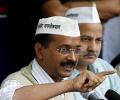
Does Delhi Chief Minister Arvind Kejriwal really face a terror threat?
The return of terror after a gap of three years and a gunfight with suspected Indian Mujahideen terrorists in which an encounter specialist lost his life sent shivers in the capital. If one goes by figures provided by Delhi Police, the year also witnessed a decline of 12.78 per cent in crime rate in the city, which saw the murder of a TV journalist, elimination of the leader of the dreaded Bikers' Gang Bunty and the murder of another encounter specialist Rajbir Singh.

A call to the Alipore jail from Karachi last year is not something that can be taken lightly. After all, the call was made by one Jawed Baluchi to key Lashkar-e-Tayiba operative Aftab Ansari, who is serving a life sentence without remission in the 2002 American consulate attack case. Vicky Nanjappa reports
While the security agencies were grappling with the e-mail of Indian Mujahideen, some media houses have been busy in receiving emails warning of more bomb explosions in various parts of the country.
"We have raided the house in Gunia buildings and further investigations are presently on. We are verifying the personal details of the individual living there," a senior officer with the ATS told PTI.
The Indianised jihad is presently targeted against the BJP, but it could turn against the American and Israeli presence in India in due course.

The Al Qaeda and other terror groups are obsessively meticulous about accounting. Leave alone guns and explosives, they keep an account of every penny spent -- even on a bar of soap, a light bulb or spaghetti.
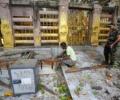
It might have taken several years, but the intelligence and security agencies in several states recently tracked down and arrested dreaded terrorists involved in creating havoc in the country. It began with the arrest of Zabbiuddin Ansari, an accused in the 2008 Mumbai terror attacks, then came the arrest of Indian Mujahideen co-founder Yasin Bhatkal followed by Lashkar-e-Tayiba bomb maker Abdul Karim Tunda, Zaveri Bazaar bomber Waqas Ahmed and now IM chief Tehsin Akthar. In a five-part series, Rediff.com's Vicky Nanjappa describes how each of these terrorists were painstakingly tracked by the Intelligence Bureau and arrested by the security agencies.

The Special Task Force of Uttar Pradesh police has arrested an active member of the Munir gang wanted in the murder case of National Investigation Agency officer Tanzil Ahmed.

The funds were allegedly raised by an operative from Ranchi named Uzair Ahmed.

Statistics show the failure of the Bihar government in acting against Naxals in the state who are able to set up bases without much difficulty. Vicky Nanjappa reports
Although the role of Shahid Bilal is not ruled out in the Uttar Pradesh blasts, the police say that the serial blasts were conducted under the supervision of Sabah Hijaji, another commander of the HuJI.
The investigators hunting for leads in the Chennai blasts case say they are certain that a member of the banned outfit Al-Ummah executed the attack.
