
In Professor Sulochana Gadgil's passing, India has lost a scientific giant, a fierce intellect, and a compassionate soul, remembers Dr Madhavan Nair Rajeevan.

The India Meteorological Department (IMD) has predicted above-normal rainfall for the upcoming monsoon season in India (June to September). The cumulative rainfall is estimated to be 105 percent of the long-period average. The IMD has also ruled out the possibility of El Nino conditions during the entire season. The monsoon is crucial for India's agriculture sector, which supports the livelihood of a significant portion of the population and contributes substantially to the country's GDP. However, while the prediction of normal rainfall brings relief, climate change is expected to cause variations in rainfall distribution.

Skymet expects a good monsoon over western and southern India.

'The global climate system doesn't look at where the carbon dioxide is coming from. 'It may be emitted by the US, but it will not remain above the US alone but covers the whole world.'

The monsoons are no picnic. Try to laugh in the rain.


The IMD said that rainfall over India in August and September would be around 106 percent of the long-period average of 422.8 mm.

Mongolia can take a lifetime to happen but rewards the intrepid traveller with enduring memories of a surreal, delightful land.

The method is based on a network analysis of regional weather data.

India is likely to see above-normal rainfall in the four-month monsoon season (June to September) with cumulative rainfall rainfall estimated at 106 percent of the long-period average (87 cm), he said.

Data spanning the years 1951 to 2014 show that temperature and pressure conditions at specific locations in the Arctic region during the pre-monsoon period correlate with the Indian summer monsoon rainfall, points out Charu Bahri.

Officials are tight-lipped on the exact menu but it is expected to reflect India's culinary diversity.

India is likely to experience below-normal monsoon rainfall this year, with a 20 per cent chance of drought due to the end of La Nina conditions and the potential for El Nino to take hold, private forecasting agency Skymet Weather said on Monday.

The El Nino impact on the Indian monsoon typically manifests by way of extended break in rainfall.

India's leading commodity exchange, National Commodity and Derivatives Exchange (NCDEX), and private weather forecasting company Skymet took a significant step towards launching the country's first tradeable weather index on Monday (August 14) by entering into an agreement to deepen their understanding of the impact that weather has on agricultural commodities. The memorandum of understanding (MoU) between NCDEX and Skymet is a profound step in the direction of linking farmers with the weather in a scientific way, according to an official statement. Sources indicate that NCDEX and Skymet will conduct workshops and seminars across the country to educate farmers about how they can scientifically use weather forecasts to hedge risks.

Above-normal heatwave days are predicted in most parts of central, east and northwest India during this period.

The southwest monsoon season concluded on Saturday with India receiving 'below-average' cumulative rainfall -- 820 mm compared to the long-period average of 868.6 mm -- in an El Nino year.

The southwest monsoon has started on a weak note and this has delayed the sowing of kharif crops. Though a cause for concern, the situation hasn't reached a stage where it warrants any panic response. Moreover, according to meteorologists and industry players, monsoon rains will witness a revival in the coming few weeks.

The arrival of the wet season that is crucial to farmers in India.

Less-than-expected rainfall and a poor spatial distribution, experts say, can rekindle fears of a rise in food and fuel inflation that can have an impact on the RBI's monetary policy. The fear of less than optimal rainfall due to El Nino this year, analysts believe, is the biggest short-term risk for the markets, which they said has not been fully priced in yet by them. Monsoon set over Kerala on June 08, a week later than its scheduled date.
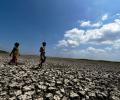
The onset of the southwest monsoon is being keenly watched this year as it may provide an early sign regarding its progress over the Indian subcontinent, particularly when El Nio is expected to rear its head during the latter half of the season.

India's economy continues to be robust, but downside risks such as rising crude oil prices, adverse weather conditions, and the global banking crisis outweigh the upside potential in gross domestic product (GDP) growth in the current financial year (FY24), the finance ministry said on Tuesday in its Monthly Economic Review for March. "We reiterate that downside risks to our official forecast of 6.5 per cent for real GDP growth in FY24 dominate upside risks," the review said. "Opec's surprise production cut has seen oil prices rise in April, off their lows of low-seventies per barrel in March.
The country can expect normal rainfall during the southwest monsoon season as a positive Indian Ocean Dipole (IOD) and a lower snow cover over the northern hemisphere are likely to counter the evolving El Nino conditions, the India meteorological department (IMD) said on Tuesday.
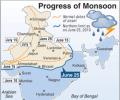
Progress of the Great Indian Monsoon
Several global models are predicting El Nio to appear around the second half of the year, which are the crucial rain-bearing months.

There is increased risk for agriculture in India from the monsoon after drought ravaged the country in 2002, forecast the Summer Outlook report of Salomon Smith Barney made available Monday.

Climate change has hampered the ability of the forecasting agencies to accurately predict severe events and weather bureaus across the world are focusing on augmenting the observational network density and the weather prediction modelling to improve predictability, India Meteorological Department (IMD) Director General Mrutyunjay Mohapatra has said.

Some of the easily digestible spices during monsoon are garlic, asafetida, pepper, ginger, turmeric, cumin and coriander. They also provide excellent nutrition.

In another forecast for August, IMD Director General Mrutunjay Mohapatra said monsoon is also likely to be normal in the month.

The IMD DG said there should not be an impression that climate change leads to rise in the temperature, but on the contrary, it leads to erratic weather.
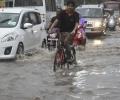
The southwest monsoon over the country is likely to be normal in July, the India Meteorological Department (IMD) said on Thursday in its forecast for the month.

The southwest monsoon is likely to arrive over Kerala on May 31, a day earlier than its normal onset date, the India Meteorological Department (IMD) said.

Mohapatra said there is a 40 per cent chance of a normal rainfall, 22 per cent above normal, 12 per cent excess and 18 per cent below normal.
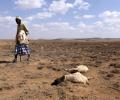
Weather watchers said it can't be known till May whether El Nio will impact the monsoon or not.

The Indian monsoon lifeline of the subcontinent - will be significantly affected by climate change, according to a Greenpeace paper titled 'Monsoon Wager: Climate change and the Indian Monsoon', released on the sidelines of the World Environment Day earlier this month.
India will receive normal monsoon this season, country's meteorological department said on Wednesday in its forecast for the Southwest monsoon that covers 75 per cent of the country, and thereby may bring much-needed respite to the economy, which is reeling under the catastrophic effect of the Covid-19 pandemic.
We should be prepared for any impact of the dreaded weather pattern.

The graphic above shows the number of heat wave deaths in India each year since 1967.

'Temperature and wind can be predicted more easily than rainfall.' 'Rainfall, as common experience suggests, is very spotty.' 'The last bit of physics required that tells us whether it is going to rain or not is very hard.' Professor Roddam Narasimha, the eminent scientist, explains the monsoon, climate change and global warming, in a fascinating conversation with Shivanand Kanavi.
El Nino, an anomalous rise in sea surface temperature off the Peru coast, has been observed to often cause the Indian monsoon to flounder, resulting in poor rainfall. Nearly 60 per cent of agricultural land is wholly rain-dependent.
 © 2026 Rediff.com - Investor Information - Advertise with us - Disclaimer - Privacy Policy - Sitemap - Feedback - About us - Terms of use - Grievances