
Close on the heels of a highly successful Indo-US Strategic Dialogue in early June, as many as five Union ministers are scheduled to visit US next week to hold series of talks with their American counterparts.
In an exclusive interview to Rediff.com, US Assistant Secretary of State Robert O Blake speaks about President Obama's trip to India, the recent US-India Strategic Dialogue and the fate of the nuclear liability bill.
The post-mortem on the United States-India Strategic Dialogue co-chaired by US Secretary of State Hillary Clinton and External Affairs Minister S M Krishna -- which also had the icing on the cake of President Barack Obama attending and delivering remarks at Clinton's reception for Krishna and the Indian delegation at the conclusion of the talks, where he pledged his unequivocal commitment to further US-India ties -- in the eyes of South Asia experts in Washington, DC, was mix
Perhaps to quash the persistent criticism that his administration is not as gung-ho about the US-India relationship as was his predecessor W Bush, President Obama will attend and deliver remarks at Secretary of State Hillary Clinton's reception June 3 at the State Department, in honor of the Indian delegation at the US-India Strategic Dialogue.
When External Affairs Minister S M Krishna underscored the folly of making a distinction 'between good Taliban and bad Taliban' at the Afghanistan Conference in London earlier this year, he was completely out of sync with the larger mood at the conference. As a result, Indian diplomacy faced a major setback when Indian concerns were summarily ignored.

India is committed to further developing friendly and cooperative relations with China, says Parrikar in Beijing.
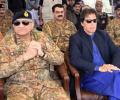
'Any conventional conflict could trigger a nuclear war with results that neither India nor Pakistan could survive easily.' >A revealing excerpt from Shuja Nawaz's The Battle For Pakistan: The Bitter US Friendship And A Tough Neighbourhood.
The Obama administration's point man for South Asia, Assistant Secretary of State Robert Blake has assured that there will be deliverables from the first US-India Strategic Dialogue that will be held in Washington, DC, on June 2-3.
Rahul Bedi, who has been writing relentlessly on India's strategic and defence related issues, thinks this year will cement India-United States defence ties like never before. New Delhi-based Bedi is a correspondent for the prestigious Jane's Defence Weekly spoke to rediff.com's Sheela Bhatt.
Prime Minister Manmohan Singh on Wednesday said India was fully committed to further promoting relations with China in an "all-round manner".
The decision by the US Commission on International Religious Freedom to place India on its 'Watch List,' for what it said was "the government's largely inadequate response to protecting religious minorities," will not impact in any way on the growing US-India strategic partnership, Assistant Secretary of State for South and Central Asia Robert Blake has said.
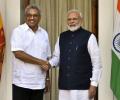
New Delhi is approaching Gota with an open mind, observes N Sathiya Moorthy.

'This is a historic juncture when the US is in great need of an alliance with India to strengthen its hands in the fierce struggle with China in the Asian theatre,' points out Ambassador M K Bhadrakumar.
The paper "India's Strategic Defense Transformation: Expanding Global Relationship" by Brian Hedrick of Strategic Studies Institute of US Army Department of Defense, was released oN Wednesday, takes a global view of India's rise as a regional and future global military power.

The Advanced Systems Laboratory (ASL) in Hyderabad, which develops India's strategic (long-range, nuclear-tipped) missiles, has dramatically increased the options for its forthcoming Agni-5 missile by making it highly road-mobile, or easily transportable by road.

'Any fear or apprehension that this dialogue is aimed towards China, that is mistaken.'
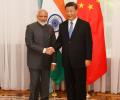
'The fact that Modi and Xi exuded confidence to accelerate the negotiations for a border settlement alone underscores that the Russia-India-China triangle has become very dynamic,' notes Ambassador M K Bhadrakumar.

"It would be my hope that people understand why this particular transaction is important for us," the EAM said in Washington, DC.

The Chinese media has accused India of using the Dalai Lama card to deal with China's growing economic and political influence in South Asia and warned New Delhi of "severe consequences" if it hosted the Tibetan spiritual leader in a "disputed" area in Arunachal Pradesh.

'The unresolved problems with Pakistan are a bit of a drag on its other international ambitions,' Teresita C Schaffer, director of the South Asia programme at the Centre for Strategic and International Studies, a Washington, DC, think-tank and former US diplomat, tells Aziz Haniffa.
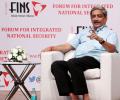
Former NSA Shivshankar Menon said the defence minister did not have a right to voice his personal opinion on nuclear policy in public, particularly when that opinion contradicted the country's official policy.

'Two powerful men shaking hands with two powerful women as equals. This photograph made me very happy,' says Aakar Patel.
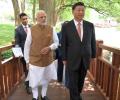
There is a sense of relief in Beijing that Modi will be at the helm of affairs in Delhi at a critical juncture in the geopolitics of the region, says Ambassador M K Bhadrakumar.
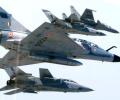
'For Pakistan, the comfortable old calculations and certainties are no longer valid.' 'Strikes on Indian targets now carry a high risk of retaliation and escalation,' notes Ajai Shukla.
Addressing the Congress working committee meeting in New Delhi, Gandhi said it was "imperative for us to debunk the false propaganda being spread by the BJP, the Left parties and other political opponents."
Perpaps to clear the air on the Indo-US nuclear deal, Prime Minister Manmohan Singh on Tuesday said the safeguards agreement with IAEA will not impinge on India's strategic programme.
Bharatiya Janata Party's prime ministerial candidate L K Advani on Saturday reportedly told United States Secretary of State Condoleezza Rice that his party wanted best of relations with the US, but opposed the nuclear deal after the Hyde Act was passed, as it closed India's strategic options."Advani told Rice that the BJP developed strong objections to this present treaty only after the Hyde Act was passed because we believe that it impairs our nuclear programme.

India on Thursday successfully test-fired its indigenously developed nuclear capable Prithvi-II surface-to-surface missile with a strike range of 350 km as part of a user trial by the army from a test range at Chandipur in Odisha.

Ahead of next month's annual Indo-Russia summit, Prime Minister Narendra Modi on Thursday met Russian Premier Dmitry Medvedev who said India is a "close and valued" partner for his country.
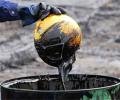
The Indian desire to deepen its ties with Vietnam, especially in the oil sector, besides defence and trade, was conveyed to the top leadership in Hanoi by External Affairs Minister Sushma Swaraj.
"Yes, there is truth in what you say," Rajnath Singh said when asked if the government was soft on China owing to support extended to it by the Left parties. "A complacent UPA is helping China's strategic expansion," the BJP president told reporters. "The manner in which the UPA government is busy placating China, it has put our strategic interests in jeopardy," he said.

Since 2016, when India was officially recognised in US law as a 'major defence partner', Washington has purposefully upgraded the defence relationship.

Days before Narendra Modi arrives in the US to speak at the UN, meet Barack Obama, gupshup with the likes of Nadella, Pichai, Zuckerberg, and address desis in Silicon Valley, his ministers will help set the commercial and strategic tone for the prime minister's visit.
"One of the reasons we give aid and platform and radar and things like that is to make sure that we are the dominant powers in the Indian Ocean Region," Union Minister of State for Defence, M M Pallam Raju told reporters in Begaluru.
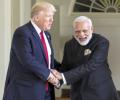
'The biggest challenge Swaraj and Sitharaman will face is how far they can take their counterparts Pompeo and Mattis seriously.' 'One just doesn't know how long they will even keep their jobs.' 'They are basically salesmen peddling American wares.' 'Actually, there is nothing like 'American policies' in the Trump era,' says Ambassador M K Bhadrakumar.

To mark Prime Minister Modi's seventh meeting with Obama and his historic joint address to US Congress -- the sixth Indian PM to do so -- India Abroad, the newspaper published from New York and owned by rediff.com, reached out to diplomats and strategic thinkers in New Delhi and Washington, DC, to assess the current state of the US-India relationship and suggest a road map for the future.

'India needs to be cautious that its differences with Pakistan do not obstruct SCO's functioning,' says Sana Hashmi.
"Some of the fears are exaggerated," and added, "some of the training turns out to be sort of cadet level. Some exchanges don't lead to a lot. I think we just need to have a realistic sense of what this is," Boucher added.
"The Left parties are basically anti-US and therefore countries that are seen as allies of Washington are disliked by them. They do not like whatever America does while we look at things on a case to case basis with regard to US," Swaraj, who is on a three-day visit to Israel as the chairperson of Indo-Israel Parliamentary Friendship Group, said, adding, "We are not anti-US in principle, but we oppose its policies which are against India's interest."
The United States has said that broad-based partnerships between America and India are critical and more important as compared to Pakistan, as New Delhi is growing as a potential power with global influence.
 © 2026 Rediff.com - Investor Information - Advertise with us - Disclaimer - Privacy Policy - Sitemap - Feedback - About us - Terms of use - Grievances