
A high degree of mistrust continues to strain the bilateral relationship between India and China, the Pentagon has informed the United States Congress. New Delhi remains concerned by China's close military ties with Pakistan and its growing footprint in the Indian Ocean, Central Asia and Africa, Pentagon said in its annual report.
'Border disputes cannot be solved by resorting to border conflicts. Only by mutual consensus, and a spirit of give-and-take, can we arrive at a long-lasting solution,' says Professor Wang Dehua, ahead of Prime Minister Manmohan Singh's visit to China next week.' Exclusive to Rediff.com
'My understanding is that by the time President Xi Jinping came for the Chennai summit [2019], he had already instructed his army to undertake the action in Galwan in the summer of 2020.'

In his conversation with Prime Minister Narendra Modi, President Xi Jinping stressed that improving China-India relations serves common interests and is conducive to peace and stability of the region and the world.
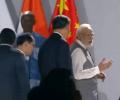
Prime Minister Narendra Modi conveyed to Chinese President Xi Jinping India's concerns on the "unresolved" issues along Line of Actual Control (LAC) in eastern Ladakh during a conversation on the sidelines of the BRICS summit, Foreign Secretary Vinay Mohan Kwatra said on Thursday.

India has not yet received any confirmation on Chinese President Xi Jinping's in-person participation at the upcoming G20 summit, people familiar with the matter said on Thursday amid reports that he is likely skip the conclave.
.jpg)
Prime Minister Narendra Modi in a conversation with Chinese journalists based in New Delhi on Tuesday said, "India and China are bound by history, connected by culture, and inspired by rich traditions. Together they can create a bright future for the entire mankind."
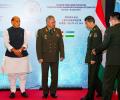
Singh conveyed to Li that India wants to improve relations with China but it can happen only after peace and tranquillity are restored at the border, the sources said.

Prime Minister Modi and President Xi held the conversation on Wednesday on the sidelines of the BRICS (Brazil, Russia, India, China, South Africa) summit in Johannesburg.

Chinese Foreign Minister Qin Gang will travel to India to attend the Shanghai Cooperation Organisation (SCO) foreign ministers' meeting being held in Goa on May 4 and 5, the foreign ministry in Beijing announced on Tuesday.

Defence Minister Rajnath Singh on Thursday held talks with his Chinese counterpart Li Shangfu and is learnt to have discussed the lingering border row in eastern Ladakh.

India and China made progress in five-six friction points along the Line of Actual Control in eastern Ladakh through talks in the last three years and efforts are underway to resolve the remaining issues, External Affairs Minister S Jaishankar said on Monday.

Raking up the border issue, Congress leader Rahul Gandhi on Friday said every individual in Ladakh knows that China has "taken away our land" and claimed that Prime Minister Narendra Modi's assertion that not an inch of land was taken away was "absolutely false".

On Pakistan, the publication quoted him as saying that India wants "normal and neighborly relations."

He said China has accrued significant capacities for force mobilisation, application, and sustenance of military operations and maintained the long-pending boundary issue can not be divorced from bilateral relations between the two Asian giants.

External Affairs Minister S Jaishankar is set to hold separate bilateral talks with his Chinese counterpart Qin Gang and Russia's Sergey Lavrov at a beach resort in Goa on Thursday on the sidelines of a conclave of the Shanghai Cooperation Organisation (SCO) amid rapidly evolving regional security situation.
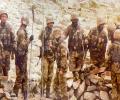
Jaishankar said China, in violation of the 1993 and 1996 agreements not to mass troops on the Line of Actual Control, chose to do so, and added that its attempt was obviously to unilaterally change the LAC.
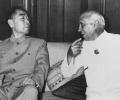
'The war of 1962 exposed the hollow intellectual foundations of Nehruvian foreign policy, especially vis-a-vis China and that is why it was such a shock.'

'Wang Yi said the border issue is important and we should stay committed to peacefully addressing it through consultation and coordination.'
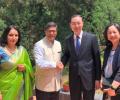
Sun Weidong is an expert on South Asia who worked closely with external affairs minister S Jaishankar.
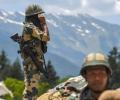
Gen Naravane said India is dealing with China in a "firm" and "non-escalatory" manner to ensure the sanctity of its claims in eastern Ladakh, and that it was even open to initiating confidence-building measures.
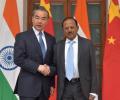
The two sides have already held 21 rounds of talks under the framework of SR dialogue which was set up to find an early solution to the border dispute.

Earlier, Modi met Jinping seperately and the two leaders concurred there had been a perceptible improvement in bilateral relations.
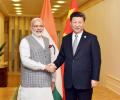
'At the informal summit, the two leaders will have heart-to-heart discussions on overarching issues and try to build mutual trust'

Against the backdrop of the standoff between Indian and Chinese troops in eastern Ladakh, the White House press secy said the United States was closely monitoring the current situation and supports its peaceful resolution.
Experts and observers of India-China ties have warned that the current war of words between the two countries could spin the traditional Asian rivalry out of control. "The most urgent present job for both sides is crisis management," the Christian Science Monitor quoted Han Hua, an expert on South Asia at Peking University, as saying. "I don't think either government wants the situation to go further downhill," he added.He said, "The structural problem is leadership."
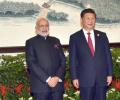
Prime Minister Narendra Modi and Chinese President Xi Jinping have agreed to make efforts to put India-China ties in the "right direction" and to "respect and accommodate" each other's concerns to avoid "impedance" relations, a top Chinese diplomat said on Tuesday.
India-China ties have developed rapidly and the exchanges of high-level visits have forcefully promoted bilateral ties and cooperation for mutual benefit, said Pranab Mukherjee. He met his Chinese counterpart Yang Jiechi over the weekend in New York.

The PM will meet Mongolian President Tsakhiagiin Elbegdorj on his first ever visit to the country.

The Summit will take bilateral relations to a higher level and have a major and positive impact on regional and world peace, stability and development, Sun said.
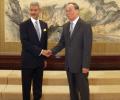
"Our relationship is so big that it is no longer a bilateral relationship. It has global dimensions," the report quoted Jaishankar as saying.

'How and if India retaliates will go a long way toward determining the trajectory of this crisis.'

'The Chinese made their point repeatedly after August 5. They backed Pakistan more overtly than in the past.' 'Kashmir is not completely off their radar. But in order to keep the atmosphere surrounding the Chennai meeting, they did not discuss Kashmir.'

The delegations were led by Brigadier JKS Virk from the Indian side and Senior Colonel Chen Zheng Shan from the Chinese side
'India will come increasingly in the US crosshairs if it insists on maintaining its strategic autonomy, warns Ambassador M K Bhadrakumar.
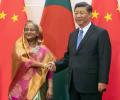
'Beijing is comfortable with Hasina's pragmatism -- perceived as 'pro-India', but staying out of Indian orbit and receptive to forging close ties with China and yet, siding with neither neighbour,' says Ambassador M K Bhadrakumar.

Pakistan's powerful Army Chief Gen Raheel Sharif's visit to Beijing comes in the backdrop of assertions by Pakistan that it will raise its concerns at the international level over India's successful test of supersonic interceptor missile.

The expulsion is likely to cloud India-China ties as Narendra Modi visits China for the G-20 Leaders Summit on September 4-5 and Xi Jinping is scheduled to be in Goa for the BRICS meeting on October 15-16.

India said a new mechanism will be set up for issues relating to trade and investment.
 © 2026 Rediff.com - Advertise with us - Disclaimer - Privacy Policy - Sitemap - Feedback - About us - Terms of use - Grievances