
The cold wave days in December too are expected to be 'below-normal' this year.

Former BCCI president Sourav Ganguly on Saturday expressed optimism about the Eden Gardens keeping its date with the 2025 IPL final

'Nobody asked us to work on this. It was on our own that we decided to embark on this journey.'

Wholesale price inflation dropped to 0.85 per cent in April as prices of food articles, manufactured products, and fuel eased, government data showed on Wednesday. WPI-based inflation was 2.05 per cent in March. It was 1.19 per cent in April last year.

The rainfall in July was minus seven per cent which comes to around 93 per cent of the Long Period Average, IMD Director General Mrutyunjay Mohapatra said.

The IMD said India did not experience any "break monsoon" conditions this year because of the large number of low-pressure systems.

Delhi is likely to receive the first monsoon showers on June 30 or July 1, India Meteorological Department (IMD) officials said on Tuesday.

The Met office had said Monday that significantly higher-than-normal temperatures may have an adverse impact on wheat and other crops.
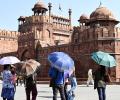
'The intensity and frequency of heatwaves will be much higher than in previous years over Punjab, Haryana, Rajasthan, Gujarat, Madhya Pradesh and Odisha.'

Trading sentiment in the equity market will largely be driven by domestic corporate quarterly earnings, any update related to US tariffs and foreign fund movements this week, analysts said. Investors would also focus on world market trends, movement of global oil benchmark Brent crude and the rupee-dollar trend for further cues, experts noted.
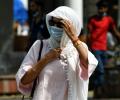
No part of northwest, central and east India is likely to record a heatwave over the next five days, the MeT office said.

Western disturbances are near Pakistan-Afghanistan and are moving towards Delhi and thunderstorms or dust storms are likely to be experienced in northwest India, senior scientist at IMD RK Jenamani told ANI.

Mumbai recorded its coldest day on Monday since December 24, 2015 with the temperature dipping to 13.7 degrees Celsius, an India Meteorological Department official said.

Overall automobile retail sales in India grew a modest 2.95 per cent in April this year to 22,87,952 units with completion of purchases by customers around Chaitra Navratri, Akshay Tritiya, Bengali New Year, Baisakhi and Vishu helping April end on a positive note, Federation of Automotive Dealers Associations said on Monday.

Residents of North India battle freezing conditions.

The southwest monsoon is expected to reach Kerala during the next two to three days, marking a sluggish start to the seasonal rains that are the lifeline of India's agri-based economy.

The Met Office has issued a yellow alert, warning of moderate rain which could cause more problems to the residents of Delhi.

States are mandated to develop and implement 'heat HAPs' for prevention of heat-induced diseases. But most do not go beyond standard advisory on heat prevention.

IMD has decided to increasingly use cutting-edge technology such as artificial intelligence (AI) and machine learning (ML) in forecasting, both to avoid such glitches and to counter the disruption of normal seasonal patterns as a result of climate change. It has formed various internal sub-groups of senior officials and meteorologists to decide on how best to use AI and ML in predicting cyclone intensity, and in making short-range weather forecasts (those valid for up to three hours) as well as long-range forecasts.

While there was a brief respite from the incessant downpour on Tuesday, collaborative efforts from the defence, national, and state disaster response forces took the lead in executing rescue and relief operations.

Climate scientists warn that climate change is intensifying heatwaves in India, with the cooling effects of La Nia potentially becoming less effective in a warmer future. The India Meteorological Department (IMD) predicts an early summer with above-normal temperatures and intense heatwave spells, following an unusually dry winter and the warmest February since 1901. Experts emphasize the role of human-caused climate change, along with natural climate drivers like El Nio and La Nia, in shaping weather patterns. While La Nia typically brings cooler temperatures, scientists suggest that under climate change, its ability to mitigate heatwaves may be diminished.

With rainfall and monsoons becoming highly unpredictable partly due to climate change and partly due to usual changes in weather patterns, it is such innovations by IMD which will help in planning better, reports Sanjeeb Mukherjee.

As Cyclone Dana barrels toward the coasts of Odisha, threatening to impact nearly half of the state's population, the government is racing against time to execute a massive evacuation plan aimed at relocating about 10 lakh people in several coastal districts to safety. In West Bengal, the cyclone is set to bring heavy rainfall in several southern West Bengal districts, including Kolkata, the India Meteorological Department (IMD) has said.

The Southwest Monsoon usually covers the entire country on July 8. The earlier normal date for the monsoon to cover the entire country was July 15.

The weather department said its latest model analysis had indicated that the moist easterly winds in the lower level from the Bay of Bengal would spread to northwest India, covering Punjab and Haryana by July 10, leading to the advancement of monsoon and an increase in rainfall activity over the region, including Delhi, from July 10 onwards.

A fresh spell of heatwave is likely to begin over northwest India from May 7 and over central India from May 8, the India meteorological department said on Thursday.

Manual horizontal digging will start soon in addition to the ongoing top-down drilling to rescue the 41 trapped workers in the Silkyara tunnel in Uttarkashi, the NDMA said on Monday.
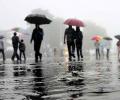
IMD Director General M Mohapatra said there is cyclonic circulation along the Karnataka coast which is hindering the progress of the southwest monsoon.
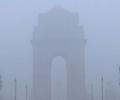
The India Meteorological Department (IMD) reported that very dense fog began forming around 5.30 am, resulting in a thick haze over different parts of the national capital.

Brace for some warmth this winter as the India Meteorological Department (IMD) in its December-February forecast on Thursday said that the minimum and maximum temperatures could remain 'normal' to 'above normal' over most parts of Northwest and Northeast India. Both the minimum and maximum will remain below normal in Southern Peninsular and Central India in these winter months. While this could give some respite from the intense cold of North India, it could have a negative impact on the standing rabi crops if the temperature rise is unusual and abnormal.

The mean maximum temperature for the month of March was 28.2 degrees Celsius in 2020 and 2019. It was 32.8 degrees Celsius in 2018; 30.7 degrees Celsius in 2017 and 31.5 degrees Celsius in 2016, according to the India Meteorological Department data.

Besides strengthening the IMD's infrastructure, Mohapatra said his priority will be to improve the dissemination of weather-related information -- from nowcasts to weather forecasts -- focus on sector-related forecast and give impact-based prediction in all areas.

After its late withdrawal from northwest India, the southwest monsoon remains active over some parts of the country.

Cyclonic storm Fengal has commenced making landfall close to Puducherry and it may approximately take 4 hours for it to cross the coast completely, an India Meteorological Department (IMD) official said. The process of the cyclone's landfall commenced at about 5.30 pm on November 30. The IMD said the forward sector of spiral bands associated with the cyclone has entered into the land and is likely to move west-southwestwards and cross north Tamil Nadu-Puducherry coasts between Karaikal and Mahabalipuram close to Puducherry as a cyclonic storm with a wind speed of 70-80 kmph gusting to 90 kmph during next 3 to 4 hours.

Skymet expects a good monsoon over western and southern India.

The landfall process of the severe cyclonic storm Dana was complete on Friday morning and the system took at least eight and half hours to enter the landmass, India Meteorological Department (IMD) said.

More than 150 express/passenger trains running through South Eastern Railway jurisdiction have been cancelled in view of the severe cyclonic storm, an SER official said.

The India Meteorological Department (IMD) on Friday predicted 'moderate to heavy rainfall' for Mumbai city and its suburbs and the possibility of 'very heavy to extremely heavy' showers at isolated places in the next 24 hours.

India recorded around 16 per cent more rainfall than normal in August, with rainfall over Northwest India recorded at 253.9 mm, the second highest in August since 2001, the India Meteorological Department (IMD) said on Saturday.

"We are expecting that the temperature will be higher than normal in the entire northwest India and the adjoining central India, starting with Gujarat, Rajasthan and up to east Madhya Pradesh and Chhattisgarh," he said at a virtual event on 'Building Climate Resilience for the Most Heat Vulnerable'.
