
Largecap equity funds remain suitable for conservative and moderate risk-taking investors seeking relatively stable returns.
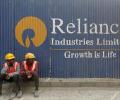
Billionaire Mukesh Ambani-led Reliance Industries on Monday sold 85 lakh shares of Asian Paints for Rs 1,876 crore through an open market transaction.

Passive funds appeal to investors seeking to avoid the risk of underperformance by the fund manager and minimise the need for frequent chopping and changing of funds.

'Increasingly, they treat gold as a financial asset in their portfolio rather than just as jewellery.'

'Investors should continue with their SIPs, especially during market corrections.' 'For those looking to start new SIPs, beginning with large-cap funds is a prudent strategy, followed by flexi-cap and value-oriented approaches.'

'They are ideal for short-term financial goals like children's education or a down payment for a house.' 'They are also useful for transitional savings, such as during job switches or while starting a business.'

Largecap companies are generally less vulnerable to economic slowdowns than their mid- and smallcap counterparts.

Business cycle funds aim to optimise returns by aligning their portfolios with different phases of the economic cycle. First-time investors, those who prefer stable sector allocations, and those averse to volatility should steer clear of them.

If you already hold significant amounts of equity in your portfolio, avoid MAAFs with over 60 per cent equity. But if you lack equity exposure, an aggressive MAAF may be appropriate.

'A long-term investor with a 4 to 5 year horizon could invest in this theme via SIPs.'

Despite the uncertainties created by rising bond yields and oil prices, fund managers have been proactively deploying fresh flows into the equity market. The cash available with equity fund managers, which has remained lower at around 5 per cent in the past few months, hit a 16-month low of 4.8 per cent in September, shows a Motilal Oswal Financial Services report. Cash holdings in equity schemes had topped 6 per cent in February amid subdued equity market sentiment.

'Investors should focus on largecap funds, flexicap funds, business cycle funds, or hybrid-category funds.'

Hospital chain Aster DM Healthcare's plans to sell its Gulf business may run into rough weather with voting advisory firm Institutional Investor Advisory Services (IiAS) raising concerns over the transaction. Recommending an 'against' vote on the resolution, IiAS has said there is no clarity on how Aster DM will utilise the proceeds that it will obtain by selling the unit, which contributes to bulk of its revenues. In November, Aster DM had announced its plans to sell its wholly-owned subsidiary Affinity Holdings, which conducts business in the Gulf Cooperation Council (GCC) region, to Alpha GCC for $1 billion.

Actively managed debt funds with the flexibility to go long on duration made a strong comeback on the returns chart in 2023, thanks to softening bond yields. The average one-year returns of floater, long-duration, gilt, and dynamic bond funds, which ranged between 2.3 per cent and 4.5 per cent at the end of 2022, now stand at over 7.2 per cent, with some schemes delivering over 8.5 per cent, according to data from Value Research. Debt fund returns are inversely related to yields of underlying investments, meaning a decline in yields is positive for funds.

An allocation to ESG theme funds can bring down the overall risk of an equity portfolio. Investors with long-term financial goals, such as retirement, should not ignore sustainable investing.

Following the sharp run in markets, valuations across the board have become elevated. The National Stock Exchange Nifty50 Index now trades at a 12-month trailing price-to-earnings (P/E) multiple of 24.3 times, 18 per cent higher than this year's low of 20.5 times. The valuation expansion in the broader markets has been sharper.

Since MAAFs invest across multiple asset classes, they offer diversification.

This product was first introduced by ICICI Prudential Mutual Fund (ICICI Prudential FMP Series 33) and Deutsche Mutual Fund in February. Recently, Birla Sun Life Mutual Fund has also floated a similar fund. The Nifty return, multiplied by the participation ratio (that is pre-decided by the fund) is the final returns. In Aviator, the participation ratio is 140-145 per cent, leading to returns of 43.14-44.5 per cent in our given example.

'The number of first-time investors into MFs can grow four times more than the current rate if we are able to accept the bank KYCs.'
Reliance Mutual Fund topped the AUM chart with its AUM in excess of Rs 660 billion, while ICICI Prudential Mutual Fund came second with an AUM of Rs 487 billion.
While investing in a low priced micro-SIP may seem like a good idea, one must read the fine print before jumping in.

Treat silver as part of the procyclical or growth assets in your portfolio, advises Sanjay Kumar Singh.

'Sector funds like IT funds should be included only in the satellite portfolio.' 'Limit your exposure to IT sector funds to around 5-10 per cent of your equity portfolio.'

Don't exit from growth-style funds as they may benefit next from a shift in investor preference.

Invest only if you wish to go overweight on the sector.

Over longer periods of three, five and 10 years, small-cap funds have rewarded their investors handsomely.

Mutual funds have launched a clutch of new fund offers in the silver ETF (exchange traded fund) category this year and collected Rs 1,400 crore in assets after the introduction of the newly-created investment asset class by market regulator Sebi in 2021. Further, fund houses including Kotak Asset Management Company have filed draft documents with the markets regulator to float silver ETF as well as silver ETF fund of funds for investors, information with the Securities and Exchange Board of India (Sebi) showed. These NFOs (new fund offers) are providing an opportunity to the investors to digitally invest and own silver which is easily tradable during market hours.

'Funds based on this theme offer socially conscious investors an option to invest in a portfolio that is aligned to their beliefs.'

One of the biggest advantages of index funds and ETFs is their low cost, points out Sarbajeet K Sen.

In 2021, there is the risk of interest rates spiking. Investors should tackle duration risk with a longer investment horizon, suggests Sanjay Kumar Singh.

Sebi had also ordered the fund house to compensate investors who had redeemed their units since the date of allotment of shares in the I-Sec IPO.

The BSE Sensex lost about 1,600 points, while the National Stock Exchange Nifty was down about 400 points.

While debt funds have emerged as the flavour of the season, not all investors understand debt funds. So the best they can do is put trust in the fund manager and the fund house.

Over 700,000 new investor accounts have been opened so far in FY15.

Investors with moderate risk profile and investment horizon of over three years could look at investing in balanced funds.

ICICI Prudential has tied up with the healthcare service provider to enable investors in its ICICI Prudential Savings Fund use the money seamlessly for medical purpose.

In 2015, foreign investors slowed net buying of Indian equities.

Equity fund managers say large-caps offer higher relative safety, especially in such times.

The KYC parameters now include declaration of the gross annual income or net worth.
 © 2026 Rediff.com - Investor Information - Advertise with us - Disclaimer - Privacy Policy - Sitemap - Feedback - About us - Terms of use - Grievances