
M Karunanidhi was a masterful practitioner of modern-day politics, wielding considerable influence beyond his own state, in the corridors of power in New Delhi, for a long time and sewing up alliances with both the Congress and the Bharatiya Janata Party.

'This was the worst phase yet in the state's human rights history.' 'Notorious interrogation centres were set up, large numbers died in firing on civilian mobs.' 'This is what today's generations might identify better as the Haider phase in Kashmir's history,' says Shekhar Gupta.

Even as the polity find ways and means to address the genuine concerns and fears of the society, the Sri Lankan State apparatus would have to unravel these mystery-questions with convincing answers, and a road-map to the future, says N Sathiya Moorthy.
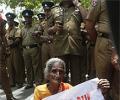
Prime Minister Manmohan Singh's decision not to attend the Commonwealth Heads of Government Meeting at Colombo has once again put the focus on alleged cases of human rights abuses in Sri Lanka.

Israel threatened to wipe out Hamas if current truce in Gaza collapsed as time ran out on Wednesday on the 72-hour ceasefire with no breakthrough in indirect talks between Israeli and Palestinian negotiators due to "significant disagreements".
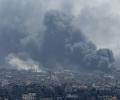
Eyebrows went north in India, especially in New Delhi where in the confusion some people criticized the United Nations Security Council (UNSC) which is based in New York. Chitra Subramaniam offers some perspective.

The fact that known terrorists like Hafiz Saeed and Syed Salahuddin have been able to hold huge rallies in Pakistan's main cities is a reflection of the state of affairs in Pak, said India.

'It will be foolhardy to overlook that this stunning shift in China's stance comes as the culmination of the severely damaged India-China relationship under the present government,' says Ambassador M K Bhadrakumar.

In the year since Modi cast the spotlight on Pakistan's human rights violations in Balochistan, India has not done much more than raise the issue at the UN a few times.

Saudi Arabia on Sunday came under attack globally a day after it carried out mass execution of 47 people, including Shia cleric Sheikh Nimr al-Nimr who was a vocal critic of the government and the Saudi monarchy.
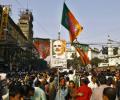
It has been said that by 2025, India could become among the top five economies in the world. If India does become a $5 trillion economy but gets all its rivers polluted, food chain poisoned and genetic pool depleted and biometric database of Indians sold or stolen at the behest of commercial czars, will it not be a pyrrhic economic victory, asks Gopal Krishna.

Commerce Minister Anand Sharma has a tough time in Davos pacifying African leaders, who are extremely upset over Delhi law minister's midnight raid. Anita Katyal reports

Atul Keshap, a senior Indian American career diplomat and one of the rising stars in the United States foreign service, has been picked by Nisha Desai Biswal, the newly appointed assistant secretary of state for South and Central Asian affairs, to be her deputy.

Bloodbath in Gaza continued unabated today with Israel and Hamas refusing to back down in the conflict that has killed over 660 Palestinians and 31 Israelis, even as US Secretary of State John Kerry said his ceasefire negotiations in Jerusalem were making progress.

'Previous governments in India had reservations about working with Israel.' 'Modi has shed this tag.' 'Disengaging itself from its traditional and ideological foreign policy approach in the Middle East shall serve India's long-term interests.' Rajaram Panda explains why the significance of Modi's visit to the Jewish nation goes beyond markers like the first-ever visit to Israel by an Indian PM and 25 years of diplomatic ties.
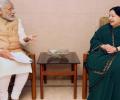
Narendra Modi's meeting with J Jayalalithaa in Chennai has set the rumour mills abuzz. Will the Tamil Nadu chief minister ally with the BJP ahead of the 2016 polls, asks N Sathiya Moorthy.

India has said the current crisis in Gaza can be resolved through a negotiated political settlement and dialogue remains the "only viable option" to effectively address issues confronting the region and its people.

One shocking finding of the investigation was the extent to which sexual violence was committed against detainees, often extremely brutally, by the Sri Lankan security forces, with men as likely to be victims as women.
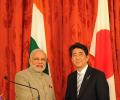
'Secretiveness and the element of surprise in announcing decisions marks the Modi style of diplomacy. From being a voluble politician, he became a reticent statesman... But the diplomatic dance is performed on thin ice and his adroitness is still to be proved,' says Ambassador T P Sreenivasan.

In a frontal attack on the Narendra Modi government, Congress President Sonia Gandhi on Wednesday said there has been an "alarming increase" in communal incidents since it came to power and asked party men to resist its "authoritarian and sectarian" tendencies.

Since the US and India broadly share similar interests in Sri Lanka, they should coordinate closely to ensure that the country preserves its democratic institutions, says Lisa Curtis

Do Modi's foreign visits actually serve India or they nothing more than expensive tools for domestic positioning and image-building, asks Shehzad Poonawalla.

Imagine being a part of a country, but being discriminated against by the majority community and atrocities being committed against you by the state. This is the deplorable conditions that the Rohingyas of Myanmar live in where they are cut off from their livelihoods and sources of income, unable to access markets, hospitals and schools, and have little or no access to relief aid. In order to understand the situation and the genesis of the tragedy unfolding, Rediff.com's Archana Masih speaks to Ambassador Vijay Nambiar, the United Nations' Chef de Cabinet (Chief of Staff), who had served a long stint with the UN in New York on the issue.

Abstaining from voting on a UNHRC resolution on Sri Lanka was dictated as much by necessity and self-preservation as by a desire to place bilateralism at the front and centre of New Delhi's ties with Colombo, says Ramesh Ramachandran.

'The path to a resolution of the ethnic conflict is likely to be complicated and controversial with the majority Sinhalese community, and will become less likely if delayed.' 'It will certainly give Rajapaksa fresh political oxygen with which to revive himself and rally the opposition.'

The Security Council as it is today is unable to bring peace and security in the world and so there is reason for countries like India to become members of the Council, Ambassador Asoke Kumar Mukerji tells Sheela Bhatt/Rediff.com.
 © 2026 Rediff.com - Investor Information - Advertise with us - Disclaimer - Privacy Policy - Sitemap - Feedback - About us - Terms of use - Grievances