
Laying the roadmap of the Narendra Modi government for its second term, President Ram Nath Kovind on Thursday said empowering every person is the main goal for a 'New India' by 2022 on the back of a "stronger mandate" for continuing uninterrupted the journey of development started in 2014.

A five-judge constitution bench headed by Chief Justice J S Khehar will decide if 'triple talaq' among Muslims is fundamental to the religion.

"Over a dozen Islamic countries such as Pakistan, Tunisia, Morocco, Iran and Egypt have regulated triple talaq. If Islamic countries can regulate the practice by enacting law, and it has not been found against sharia, then how can it be wrong in India, which is a secular country?" Prasad said.
While seeking response from former Union minister and senior advocate Kapil Sibal, representing AIMPLB, the bench said, "Don't infer anything from our side."
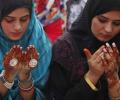
The group will not just seek permission for women to offer prayers in the mosques, but also fight for appointing them as 'imams' (clerics).
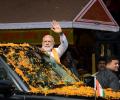
Making an intervention during the discussion on the motion for granting constitutional status to the national commission for backward classes, Modi highlighted that there are sections among Muslims, who are backward, adding that they should be included in the discussion over backward classes.

The judges in the minority verdict said that if the Centre does not bring a law within six months, then its injunction on triple talaq will continue.
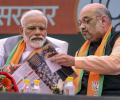
Rediff.com does a quick checklist on what the two manifestos have to say on hot-button issues of the day.

The panel suggested changes in laws relating to marriage, divorce, alimony, and marriageable age for men and women.
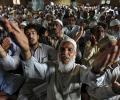
'The Ulema have come out as villains against Indian secularism, impeding the secular united resistance against violent Hindutva that is backed by ministers in the government,' says Mohammad Sajjad.

Along with the triple talaq matter, the Supreme Court will also hear cases related to Aadhaar and WhatsApp during the nearly 50-day summer vacation.

The apex court said 'we are not straightaway arriving at any conclusion' as there were 'very strong views' on both sides. It said it will also see if there was any error in previous judgements which dealt with the issue and decide whether it can be referred to a larger or a five-judge constitution bench.
The bench had made it clear that it would examine whether the practice of triple talaq among Muslims is fundamental to their religion.

'Electricity, better roads and uninterrupted water supply are problems for everyone in India, not Muslims alone.' 'Regional parties are solving these problems much better. And for that reason, Muslims favour regional parties.'

'We need to change the attitude of Muslims.' 'Muslim youngsters have to be taught not to misuse triple talaq.'

He said there is a fundamental distinction between religious practices, rituals and civil rights.

The board said that practices provided by Muslim Personal Law on the issues of marriage, divorce and maintenance were based on holy scripture Al-Quran and "courts cannot supplant its own interpretations over the text of scriptures".

"Crores of Muslim women had always demanded that triple talaq should be banned, as it is also banned in Islamic countries," he said.

When the bench asked Sibal 'shouldn't we hear the matter', he replied, 'Yes. You shouldn't.'
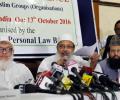
When the Muslim Personal Law Board promises 'advisories' and nikahnamas to the Supreme Court, one has to remember not only its recent campaign against any change in Muslim personal law, but also its past record of inaction on the question of triple talaq, says Jyoti Punwani.
