
The US has received sufficient number of applications needed to reach the Congressionally mandated 65,000 H1-B visa cap for the fiscal year 2023, the country's federal agency for immigration services said on Tuesday. The H-1B visa is a non-immigrant visa that allows US companies to employ foreign workers in speciality occupations that require theoretical or technical expertise. Technology companies depend on it to hire thousands of employees each year from countries like India and China.

The US President said that companies have to bring people to "get those plants opened, we want you to do that, and we want those people to teach our people how to make computer chips and how to make other things."

Indian-American executive Srini Gopalan has been appointed chief executive officer of telecom operator T-Mobile, amid ongoing debates over H-1B visa policies. Gopalan's appointment, effective from November 1, 2025, comes as US President Donald Trump signed a proclamation imposing a staggering $100,000 fee on new H-1B visas, triggering widespread panic, concern and fear among Indian professionals on work visa.

If the Indian government is indeed serious about reversing brain drain, it needs to put much more emphasis on research and innovation, especially in areas that will determine the future, asserts Prosenjit Datta.

Gor also announced that India will be a member of the Pax Silica alliance.

In a huge relief for H-1B visa holders, a White House-backed bipartisan deal has been unveiled under which automatic work authorisation would be granted to about 100,000 H-4 visa holders, who are spouses and children of a certain category of H-1B visa holders. The National Security Agreement that was announced on Sunday after long negotiations between the Republican and the Democratic leadership in the US Senate also provides a solution to about 250,000 aged-out children of H-1B visa holders. The move comes as good news for hundreds and thousands of Indian technology professionals who are waiting in a painstakingly long wait for a Green Card, in the absence of which their spouses cannot work and their aged-out children face the threat of deportation.

'The kids are already used to this place. We go back and that's a different environment.' 'So, mentally, emotionally we are stressed.'

As of September 2025, the expected time of interview appointments for visitor visa (B-1/B-2) at New Delhi was 12 months, far more than the time at other US consulates in the capital cities of top economies of the world.

'As Mayor, I will use my platform to reject any efforts by the Trump administration to curtail immigration.'

With discretionary spending still under pressure, the information technology (IT) services industry continued to face an uncertain demand environment in the third quarter of 2025-26 (Q3FY26).

'New announcements are made every day which brings tremendous amount of instability and uncertainty.' 'Relying on America has become a big problem.'
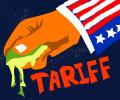
A trade deal makes sense only if it is fair and reciprocal. If the cost is strategic dependence or loss of policy space, waiting is the wiser option, asserts Ajay Srivastava.
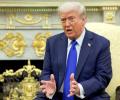
The US Representative criticised the administration's new USD 100,000 fee on H-1B visas, observing that Indians hold 70 per cent of these visas and saying the change directly harms workers who have long supported US innovation across technology, science and medicine.

Ramaswamy's stance on H-1B visas is reminiscent of the 2016 Trump campaign, when then-candidate Donald Trump, who has also hired a number of foreign workers under H-1B visas for his businesses, took a hardline stance on these foreign workers before later softening his rhetoric.

'Techies who did a master's there and moved to US companies look down on Indian companies who they consider as just doing body shopping.'

The decision to hike US H-1B visa application fee to $100,000, trade talks and the GST rate cut will be the key drivers for stock market movement this week, analysts said.

As large-scale layoffs begin at Facebook's parent company Meta, employees on work visas such as H-1Bs are now faced with uncertainty over their immigration status, with CEO Mark Zuckerberg acknowledging "this is especially difficult if you're here on a visa" and offering support to those impacted. Meta announced that it is laying off 11,000 employees or 13 per cent of its workforce, with Zuckerberg describing it as "some of the most difficult changes we've made in Meta's history." US-based technology companies hire a large amount of H-1B workers, the majority of whom come from countries such as India.
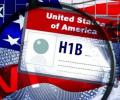
The H-1B visa is a non-immigrant visa that allows US companies to employ foreign workers in speciality occupations that require theoretical or technical expertise.

The US is planning to resume the process of domestic visa revalidation in certain categories, like H-1B and L1 visas, on a pilot basis later this year, a move that will benefit tens of thousands of foreign tech workers, particularly from India. Until 2004, certain categories of non-immigrant visas, particularly the H-1B, could be renewed or stamped inside the US. After that, for the renewal of these visas, in particular, those on H-1B, the foreign tech workers have to go out of the country, mostly to their own country to get the H-1B extension stamped on their passport.

Among Sensex firms, Trent, Power Grid, Tata Motors, Tata Consultancy Services, Asian Paints, NTPC, Adani Ports and Bajaj Finance were the laggards. However, Bharat Electronics, Axis Bank and Bharti Airtel were the major gainers.
A presidential advisory sub-committee has recommended the federal government to extend the grace period for H1-B workers, who have lost their jobs, from the existing 60 days to 180 days so that the workers have enough opportunities to find a new job or other alternatives. "The immigration subcommittee recommends the Department of Homeland Security and the US Citizenship and Immigration Services (USCIS) to extend the grace period for H1-B workers, who have lost their jobs, from 60 days to 180 days," Ajay Jain Bhutoria, member of the President's Advisory Commission on Asian Americans, Native Hawaiians, and Pacific Islanders, said on Tuesday. In his presentation, Bhutoria highlighted the significant challenges faced by H1-B workers laid off from their jobs.

From the Sensex firms, Tech Mahindra, Tata Consultancy Service, Infosys, HCL Tech, Tata Motors, Trent, Reliance Industries and Larsen & Toubro were among the major laggards. However, Eternal, Bajaj Finance, Adani Ports and UltraTech Cement were among the gainers.
The US has received enough electronic applications during the initial registration period to reach the 2022 fiscal year cap for the H-1B foreign workers visa, the most sought-after work visa among Indian professionals. The US Citizenship and Immigration Services, the federal agency which screens and allocates H-1B applications, said it was randomly selected from among the registrations properly submitted to reach the cap. The H-1B visa is a non-immigrant visa that allows the US companies to employ foreign workers in speciality occupations that require theoretical or technical expertise. The technology companies depend on it to hire tens of thousands of employees each year from countries like India and China.

As per the new rule, foreigners who file to renew their EAD on or after October 30, 2025, will no longer receive an automatic extension, the DHS said in a news release.

A group of influential lawmakers have introduced a bipartisan legislation in the US Senate to comprehensively overhaul the H-1B and L-1 visa programmes and usher in more transparency in the recruitment of foreign workers. The H-1B visa is a non-immigrant visa that allows US companies to employ foreign workers in speciality occupations that require theoretical or technical expertise. Technology companies depend on it to hire tens of thousands of employees each year from countries like India and China.

The US has received enough petitions needed to reach the Congressionally-mandated 65,000 H-1B visa cap for the fiscal year 2021 and successful candidates for the most sought-after work visa among foreign professionals, including Indians, would be decided by a computerised draw of lots. The H-1B visa is a non-immigrant visa that allows the US companies to employ foreign workers in speciality occupations that require theoretical or technical expertise. The technology companies depend on it to hire tens of thousands of employees each year from countries like India and China.

Among Sensex firms, Tata Motors, Bharat Electronics, UltraTech Cement, Tech Mahindra, Mahindra & Mahindra, ICICI Bank, Tata Consultancy Services and Axis Bank were the major laggards. However, Power Grid, Hindustan Unilever, NTPC and HCL Tech were among the gainers.

Indian information-technology (IT) service providers are likely to report another quarter (July-September) of low, single-digit growth owing to macro uncertainties, chiefly emanating from America, with no respite in sight even in the second half of the year.

'If companies want to hire foreign workers instead of Americans, my bill will hit them where it hurts: Their pocketbooks.'

Bengaluru is at a critical juncture, where its economic model, reliant on attracting and retaining skilled professionals, is directly threatened by a measurable decline in urban quality of life, point out Shishir Gupta and Rishita Sachdeva.

In a latest report on immigration, US Chamber of Commerce, which is world's largest chamber with more than 3 million members, asserted that such an allegation against Indian companies is 'hyperbole'.
The US has received enough petitions needed to reach the congressionally mandated 65,000 H-1B visa cap for the fiscal year 2022, a federal agency has announced. The H-1B visa is a non-immigrant visa that allows US companies to employ foreign workers in speciality occupations that require theoretical or technical expertise. Technology companies depend on it to hire tens of thousands of employees each year from countries like India and China.
It has been the preferred visa for Indian IT companies and has helped them keep costs down and gain a margin advantage over multinational players by sending engineers to the US.

The US remains the largest market for IT outsourcing, and for Indian giants TCS, Infosys and Wipro, it contributes around 40 per cent of their top line.
The Indian IT companies, which account for a large number of H-1B applications, are likely to face the additional financial burden because of this proposed increase in H-1B filing fees.
In a move that will benefit a significantly large number of Indian technology professionals, the US is set to begin a pilot programme for domestic renewal of certain categories of H-1B visas in December. The H-1B visa is a non-immigrant visa that allows US companies to employ foreign workers in speciality occupations that require theoretical or technical expertise. Technology companies depend on it to hire tens of thousands of employees each year from countries like India and China.

The Congressional-mandated cap of 65,000 H-1B visas and another 20,000 in the advanced degree categories were reached within the first five days after USCIS started accepted H-1B applications in April.

Ayan Pramanik and Shivani Shinde Nadhe report on the uncertainties that have dragged down shares of TCS, Tech Mahindra and HCL Technologies.

From the Sensex firms, Infosys climbed 3.86 per cent. HCL Tech, Tata Consultancy Services, Axis Bank, Kotak Mahindra Bank, Titan and Tech Mahindra were also among the gainers. However, Eternal, UltraTech Cement, Bharti Airtel and Adani Ports were among the laggards.

The 2025 US National Security Strategy marks a major pullback, with America turning backward and effectively allowing China greater dominance in Asia. while long-time partners like India are left to face an increasingly unstable global order largely on their own, observes Rajeev Srinivasan.
 © 2026 Rediff.com - Advertise with us - Disclaimer - Privacy Policy - Sitemap - Feedback - About us - Terms of use - Grievances