

If the Indian government is indeed serious about reversing brain drain, it needs to put much more emphasis on research and innovation, especially in areas that will determine the future, asserts Prosenjit Datta.
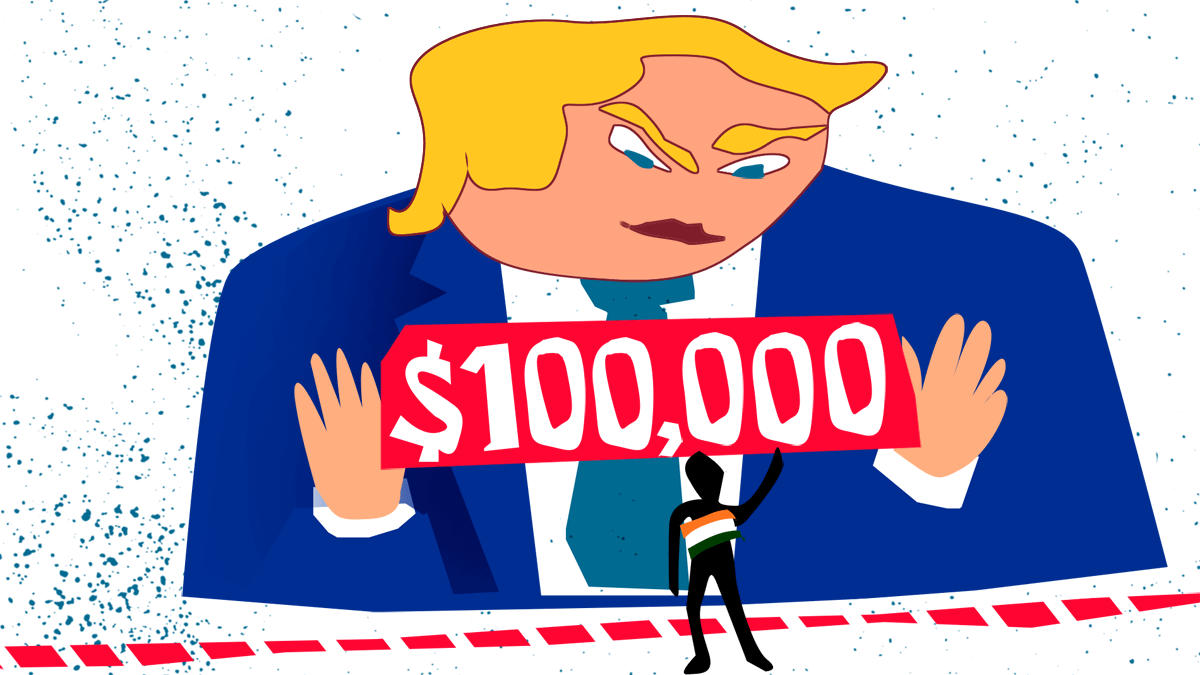
Shortly after United States President Donald Trump announced that fresh H-1B visa application fees were being hiked to $100,000, a move ostensibly aimed at protecting domestic US job seekers against cheaper talent from India and other countries, a slew of Indian experts claimed that the country would gain massively from the move.
Their assumption was that because of the visa fee hike and other measures being taken by the US to curb the entry of foreign workers, a large number of Indians on H-1B visas, in fields ranging from technology to healthcare, would return to help develop these sectors in India.
This is wishful thinking. Various Indian policymakers and other luminaries, after making some encouraging and jingoistic statements, have not bothered to put together any concrete plan or announce any major steps to encourage Indian talent to return.
Contrast this with other countries that have been quick to make announcements designed to attract the talent that will become available because of the H-1B visa fee hike.
Rachel Reeves, chancellor of the exchequer in the United Kingdom, announced that the country would make it easier to attract global talent, even as the US was actively discouraging them.
Among the steps the UK is contemplating is doubling the number of visas for high-skilled foreign workers and a special free visa for a select group of highly accomplished global talent.
While these steps are in no way directed specifically at Indian talent working on H-1B visas in the US, it may be attractive to at least some of those Indians in STEM (science, technology, engineering, and mathematics) fields in the US who are now looking at other options.
The steps being contemplated are not specifically for those who were earlier planning to apply for H-1B visas -- it is also aimed at foreign researchers and others that the UK wants to woo for its own technology research.
Meanwhile, several other European countries -- notably Germany, Portugal, and France -- are taking steps to attract more of the world's top talent.
Some Nordic countries are also trying to attract global talent in search of attractive shores.
Many Asian countries are also reportedly exploring measures to make themselves more attractive to global technology and other talent.
And China, which has now become the US' biggest rival in areas of science and technology, including artificial intelligence (AI), quantum computing, and biotech, having earlier introduced targeted programmes to bring back Chinese talent from the US, is now going all out to attract global talent as well.
The newly announced K visa, starting from today (October 1), is designed specifically to attract foreign tech talent, even though China already has strong domestic talent in cutting-edge areas of science and technology.
While the US H-1B visa hike to discourage global STEM talent is likely to ensure that a large number of highly skilled workers from India and other countries will now seek opportunities elsewhere, Indian policymakers seem oblivious to the fact that this will not automatically mean that the best Indian brains will flock back to the country.
The government seems to be unaware that it needs to take concrete steps to make India a popular destination for global tech and other talent.
If the Indian government is indeed serious about reversing brain drain, it needs to put much more emphasis on research and innovation, especially in areas that will determine the future.
India's spending on research -- by the government, in universities as well as by big corporations -- is abysmal.
Opportunities and the ecosystem that support researcher-entrepreneurs are practically non-existent and need to be created from scratch.
Special incentives, including monetary ones, should be put in place to attract top talent from abroad.
For a long time, the US remained a leader in technology and innovation because it created the perfect environment for global technology talent to flourish.
It created conditions for immigrants to come to the country and build world-beating tech companies.
Some of the more famous names who came to the US and flourished in areas such as chip design, AI, biotech, and genomic research are immigrants.
Now that the US seems determined to actively discourage them, both new talent and some of the existing ones may look for opportunities elsewhere. India seems strangely slow in actively wooing them.
A caveat here: A large number of Indians who go on US H-1B visas would not qualify as top research talent but are taken for mid-level project execution and other operational roles.
However, many who went on H-1B visas went on to head the biggest companies -- Satya Nadella is one example.
Also, a lot of Indian talent in the US (and at other top universities for science and technology students) went abroad to study but stayed back -- Sundar Pichai was one of them.
Successive Indian governments have done little to attract the best minds from abroad or to ensure that the best minds in India stay and work towards developing the country.
The fact that we have become the fifth largest economy in the world is despite this. Yet, if we want to become a truly powerful global economic player, we cannot afford to ignore the race for global science and tech talent.
Prosenjit Datta is former editor Business Today and Businessworld, and founder of ProsaicView, an editorial consultancy.
Feature Presentation: Ashish Narsale/Rediff








 © 2026