
According to a report by France 24, the US President did not say whether he meant nuclear-powered or nuclear-armed submarines. He also did not elaborate on the locations.
'But that was not our aim. Our objective was already achieved.'
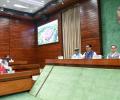
At the customary meeting ahead of the session beginning Monday, the opposition raised various issues, including voter roll revision in Bihar, the Pahalgam terror attack and Trump's 'ceasefire' claims.

A US official has stated that India's continued purchase of Russian oil is a point of contention in the relationship between the two countries, as it helps fund Russia's war efforts in Ukraine.
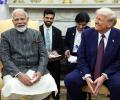
Congress general secretary Jairam Ramesh said Modi should take inspiration from former prime minister Indira Gandhi and stand up to the president of the United States.
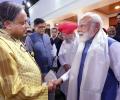
Prime Minister Narendra Modi's energy, dynamism and willingness to engage remains a 'prime asset' for India on the global stage but deserves greater backing, Congress MP Shashi Tharoor said on Monday, in remarks that are likely to irk his party and widen the growing cracks in his ties with its leadership.
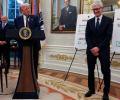
'India has intentionally taken advantage of the war in Ukraine to dramatically increase its purchases of Russian crude, when there are roughly 40 major crude providers that could satisfy Indian demand.'

Rahul Gandhi accuses PM Modi of prioritizing his image over national security after the Pahalgam attack, challenging him to refute Trump's claims of brokering a ceasefire between India and Pakistan.

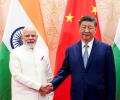
The Global Times, a prominent state-run Chinese media outlet, published an article titled "China and India are cooperation partners, not rivals: Xi," highlighting President Xi Jinping's remarks about the bilateral meeting, saying, "as long as the two countries stick to this overarching direction, China-India relations can sustain steady and long-term growth."

Trump also repeated his claim that seven fighter jets or more were shot down during the hostilities.
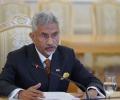
The relations between New Delhi and Washington are on a downturn after Trump doubled tariffs on Indian goods to a whopping 50 per cent, including 25 per cent additional duties for India's purchase of Russian crude oil.

There had been intense speculation whether Tewari and Shashi Tharoor, both part of the diplomatic delegations that had been sent abroad to convey India's stand, would speak in the Lower House or not during the ongoing debate on the Pahalgam attack and Operation Sindoor.

'The background for the Saudi-Pakistan agreement is the fact that the regional security order has collapsed due to the Israeli attack on Doha.' 'The Americans have largely abandoned their security guarantee for West Asia and the region has no choice but to look at alternatives.'

The Trump administration is implementing a pilot program requiring visitors from countries with high visa overstay rates to pay a bond of up to USD 15,000.

In the short run, the Trump presidency has already ensured one thing: The assumptions of the past can no longer guide the strategies of the future, points out Manish Dabhade.

Congress Working Committee (CWC) member Shashi Tharoor on Thursday said he has differences of opinion with some in the party leadership, but he is not going to speak about them in light of the bypoll in the Nilambur constituency.
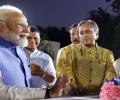
The Congress on Tuesday distanced itself from party MP Shashi Tharoor's remarks in an article in which he stated that Prime Minister Narendra Modi's energy, dynamism and willingness to engage remained a 'prime asset' for India on the global stage.

India-US relations, like Rome, were not built in a day, nor can they be demolished in a day.
All said and done, when the new global order emerges, India can only remain with the democracies, asserts Ambassador T P Sreenivasan.
'What's currently underway is not a 'reset'.' 'What needs to be arrived at is a new balance.'

'However, we must implement a tit-for-tat approach -- reciprocating their conduct with precision.' 'If they demonstrate respect, we respond accordingly. If they adopt hostile positions, we mirror that hostility with equal intensity.'
The lawmakers slammed opposition leaders over their remarks on the development, alleging that they were "happy" with the US government's move when "everyone" should be standing together in such a situation.

Trump couldn't care less anymore about the Israeli demand for Iran's 'de-nuclearisation' and 'de-militarisation.' Trump pins hopes on a grand bargain with Iran as a partner in America First, argues Ambassador M K Bhadrakumar.

'The Alaska Summit made me realise that while difficult, peace is within reach.'

The way to deal with a bully is to resist bullying, because submission in the first instance only invites even more overbearing demands in future. What may seem like a small price to pay now will lead to a much higher price later, warns former foreign secretary Shyam Saran.
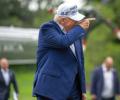
Trump has repeatedly claimed that he "helped settle" the tensions between India and Pakistan and that he told the nuclear-armed South Asian neighbours that America would do a "lot of trade" with them if they stopped the conflict.

INDIA bloc parties are set to raise issues such as the Pahalgam attack, US President Trump's claims of brokering a ceasefire, and concerns over electoral roll revisions in Bihar during the Parliament's Monsoon session.
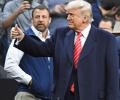
Strategic affairs experts express concern over US President Donald Trump's tariffs on India, his 'bullying tactics,' and increasing attempts to hyphenate New Delhi with Islamabad, signaling a potential shift in the bilateral relationship.
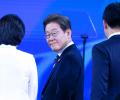
Lee Jae-myung's decisive victory in South Korea's snap presidential election marks a major political shift driven by public backlash against authoritarian, with significant implications for domestic reform and the future of the US-South Korea alliance, observes Dr Rajaram Panda.
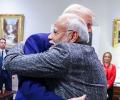
One must wonder whether Mr Modi's efforts to wine and dine the Big Two of today's world were seen as a sign of weakness rather than a proffered arm of friendship, points out R Jagannathan.
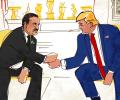
'Trump has personally weighed in to overcome doubts and reservations about Pakistan among his top advisors.'

'Geopolitically and diplomatically it's a very difficult situation for India.'

Former foreign secretary Harsh Vardhan Shringla, Special Public Prosecutor Ujjwal Nikam, Kerala BJP leader C Sadanandan Master and Delhi-based historian Meenakshi Jain have been nominated to the Rajya Sabha.

'Modi's initial forays into foreign policy had the flavour of Aswamedha Yagas launched by ancient kings to conquer the world.' 'He overcame the hesitations of history and explored unconventional ways to win friends and influence people.' A fascinating excerpt from Ambassador T P Sreenivasan's new book, Modiplomacy -- Through a Shakespearean Prism.
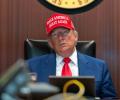
'What the Americans want is to destabilise Iran. For destabilising Iran, you need access. 'One access is through Iraq. The other access is through Pakistan.'

'America holds about 16% of IMF voting rights, giving it crucial influence over Pakistan's desperately needed bailout loans.'

The Congress on Wednesday alleged that the government has announced the start of the Monsoon session of Parliament 47 days before it is due in order to run away from the demand of the party and Indian National Developmental Inclusive Alliance (INDIA) for an immediate special session to discuss the Pahalgam attack and the Centre's failure to bring the terrorists to justice.
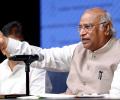
Soon after Kharge's remarks, Tharoor put out a cryptic post on X in which there was an image of a bird with the caption --"Don't ask permission to fly. The wings are yours. And the sky belongs to no one..."

Chinese foreign policy will acquire a more ideological and less pragmatic character. It will be conducted with more nationalist overtones, predicts former foreign secretary Shyam Saran.
'We should watch -- in the near term -- for signs that the two have totally fallen out at a personal, political level.' 'Trump and Modi know how to be dealmakers, but they also know how to hold a grudge.'
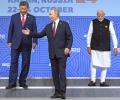
Russian Foreign Minister Sergey Lavrov alleged that NATO is blatantly trying to lure India into anti-China intrigues.
