
The Congress party launched a scathing attack on the central government regarding the Pahalgam terror attack and Operation Sindoor, demanding accountability from Home Minister Amit Shah and clarification on the number of Indian jets downed during the operation.

Congress general secretary, communications, Jairam Ramesh said the G7 Summit of the presidents of the US and France; the prime ministers of the UK, Japan, Italy and Canada; and the Chancellor of Germany is taking place in Kananaskis in Alberta, Canada, from June 15.
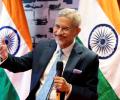
'The logic every one of our neighbours must realise is that working with India will give you benefits, and not working with India has a cost.'
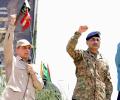
'We need to be very vigilant as we are passing through some fraught times.'
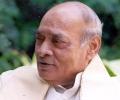
P V Narasimha Rao strongly felt that the reforms would have to be mindful of Indian concerns and would have to protect the interests of our poor and our working people, he said.
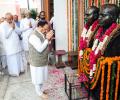
'As we read and assess what is going on around us in the India of 2025, it is instructive to do this through the lens of 75 years ago and the events that led to the formation of the BJP as we know it,' recalls Aakar Patel.

Narendra Modi's promise to allow states a bigger say in strategising and building foreign policy is unexceptionable, says TP Sreenivasan.

India looks less equal to China than 5 years ago, the strategic alliance with the US is hobbled by trade, and Pakistan is looking anything but chastened by Balakot. What has gone wrong? asks Shekhar Gupta.
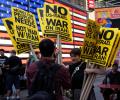
Israel's aerial assault on Iran is widely viewed as an act of naked aggression with no basis in international law, carried out unilaterally despite US opposition and aimed at derailing ongoing US-Iran nuclear negotiations, observes Ambassador M K Bhadrakumar.
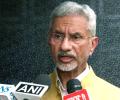
India on Thursday welcomed Kabul's firm rejection of attempts to create distrust between India and Afghanistan during a phone conversation between External Affairs Minister S Jaishankar and acting Afghan Foreign Minister Amir Khan Muttaqi.
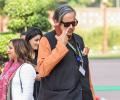
The government nominated Tharoor, who serves as chairman of the Parliamentary Standing Committee on External Affairs, to lead one of the seven multi-party delegations abroad for putting across India's stand against Pakistan for supporting terrorism.

The Congress party also called for a special session of Parliament to evaluate the situation in detail, to identify any mistakes that were made, and to ensure that they are not repeated in the future.

The United States State Department has authorised a Foreign Military Sales (FMS) case for Turkiye to purchase AIM-120C-8 Advanced Medium-Range Air-to-Air Missiles and related elements of logistics and program support for an estimated cost of $22 million.

'The big power struggle in faraway Europe erupted at a most critical juncture when India has been increasingly sceptical about American policies and statesmanship,' argues Ambassador M K Bhadrakumar.
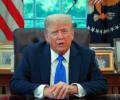
Trump has partially restricted and limited the entry of nationals from the seven nations: Burundi, Cuba, Laos, Sierra Leone, Togo, Turkmenistan, and Venezuela.
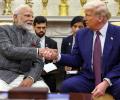
Trump went on to say that "I'm using trade to settle scores and to make peace."
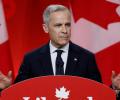
In a dramatic turn of events, Prime Minister Mark Carney's Liberal Party secured victory in Canada's federal election, overcoming earlier predictions of defeat.
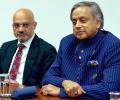
Tharoor said that though India's case might not be at the top of the agenda for the US media, India can get its message across easily.

State Department Spokesperson Tammy Bruce Sunday said, "President Trump stated clearly that the United States is no longer going to blindly dole out money with no return for the American people. Reviewing and realigning foreign assistance on behalf of hardworking taxpayers is not just the right thing to do, it is a moral imperative."

In the first-ever separate resolution on foreign policy brought in its National Executive in Bengaluru, BJP attacked the previous Congress-led Government, saying "a cursory glance at the 'lost decade' of the UPA, reveals retreat and a loss of direction in engaging with neighbours, ham-handed diplomacy vis--vis Pakistan and a blind-spot in our foreign policy to the Indian Ocean island states."
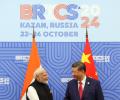
'Don't play the American game... India is too big for a US game.'

'Alas, the Congress party offers no suggestions as to how to unscramble the omlette it cooked during 2004-2014 on which the Modi government may have since lavishly spread some tomato ketchup,' says Ambassador M K Bhadrakumar.

The external affairs ministry's files, as distinct from those of the ministry of defence or the agencies, at least from before 1974 should be declassified. And if select files that are more than 40 years old are not to be declassified, the ministry should follow explicit guidelines to justify taking such a view, says Jaimini Bhagwat.
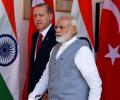
India-Turkiye ties are strained over Ankara's Islamabad tilt, its arms links with Pakistan, and fallout from the Pahalgam terror attack.
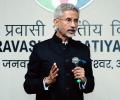
External Affairs Minister S Jaishankar will represent India at the inauguration of Donald Trump as the 47th President of the United States on January 20.
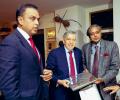
All-party parliamentary delegations on Friday met leaders and diplomats from several countries to galvanise international action against terrorists and decisively counter the tactics of those who perpetrate, support and sponsor cross-border terror activities against India.
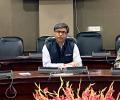
The sources said Misri reiterated the government's stand that the decision to stop military actions was taken at a bilateral level, as some opposition members questioned US President Donald Trump's repeated assertions about his administration's role in stopping the conflict.

'Foreign policy-making cannot be shifted out of Delhi and the regional satraps, who do not have a national perspective, should not be allowed to dominate foreign policy. But regional inputs should be integral to foreign policy-making at every step of the way,' says Ambassador T P Sreenivasan.

The Congress on Sunday said it was not stopping anyone from being part of diplomatic delegations to be sent to various countries following Operation Sindoor and that its leaders who have been named at the instance of the government must listen to their conscience and contribute to the exercise.

US President Donald Trump has signed an executive order extending the operations of TikTok, the Chinese-controlled video-sharing platform, by 75 days. Trump intends to pursue a resolution that protects national security while preserving the platform used by 170 million Americans. The order instructs the attorney general to refrain from enforcing a law that would have forced TikTok's parent company ByteDance to divest from the app or face a ban from US app stores. Trump cited the national security concerns posed by TikTok and the need to review sensitive intelligence related to these concerns. He also emphasized the importance of finding a resolution that protects national security without abruptly shutting down the platform.
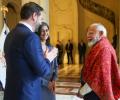
Vance is expected to be accompanied by at least five senior officials, including from the Pentagon and the State Department, the people cited above said.

Badar Khan Suri, an Indian postdoctoral fellow at Georgetown University, is facing deportation after US authorities accused him of "spreading Hamas propaganda" and having "close connections to a suspected terrorist." The Department of Homeland Security claims Suri has been actively promoting antisemitism on social media and is connected to a senior Hamas advisor. Suri's lawyer, Hassan Ahmad, argues that his client is being targeted due to his wife's Palestinian heritage and their opposition to US foreign policy towards Israel. The incident follows the self-deportation of another Indian student from Columbia University who was also accused of supporting Hamas.

The Congress on Sunday demanded answers from the government on whether it has accepted third-party mediation on Kashmir after the United States made announcements on behalf of India and Pakistan, and slammed attempts to 'internationalise' the issue and 'hyphenate' the two countries.
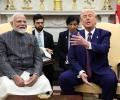
'Trump's aggressive stance towards China and preference for military posturing could shift the Quad's balance towards overt militarisation.'
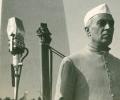
On Jawaharlal Nehru's 61st death anniversary, Utkarsh Mishra recalls how India's first prime minister cultivated a unique role for the newly independent country on the world stage.
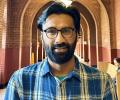
In his petition, Suri's lawyer said that he is being punished as his wife, who is a US citizen, is of Palestinian heritage and because the government suspects that he and his wife are against the US foreign policy towards Israel.
'India enjoys conventional superiority, but nuclear deterrence imposes clear boundaries.'

US Vice President J D Vance and his wife Usha arrived in Delhi on Monday for a four-day visit. They were welcomed by Union Minister Ashwini Vaishnaw. Vance's visit comes amid ongoing trade talks between India and the US. Prime Minister Narendra Modi will host a dinner for the Vances on Monday evening after holding talks with the US Vice President. Vance and his family will also travel to Jaipur and Agra during their trip.

The US foreign policy under President Donald Trump would put "America first" and would be based on the principle of "peace through strength," the White House said today, hinting at massive military expansion under the new administration to maintain "unquestioned" US military dominance.
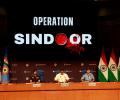
'We should not just react when a terror attack happens on our soil.' 'Our approach should be continuous and a launch pad should be destroyed the moment it comes up.'
