
Union Minister Kiren Rijiju on Saturday said funds meant for Central projects would be under BJP's scanner to ensure judicious utilisation in Arunachal Pradesh.
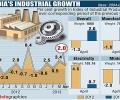
Vivek Mahajan (Head - Research) Aditya Birla Money, analysed the slow IIP growth.

The government has spent a little less than one-third of the Budget estimate of capital expenditure, it can still spend about Rs 20,000 crore this year without disturbing its fiscal deficit target.
Barry Eichengreen, professor of economics and political science, University of California, Berkeley, analyzes the transparency of the Reserve Bank of India, the growth rate of the Indian economy and why he feels globalisation can never be rolled back.

With cash -- the primary medium of exchange -- all but disappearing, it is now unlikely that the expected fillip to demand on account of a good monsoon and proceeds from the Seventh Pay Commission payout will materialise.

India is Asia's third-best performing equity market.

'Experts are not ruling out further pain as global factors cannot insulate India from the aftermath.'

Soft oil prices are expected to persist in 2015 and will be accompanied by significant real income shifts from oil-exporting to oil-importing countries.

The finance minister chided the central bank on Tuesday over its focus on fighting inflation, saying the Reserve Bank of India (RBI) also needed to abide by the government policy to promote economic growth.

Given the volatility of the global marketplace, India is already on a strong wicket and well poised to provide a lucrative option to foreign investors.

The silver lining is that a pick-up in the US economy could help emerging market exports.

'We forecast real GDP growth to moderate to 6.7 per cent in the year ending March 2018.' 'However, as disruption fades, we expect to see a rebound in real GDP growth to 7.5 per cent in the next fiscal year.'

Morgan Stanley draws optimism from a slew of favourable factors.

The manufacturing sector during the fourth quarter recorded a growth rate of 9.3 per cent while the farm sector grew at 2.3 per cent.

Fiscal consolidation is keenly awaited.

Economist Dr Subramanian Swamy, whose Janata Party merged with the Bharatiya Janata Party in August, has issued the following press statement on the Indian economy and demanded the implementation of a four-point agenda to save it.

'The optimistic advice might be "fasten your seat belts" and the pessimistic one might just turn out to be "brace for impact",' says Claude Smadja.

Consequences of China's efforts to stabilise its equity markets after three weeks of declines, which wiped out some 30 per cent of the value is far more importance to the world, says Clyde Russell.

Economist Dale W Jorgenson declares that India is doing "very, very well" and forecasts that India might continue to outrun world economies, including China over the next many years.

Little attention is paid to the management of currencies and coins in India.

Over 15 years, with seven per cent growth, the Indian economy will be three times bigger.

The government could carry out the demonetisation exercise over periodic intervals along with its surprise element, says Soumya Kanti Ghosh.

The Economic Survey called for improving business environment.

Government to pay disproportionately high interest for borrowings from savings, overturning a nearly two-decade-long process of reforms in the management of public debt.

Substantial gains can still be made with good policies and initiatives.

Reducing policy rates is not enough. The key is to ensure banks lend to credit-constrained borrowers.

Will Arundhati Bhattacharya be the RBI's first woman governor? Or will Urjit Patel succeed Raghuram Rajanas RBI governor when his term ends on September 4?

Finance Ministr Arun Jaitley will have to do a balancing act to manage fiscal prudence.

Erstwhile RBI governors, including Raghuram Rajan never had cordial relations with the government.
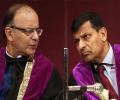
In cutting interest rates and giving a boost to the government's efforts to revive growth, RBI governor Raghuram Rajan displayed the pragmatism and flexibility familiar to those who work with him.

There is no clarity yet on how an estimated 10.9 million new jobs would be created every year.
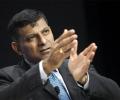
Rajan, as expected, furthered his predecessors' agenda and continued with the same resolution to make India's financial system safer, and direct the economy towards further liberalisation

The larger virtue of maintaining fiscal credibility should not be unduly diluted by quibbles on the fiscal math, says Sajjid Chinoy.

Retired banker P Balagopala Kurup says one of the reasons he favours inflation targeting is that its first priority is to insulate the lesser fortunate citizens from adversity and in the process to ensure that the economy retains its inherent vibrancy and strength.

Benchmark indices failed to sustain gains and retreated from day's high dragged primarily by the losses in metals, information technology and bank shares as investors started to book profits in late noon deals. Earlier, markets had scaled fresh all-time highs on the surprise post-budget rate cut by Reserve Bank of India (RBI). The 30-share Sensex ended down 213 points at 29,380 and the 50-share Nifty closed down 74 points at 8,922. Intra-day, Sensex reached the all-time high mark of 30,024.74 while Nifty touched the life-time high level of 9,119.20. In the broader market, both the BSE Midcap index and Smallcap indices, down 1% and 1.2% each underperformed the front-liners. Market breadth in BSE ended negative with 1,882 declines against 1,010 advances. A day after signing an agreement with Finance Ministry on inflation targeting, RBI surprised the markets with an early post-budget repo rate cut of 25 bps (basis points) to 7.5% from 7.75% which was again outside of central bank's scheduled policy review meetings as the earlier rate cut effected on January 15. "RBI's latest rate cut of 25 basis points, while a surprise in its timing is in-line with our expectations of a sharp rate-cutting cycle over the coming quarters. With inflation sustainably lower by 500bps, the RBI has in recent months acknowledged the scope for rate cuts and was only waiting for additional comfort that the government's fiscal policy would not play spoil-sport," said Dinesh Thakkar, chairman and managing director at Angel Broking in a note. Analysts at Karvy believe that further monetary policy action will depend on number of factors including easing of supply constraints, improved availability of power, land, minerals and infrastructure, fiscal consolidation, the pass through of rate cuts by banks and the expected monsoon. Citing weakness in some sectors of the economy and the overall global trend towards monetary easing as rationale for the rate cut the central bank also exuded confidence in the road map for fiscal consolidation as laid out in the Union Budget, 2015. Commenting on how the markets reacted to RBI's surprise move, K Subramanyam assistant vice-president (institutional research), Asit C. Mehta Securities said, "The unexpected cut did take the market by surprise .However, credit off-take is not dependant only on interest rates. A gradual revival in the economy would be of more help which would trigger credit off-take. Hopefully this will follow and RBI's action would prove helpful. From market point of view this is bullish as equity becomes more attractive vis-a-vis falling interest rates." On the macro-economic front, the HSBC services PMI rose to an eight-month high of 53.9 in February up from 52.4 in January indicating strong expansion in output across the sector. Respondents cited robust growth of new business as the principle factor for the increase in activity. Meanwhile, foreign portfolio investors (FPIs) bought shares worth a net Rs 773 crore on Tuesday, as per provisional data. Buzzing Stocks 9 out of the 12 sectoral indices of BSE ended in red. BSE Metal index, down 2.4% was the top loser followed by BSE Oil & Gas and Power indices, down 1.3% each. BSE Healthcare index, up 1.2% and BSE FMCG index, up 0.9% were the top losers. Bank stocks came under during late noon trades as traders booked profits at higher levels. However, RBI rate cut may encourage large lenders to cut their lending rates boosting demand for home and auto loans and provide funds for various stalled and new projects. Many stalled projects across the country are waiting for cash to restart work. The stock of stalled projects at the end of December 2014 stood at Rs 8.8 lakh crore or 7% of GDP. ICICI Bank ended down 0.1%, Axis Bank and SBI declined over 3% and HDFC Bank shed 1.5%. Sun Pharma gained over 6% on approval granted to Sun Pharma Advanced Research Company (SPARC) by US FDA for an antiepileptic drug. The product will be manufactured by Sun Pharmaceutical Industries at its Halol (Gujarat) facility in India. SPARC was formed in 2007 when Sun Pharma separated out its active projects in drug discovery and innovation into a new company. Dr Reddys Lab and Cipla have gained over 1% each. ITC gained over 1% after consecutive sessions of losses on the proposed larger-than-expected hike in excise duty on cigarettes in the Union Budget. The biggest ever auction of spectrum by the Department of Telecommunications (DoT) started on Wednesday in the morning where government expects to garner Rs 80,000-1lakh crore from the sale of spectrum. Idea Cellular gained over 2%, Reliance Communication gained around 1% and Bharti Airtel closed 0.5% higher. Metal stocks were under pressure in today's session. Hindalco declined over 3%, Sesa Sterliteended down over 4% and Tata Steel closed down 2%. Profit-taking in IT stocks led to Wipro losing around 1.8%, Infosys declining 0.7% and TCS losing 1.5%.

Along with the US and China, India could be a big enough force in global manufacturing
Voices from the Treasury are clamouring for lowering rates as this would boost demand.

During the Congress regime, India did witnessa slew of reforms which are now taken up by the Modi government too.

Faced with sluggish economic growth and dwindling exports, China on Wednesday devalued its currency for the second consecutive day.

Enhanced revenue generation is a priority for the government.
 © 2026 Rediff.com - Investor Information - Advertise with us - Disclaimer - Privacy Policy - Sitemap - Feedback - About us - Terms of use - Grievances