
The plan was to expand further, add more branches and also eventually become the third bank in India to start a wholly owned subsidiary after Singapore's DBS Bank and State Bank of Mauritius, but those plans never materialised due to lack of scale and rising non-performing assets in the country.

The case pertains to a bank guarantee of Rs 68.2 crore submitted to the Solar Energy Corporation of India Limited (SECI) on behalf of Reliance NU BESS Limited, a subsidiary of Reliance Power, a listed company, which was found to be "fake".

Citibank on Wednesday joined the list of foreign banks that have exited retail banking business in India. Mumbai-based Axis Bank completed acquisition of Citigroup's consumer business for Rs 11,603 crore. Under the deal, Axis acquired consumer banking businesses of Citibank India, which includes credit cards, retail banking, wealth management and consumer loans.


The continuing fiscal stimulus is heavily tilted towards capex, to the extent that it chips away a part of revenue spending. Accounting for other areas of revenue expenditure, such as salaries, pensions, subsidies and defence (committed spend), the room to spend on welfare schemes, health and education will narrow in FY22.

Going by the strict criteria set, only Maharashtra, Tamil Nadu, Gujarat, Karnataka, Uttar Pradesh, Andhra Pradesh, Madhya Pradesh, and Haryana qualify for such extra borrowing, as of now.

Weakness in other currencies against the dollar overseas, after US Fed indicating interest rates could rise earlier than expected as the jobs market picking up, also put pressure on the local unit, forex dealers said.
.jpg)
The Reserve Bank of India sold dollars via state-owned banks around 62.3575 per dollar to contain the rupee's fall, traders said.

The volume in the anonymous trading platform, NDS-OM, was Rs 7,210 crore - less than half the normal volume, but not as bad as the start of the day indicated.

Foreign investors have bought around $2.4 billion in both debt and equity so far in October, pushing the total inflows to nearly $36 billion so far in the year.
.jpg)
In New York market, the dollar lost ground against most major rivals on last Friday amid mixed US data on industrial production and consumer sentiment.
.jpg)
Most Asian currencies weakened versus the dollar with the Thai baht and Philipine peso sliding on disappointing economic data.
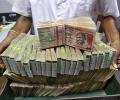
In New York market, the dollar fell further against the euro yesterday after minutes from the Federal Reserve's March meeting detailed risks that could keep interest rates depressed even after the first rate hike.

The Indian regulatory framework forced Citi to hibernate -- contrary to the claim that it never sleeps!
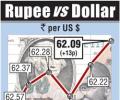
Domestic shares and other global markets rose on upbeat trade data from China earlier in the day and after a US House deal extending the federal borrowing authority.
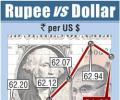
In New York market, the dollar fell against the Japanese yen yesterday, taking cues from declines in US stocks.

While the FPI limit on most bond issues would not be raised above 6 per cent, there would be some in which there would be no limits, reports Arup Roychoudhury.

The rupee had gained five paise to close at 63.25 against the dollar in on Monday's trade on fresh selling of the US currency by exporters amid bullish stocks.
With banks staying out of the bond market, and foreign investors exhausting their investment limit, the question is: Who will buy the Rs 4.6 trillion bonds that will be issued from April.

The partially convertible rupee closed at 61.31/32 per dollar, unchanged from its Tuesday close.
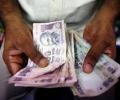
Forex dealers said besides the dollar's gains against other currencies overseas, increased demand from importers for the American unit put pressure on the rupee but a higher opening in the domestic equity market capped losses.

The rupee fell 13 paise to end at 61.21 against the American currency in Wednesday's trade following fresh dollar demand from importers, amid uptick in retail inflation and slowing industrial production growth.

Traders expect the rupee to remain wedged between the 59.60 and 60.50 levels in the absence of any key triggers in the near-term.

The bond market expects at least 25 basis points cut in the June 6 policy.

In India, it is not easy to fight it out with the large banks which are nimble-footed and technology-savvy and are continuously innovating on the retail turf with newer products for customer acquisition.

The rupee has fallen 0.8 per cent so far this year, hitting a one-month low on Friday, hurt by a stronger dollar globally as well as caution ahead of key economic data this month.

The dollar's weakness against other currencies overseas and a higher opening in the domestic equity market supported the rupee, forex dealers said.

Standard and Poor's raised the outlook for India's "BBB-minus" rating back to "stable" from 'negative,' saying Prime Minister Narendra Modi government's 'strong' mandate would allow it to implement fiscal and economic reforms.

Forex dealers said besides the dollar's gains against the euro overseas, increased demand from importers for the US currency and a lower opening in the domestic equity market also put pressure on the rupee.

The government planned to borrow 10-15 per cent of the total borrowing offshore. That works out to at least Rs 71,000 crore, or about $10.4 billion at Friday's exchange rate.

Weakness of the dollar in the overseas market also boosted the rupee, a forex dealer said.

Rajan's first few measures include swap window facility for banks to lure in NRI funds.

The Rupee is expected to weaken further against the dollar.

The rupee will largely remain stable but with a mild depreciating bias in the next one year

NBFCs are mainly dependent on funding their operation from their own cash flows.

While far from being a currency war, India does not have much of an option but to depreciate to accommodate its exports at a time when China shows its intent to let its currency depreciate.

The RBI had in the past expressed its concerns about allowing foreign investors in short-term paper, because it attracted hot money.
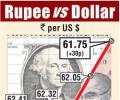
The rupee resumed higher at 61.75 as against the last closing level of 62.05 per dollar at the Interbank Foreign Exchange (Forex) Market and firmed up further to a one-month high of 61.53 before quoting at 61.59 per dollar at 1045 hours.
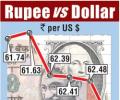
The previous bout of Fed withdrawal fears had threatened to spark a crisis of confidence in India -- sending the rupee to a record low of 68.85 in late August and leading to steep falls in bonds and stocks.

The immediate concern for the rupee is the sharp spike in oil prices
 © 2026 Rediff.com - Advertise with us - Disclaimer - Privacy Policy - Sitemap - Feedback - About us - Terms of use - Grievances