
60 years ago, on January 24, 1966, Dr Homi J Bhabha, the father of India's nuclear programme, died in an air crash on Mont Blanc. The official inquiry said the plane went off course in bad weather, but coincidences, missing evidence, and later unproven claims have kept conspiracy theories alive. A fascinating excerpt from Bakhtiar Dadabhoy's book, Homi J Bhabha: A Life.
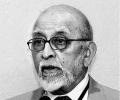
M R Srinivasan focused on the peaceful use of nuclear power at a time when the popular view among the 'hawks' was that India should build a nuclear arsenal as a deterrent.

'I hope more shows highlight the unsung heroes of our rich history.' 'As for bringing the trophy home, a man can hope, but truly I am just excited to be there.'

Dr Bhabha and Dr Sarabhai didn't feel guilty for their ambitions; it was for those 'mad scientists' that India is a powerhouse -- both at the atomic level and in the vastness of space, observes Kumar Abishek.

On Dr Homi J Bhabha's 110th birth anniversary, Dr K S Parthasarathy shares some personal memories of the legendary nuclear scientist.

Nehru's faith in science and technology, his genuine respect for Bhabha, and their burning ambition worked synergistically to place India on the nuclear map of the world. Atomic energy developed and prospered because of Nehru's vision fulfilled by Bhabha's mission, recalls K S Parthasarathy, former secretary of the Atomic Energy Regulatory Board, on the occasion of India's first prime minister's 119th birthday today.

Delhi Crime, Rocket Boys and Vir Das: Landing won Shefali Shah, Jim Sarbh and Vir Das Emmy nominations.

Deepa Gahlot picks 10 Web series that was worth the viewer's while.

I suggest we build a Vigyan Mandir (Temple of Science) with the ambience of a place of worship, so that it becomes a destination for pilgrims. We should embed on its walls bronze plaques describing each scientist mentioned here along with about a dozen of our ancient mathematicians, recommends Professor Kalyan Singhal, historian of science and technology.

A nuclear scientist and a chemical engineer, Dr Sethna was pioneer in establishing India's first reprocessing plant in 1959. India's first nuclear test was possible because of the Plutonium from this plant when the country was under tremendous pressure to sign the nuclear non-proliferation treaty by the United States.

'What I love about Parsis is that we never take anything seriously.' 'Everyone's making fun of everyone.' 'So, they were like, 'Don't f*** it up, ch****!'.'

The Indian Institute of Science topped the HRD ministry's 2017 national rankings. In 2016, the IISc was ranked among the world's top 15 universities in the Times Higher Education University Rankings. In his book The Creation of Wealth: The Tatas from the 19th to the 21st Century, R M Lala recounted how Jamsetji Tata's grand vision and immense personal contribution laid the edifice of arguably India's finest educational institution.
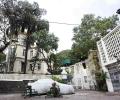
Every blade of grass and grain of sand in Mehrangir has a story to tell: The story of how one of the greatest sons of India lived here, planned and executed from here a technological and scientific enterprise which became the envy of the world. The government must save Mehrangir for future generations, says Dr K S Parthasarathy.

A controversy has erupted over the decision to discontinue postage stamps of Indira Gandhi and Rajiv Gandhi with the government saying only one family can not get this honour, even as the Congress termed the move as "insult to the history" and demanded an apology.
 © 2026 Rediff.com - Advertise with us - Disclaimer - Privacy Policy - Sitemap - Feedback - About us - Terms of use - Grievances