
Justice Bhushan Ramkrishna Gavai was on Wednesday sworn in as the 52nd Chief Justice of India.

Yadav further accused the BJP of "using distractions" to avoid addressing real issues such as rising unemployment, inflation, lack of investment in Uttar Pradesh, and failing healthcare facilities.

The jury is still out on the decision to demonetise high value currency notes on November 8, 2016, with the government claiming it has helped greater formalisation of the economy while critics saying it has failed to curb black money and reduce dependence on cash. On November 8, six years ago, Prime Minister Narendra Modi had announced the demonetisation of old Rs 1,000 and Rs 500 banknotes and one of the key objectives of the unprecedented decision was to promote digital payments and curb black money, besides eliminating terror funding. As per a Reserve Bank data, currency with the public has jumped to a new high of Rs 30.88 lakh crore an October 21, indicating that cash usage is still substantial even six years after the demonetisation move.

'I want the prime minister to be punished because he put our country in difficulties as he took this decision without Cabinet approval.' 'When he had already ordered the printing of new currency notes on May 19, 2016, why did he tell lies to the country?'
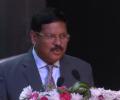
Chief Justice of India Sanjiv Khanna has recommended Justice Bhushan Ramkrishna Gavai as the next CJI. Justice Gavai, the second most senior Supreme Court judge, will become the 52nd CJI on May 14, 2024, after CJI Khanna's retirement on May 13. Justice Gavai has served on several important Constitution benches and has been a part of landmark verdicts, including the one upholding the Centre's decision to abrogate provisions of Article 370.
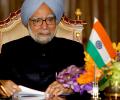
Hailed as the architect of India's economic reforms, former prime minister Manmohan Singh in one his last interviews had said in 2019 that the country's economy was 'over-regulated', the government exerted control and interferences were aplenty with even regulators having 'morphed into controllers'.

'Modi had not discussed demonetization with me prior to his announcement on 8 November 2016. 'I learnt of it along with the rest of the country. 'I was not surprised when he did not discuss the issue with me prior to making the public announcement. 'It fitted in with his style of making dramatic announcements.' A fascinating excerpt from Pranab Mukherjee's The Presidential Years: 2012-2017.

'Tomorrow I will go back home, clean my bed, pay my rent, all the normal things that a person does.' 'I'll still be the same person for my friends, my parents.' 'That grounding is the real thing, rather than the feeling of having made it.'
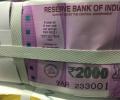
The Reserve Bank on Monday advised banks to provide shade from the sun and water to customers waiting to exchange or deposit Rs 2,000 notes. It can be noted that during the note ban in 2016, there were allegations of customers dying while waiting in queues to exchange bank notes. Following Friday's announcement of withdrawing Rs 2,000 notes -- the notes continue to be legal tender unlike demonetisation exercise -- there were concerns about customers facing inconvenience, especially given the summer being at its peak.

The Reserve Bank of India (RBI) on Tuesday told the Delhi high court that withdrawal of Rs 2000 notes is not demonetisation but a statutory exercise, and the decision to enable their exchange was taken for operational convenience.

'Demonetisation, is in principal, a mistake, because it involves a theft -- a taking of private property by the State.' 'It is one of those bad Indian ideas that has been tried twice in the past, with two failures for the record books.' 'This cloud over the economy will probably remain as long as Modi is in power.'
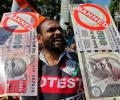
'In the total of black wealth, only 1% or less than 1% constitute cash.' 'So, even if cash is completely weaned out, it impacts only 1% of the black wealth.'

It will be interesting to see what shifts have been recorded in the last decade-and-a-half -- from the effects of demonetisation and Covid's second wave to the drop in fertility and increase in farm workers -- but we will only know this if and when the Census is conducted, points out Aakar Patel.
The Enforcement Directorate (ED) has seized its biggest-ever cryptocurrency worth Rs 1,646 crore in a money laundering investigation into a fraud investment scheme called BitConnect. The scheme, which ran between 2016 and 2018, promised investors high returns through a proprietary trading bot but was found to be a sham. The ED tracked transactions through the dark web and seized the cryptocurrency from numerous wallets. This is the agency's largest-ever seizure of virtual digital assets and the investigation is ongoing.
P K Mishra, a retired IAS officer of the Gujarat cadre, is currently serving as the principal secretary to the prime minister.

The Reserve Bank on Wednesday said 98.12 per cent of the Rs 2000 banknotes have been returned to the banking system, and only Rs 6,691 crore worth such notes are still with the public. On May 19, 2023, the Reserve Bank of India (RBI) announced the withdrawal of Rs 2000 denomination banknotes from circulation.

Nivedita Mookerji finds out how Paytm CEO Vijay Shekhar Sharma is handling his soaring popularity after the note ban as well as the criticism that comes as a package deal.

'If the government had not spent an incredible amount of energy on demonetisation it may -- may, because it had not done anything the previous six months either -- have been able to pay attention to the deeper problems of low investment and job creation.'

Technology is rapidly reshaping industries that have long been rooted in tradition, driving a wave of innovation that is transforming everything from finance, banking, steel to manufacturing.
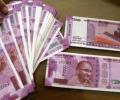
The Reserve Bank on Monday said 98.08 per cent of the Rs 2,000 banknotes have been returned to the banking system, and only Rs 6,839 crore worth such notes are still with the public. On May 19, 2023, the Reserve Bank of India (RBI) announced the withdrawal of Rs 2,000 denomination banknotes from circulation.

Opposition on Thursday paralysed Parliament, with Rajya Sabha disrupted over demand for the presence of Prime Minister Narendra Modi and his response in the demonetisation debate, which the government rejected outright.

Prithviraj Hegde explains the first results of the demonetisation exercise in layman terms.
Prithviraj Hegde explains the first results of the demonetisation exercise in layman terms.

'Not only jobs are not being generated, but people are also losing jobs.'

In the third of a six-part series T E Narasimhan finds out how the hub of India's firecrackers industry is coping after more than a month of the note ban.
The demonetisation move will force the Modi government to battle with a policy dichotomy, says N Sathiya Moorthy.

The central bank had earlier estimated the value of old Rs 500 and Rs 1,000 notes received, as on June 30, 2017, at Rs 15.28 trillion.
The Reserve Bank of India (RBI) on Monday said 98.04 per cent of the Rs 2000 banknotes have been returned to the banking system, and only Rs 6,970 crore worth such notes are still with the public. On May 19, 2023, the RBI announced the withdrawal of Rs 2000 denomination banknotes from circulation.
Gandhi said that the basic idea of these exercises is to ask all poor people whether they are Indian or not. He also said that PM's 15 friends will not have to show any document and the money generated will go into the pockets of those 15 people.

Available evidence suggests that we are on the way to a very costly failure of the current demonetisation scheme, says M R Narayana.

'If the Modi government is successful in extraditing a high-profile fugitive such as Vijay Mallya or Nirav Modi before the 2019 election, the government will be able to link demonetisation to this and turn it into a positive.'

Congress president Rahul Gandhi said the Nyay plan is a game changer and that the scheme is "fiscally perfectly doable" and will not be implemented rashly.

The RBI under former governor Shaktikanta Das resisted pressures to cut interest rates through 2024 as it kept its 'Arjuna's eye' trained on inflation, but the central bank under a new detail-oriented head will soon have to take a call if it can continue sacrificing growth. Das, a career bureaucrat who in 2016 oversaw Prime Minister Narendra Modi's highly disruptive demonetisation move, left a lasting legacy as he demitted office towards the end of 2024 after expertly navigating monetary policy for six years, the highlight of which was steering India's recovery through the pandemic.
Reserve Bank Governor Shaktikanta Das on Tuesday said the fiscal-monetary coordination was at its best during the last six years even as he thanked Prime Minister Narendra Modi for giving the opportunity to head the monetary authority of the country. Das, in a series of posts on X, on his last day of his six-year term as RBI Governor, also thanked the Finance Minister, various stakeholders and his colleagues at the central bank.

"It's (demonetisation) a disaster on economy of trust. In the last 20 years, the country has been growing very fast. But it is all based on acceptance of each other's word. By taking despotic action and saying we had promised but won't fulfil our promise, you hit at the root of this," Sen, also a Bharat Ratna awardee, said.
The minister said demonetisation has increased the tax return filings and also increased the revenue of the states and the Centre immensely.

In a Facebook post on the second anniversary of demonetisation, Jaitley said in first four years of the National Democratic Alliance government, the number of income tax returns filers has gone up to 6.86 crore from 3.8 crore in May 2014.
The sabre-rattling between parties on rival sides of the political divide over demonetisation showed no signs of softening on Saturday with the government accusing Congress of engaging in "fear mongering" and the latter hitting back calling the exercise a "not well thought out move" whose after-effects will last long.
'In the coming months, expect more government action that will be packaged as an assault on black money,' warns A K Bhattacharya.

'RBI is taking all steps to complete the process expeditiously so as to release firm figures at an early date.'
