
'Skirmishes with officials in the Press Information Bureau were an everyday affair as the newspapers sought clearances from the media censors for publishing the next day's editions'

Freedom of speech is subject to reasonable restrictions and it does not include the freedom to make defamatory statements against any person or the Indian Army, the Allahabad High Court has said, rejecting Congress leader Rahul Gandhi's plea to quash summons against him for alleged derogatory remarks during his Bharat Jodo Yatra in 2022.
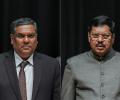
From demonetisation to sub-categorisation of Scheduled Castes to bulldozers, Justice Gavai has been part of several judgments.
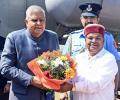
Karnataka Governor Thaawarchand Gehlot has reserved the Bill pertaining to four percent reservation for Muslims in government contracts for the President's assent, citing constitutional concerns. The Bill, which has been a subject of controversy in Karnataka, was passed by both houses of the state legislature amid protests from the opposition BJP. The Governor's decision to reserve the Bill highlights the ongoing debate over the constitutionality of religious-based reservations in India.
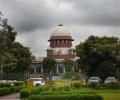
The Supreme Court on Monday directed uniform pension benefits for all retired high court judges, irrespective of their mode of appointment or tenure, saying "one rank one pension has to be the norm in respect of a constitutional office".
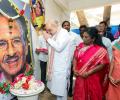
Union Home Minister Amit Shah announced on Friday that another constituent of the separatist amalgam Hurriyat Conference, the Jammu and Kashmir Mass Movement, has rejected secessionism and declared complete commitment to the unity of the country. This marks the 12th Hurriyat-linked organization to break off from separatism and reaffirm their trust in the Indian Constitution. Shah attributed this trend to the unifying policies of Prime Minister Narendra Modi's government, which he believes has "tossed" separatism out of Jammu and Kashmir.
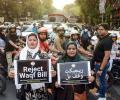
The Congress party announced its intention to challenge the constitutionality of the recently passed Wakf (Amendment) Bill, 2024 in the Supreme Court. AICC general secretary Jairam Ramesh stated that the party will "very soon" file a petition, citing concerns about the bill's impact on constitutional principles. Ramesh highlighted the Congress's ongoing legal challenges against other legislation, including the Citizenship Amendment Act (CAA), amendments to the Right to Information (RTI) Act, and changes to the Conduct of Election Rules. He emphasized the party's commitment to defending the Constitution's principles, provisions, and practices.

The comedian has failed to appear before the Mumbai police for questioning despite three summons issued to him.

The National Council of Educational Research and Training (NCERT) has removed all references to the Mughals and Delhi Sultanate from its class 7 textbooks. The new textbooks, released this week, have been designed in line with the new National Education Policy (NEP) and the National Curriculum Framework for School Education (NCFSE) 2023, which emphasize incorporating Indian traditions, philosophies, knowledge systems, and local context into school education. The textbooks now include new chapters on ancient Indian dynasties, sacred geography, and government initiatives like Make in India and Beti Bachao, Beti Padhao. The revamp has been met with criticism from opposition parties who equate it with "saffronisation."

Several petitions were filed in the apex court challenging the Act, contending that it was discriminatory towards the Muslim community and violated their fundamental rights.

Two constituents of the All Parties Hurriyat Conference (APHC) in Jammu and Kashmir have announced they are severing all ties with separatist groups. Union Home Minister Amit Shah welcomed the decision, asserting it will strengthen India's unity. The Jammu and Kashmir People's Movement (JKPM) and the J&K Democratic Political Movement (JKDPM) have both distanced themselves from the separatist ideology, vowing allegiance to India and the Constitution. The JKPM, led by Shahid Saleem, and the JKDPM, led by Shafi Reshi, issued statements detailing their decision. Shah said the move is a big victory for Prime Minister Narendra Modi's vision of a developed, peaceful, and unified India. The APHC, which has been banned by the government, has been unable to address the legitimate aspirations of the people of Jammu and Kashmir, Saleem said.
The Supreme Court of India has overturned an order by the National Green Tribunal (NGT) that halted construction activities at Auroville in Chennai. The court emphasized the need for a "golden balance" between the right to development and the right to a clean environment, upholding the principle of sustainable development. The decision comes as a victory for the Auroville Foundation, which had challenged the NGT order, and highlights the ongoing debate about balancing environmental concerns with economic growth in India.

'The time has come to have a relook at the Constitution as every document has a shelf life.'

Tamil Nadu Governor R N Ravi has sparked controversy by asking students at a government-aided college in Madurai to chant "Jai Shri Ram". The State Platform for Common School System-Tamil Nadu (SPCSS-TN) has demanded his removal, alleging that he violated his oath of office and secular principles. The group claims Ravi's actions were against the Constitution, which outlines India as a secular country and emphasizes the importance of upholding secular values in education. The incident follows a recent Supreme Court ruling that overruled Ravi's decision to withhold 10 Bills passed by the Tamil Nadu government, highlighting ongoing tensions between the Governor and the state administration.

'So, they have taken away the word Waqf from the Bill.' 'It will now be known as the UMEED Act.'

A Delhi court has reprimanded Tihar Jail authorities for allegedly keeping Christian Michel James, an alleged middleman in the AgustaWestland case, with an inmate who has received 41 punishments for misconduct, raising concerns about Michel's safety. The court also ordered the jail to provide Michel with a table fan, stating that even animals in zoological parks are provided air conditioning. Michel had previously requested to finish his sentence and leave India due to security risks.
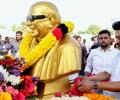
This article traces the history of the DMK's fight for state autonomy, beginning with C.N. Annadurai's advocacy in the 1960s and culminating in M. Karunanidhi's resolution in the Tamil Nadu Assembly in 1974. The article highlights the key figures involved, the arguments presented, and the impact of the Rajamannar Committee Report.

The Allahabad High Court Bar Association (HCBA) has condemned the "clandestine" manner in which Justice Yashwant Varma, who was transferred from the Delhi High Court amid cash-at-home allegations, was administered the oath of office. The HCBA, which had opposed the judge's repatriation, questioned why the oath was not notified to the Bar and alleged that the move has further eroded public trust in the judicial system. The HCBA has urged the Chief Justice of the Allahabad High Court not to assign any administrative or judicial work to Justice Varma. The incident of cash recovery has reignited debate over the issue of judicial accountability, with calls for stringent action to restore faith in the judiciary.
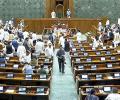
The Rajya Sabha, India's upper house of parliament, was adjourned on Monday without transacting any business due to a heated exchange between the ruling Bharatiya Janata Party (BJP) and the opposition Congress over the issue of reservations to Muslims in public contracts in Karnataka. The BJP accused Congress of seeking to amend the Constitution to provide reservations based on religion, while Congress asserted its commitment to protecting the Constitution. The debate centered around a statement by a senior Congress leader, who was reportedly advocating for changing the Constitution to provide reservations for Muslims.
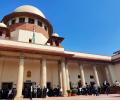
The Supreme Court on Monday agreed to consider listing for urgent hearing the petitions challenging the constitutional validity of the Waqf (Amendment) Act, 2025.
The Supreme Court of India will likely hear a batch of petitions challenging the constitutional validity of the Waqf (Amendment) Act, 2025 on April 15. The Act, which came into force on April 8, has been met with widespread criticism from various stakeholders, including politicians, the All India Muslim Personal Law Board (AIMPLB), and Jamiat Ulama-i-Hind. They argue that the law is discriminatory and violates the fundamental rights guaranteed under Articles 25 and 26 of the Constitution. The petitions allege that the amendments give the government more control over the administration of Waqf, effectively sidelining the Muslim minority from managing their own religious endowments.

The high court noted that the contention of the petitioner demanding a virginity test of his wife is unconstitutional as it violates Article 21 of the Constitution which includes the right to dignity of women.

Prem Bihari Narain Raizada wrote 145,000 words in flowing italic styles. It took him 6 months and hundreds of nibs.
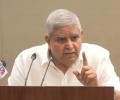
Rajya Sabha member Kapil Sibal has criticised Vice President Jagdeep Dhankhar for questioning the judiciary over the timeline for the president to take decisions, calling it "unconstitutional " and a lowering of the dignity of the chair. Sibal asserted that Dhankhar's remarks are not neutral and amount to an attack on the judiciary by the executive. He also pointed out that the president acts on the aid and advice of the council of ministers, and therefore, the president's power cannot be curtailed. Sibal urged Dhankhar to seek a review of the judiciary's decision or an advisory opinion from the Supreme Court if he has problems with it. He also questioned why Dhankhar only focuses on actions taken during Congress governments and not after 2014.
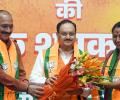
BJP president JP Nadda said on Sunday that the party does not seek to control the Waqf Board but wants to ensure that those managing it operate within the bounds of law and adhere to established rules. He said the properties and funds of the Waqf Board should be dedicated to promoting education, providing healthcare and employment opportunities for the Muslim community. Nadda also highlighted the BJP's growth and achievements, emphasizing its commitment to national unity and cultural heritage.

A three-judge Supreme Court bench will hear petitions challenging the constitutional validity of the Waqf (Amendment) Act, 2025, on April 16. The petitions, including those by politicians and the All India Muslim Personal Law Board (AIMPLB) and Jamiat Ulama-i-Hind, were filed in the top court challenging the validity of the newly-enacted law. The Centre has filed a caveat in the apex court, seeking a hearing before any order is passed.
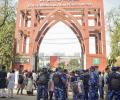
A fresh plea has been filed in the Supreme Court challenging the constitutional validity of the Waqf (Amendment) Act, 2025, claiming it was a "blatant intrusion" into the rights of a religious denomination to manage its own affairs in the matter of religion. The plea, filed by Samastha Kerala Jamiathul Ulema, argues that the amendments would distort the religious character of Waqfs and irreversibly damage the democratic process in their administration. Several other petitions have been filed in the apex court challenging the validity of the bill, including those by Congress MP Mohammad Jawed, AIMIM president Asaduddin Owaisi, and AAP MLA Amanatullah Khan.
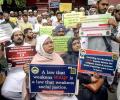
'The new Waqf bill sows the seed for conflict in every town and village of India.'
The Supreme Court will hear a plea seeking an independent selection process for the Comptroller and Auditor General of India (CAG) on March 17. The PIL, filed by the Centre for Public Interest Litigation, argues that the current system of appointment solely by the executive and the prime minister violates the Constitution and undermines the CAG's independence. The petition calls for a transparent process involving the prime minister, Leader of the Opposition, and Chief Justice of India. The PIL contends that the CAG's role as a watchdog over government finances requires a fair and non-arbitrary appointment procedure.

Comedian Kunal Kamra has been granted interim anticipatory bail by the Madras High Court in a case filed against him for allegedly making defamatory remarks against Maharashtra Deputy Chief Minister Eknath Shinde during a stand-up comedy show. Kamra, who resides in Tamil Nadu, was summoned by the Mumbai Police and feared arrest, prompting him to seek bail from the Madras HC. The court granted him bail until April 7, on the condition that he executes a bond to the satisfaction of the judicial magistrate at Vanur in Villupuram district, Tamil Nadu.
The Supreme Court of India has ordered the burial of a pastor whose body has been lying in a mortuary since January 7th, after a dispute arose regarding the location of his burial. The court issued a split verdict, with one judge ruling for burial on the family's private land and the other for a designated place away from the village. The decision was made due to the prolonged delay in the burial and the potential for unrest. The court ordered the state government to provide security to prevent any further incidents.

Stand-up comedian Kunal Kamra has once again found himself at the center of a controversy, this time for his comments about Maharashtra's Deputy Chief Minister Eknath Shinde. Kamra has been a controversial figure for years, with his comedy often targeting politicians and other public figures. This latest incident has led to a backlash from Shinde's supporters, who have vandalized the venue of Kamra's show. Kamra has a history of making controversial remarks, including heckling a TV anchor on a flight and making comments about the judiciary.

The Supreme Court of India will examine the jurisdiction of the Lokpal, India's anti-corruption ombudsman, in entertaining complaints against sitting high court judges. The court is considering a suo motu proceeding initiated over the Lokpal's January 27 order on the issue. The case involves two complaints filed against a sitting additional judge of a high court, alleging that he influenced a judge of the subordinate judiciary and a judge of the same high court set to deal with a suit filed against the complainant by a private company.

'One murder gets national coverage because of political connections.' 'The other two and the brutal torture? Not much outrage.' 'Are Dalit and OBC lives worth less?'

Opposition parties in India, led by the Congress, have demanded a detailed discussion in Parliament on alleged discrepancies in voter lists. Rahul Gandhi raised the issue in the Lok Sabha, highlighting concerns about the integrity of the electoral process. The opposition alleges large-scale duplication of EPIC numbers, which they claim undermines voter integrity and the electoral process. They have also pointed out instances of inflated voter lists in states like Maharashtra and Haryana. The Election Commission has acknowledged discrepancies but maintains that these are not widespread and that corrective measures are being taken. The opposition, however, insists on a comprehensive discussion on the matter to ensure the integrity of elections in India.

'What attitude has spawned such gruesomeness in the state of Saint Tukaram, Saint Dnyaneshwar, and great leaders like Chhatrapati Shivaji, Chhatrapati Shahu, Phule and Ambedkar?'
Kharge claimed that the wording as well as the tone and tenor of the remarks made by the Home minister "are clearly satirical and made in a very bad taste".
Vice President Jagdeep Dhankhar has questioned the Chief Justice of India's involvement in executive appointments, specifically citing the selection of the CBI director. He believes this practice undermines democratic principles and calls for revisiting the existing norms. Dhankhar also raised concerns about the "doctrine of basic structure", suggesting it has a debatable jurisprudential basis. He emphasized the importance of each institution operating within its constitutional boundaries and highlighted the need for coordinated autonomy. The vice president also discussed the need for a balanced approach to judicial review and the importance of judges focusing on judgments rather than other forms of expression. He stressed the need to revisit the current state of affairs to restore the judiciary's sublimity.
The Supreme Court of India has expressed concern over the protracted trials in heinous offences related to Maoist activities, stating that indefinite incarceration violates the right to liberty under Article 21 of the Constitution. Two separate benches of the court granted relief to two accused, citing the delayed trials. One bench expedited the trial of a man accused of transporting ammunition for a banned organization, while the other granted bail to a man accused of transporting materials for Naxal activities. The court emphasized the importance of speedy trials and suggested the establishment of special courts to handle Maoist-related cases, aiming to expedite proceedings. The court also criticized the practice of examining an excessive number of witnesses, which can lead to indefinite delays in the conclusion of trials.

The Supreme Court of India has dismissed a plea seeking directions to states to take immediate action against mob lynching and cow vigilantism, particularly against Muslims. The court stated that it was not feasible to "micro-manage" such incidents from Delhi and referred to its 2018 verdict, which issued guidelines to address mob violence and cow vigilantism. The court also noted that the new Bharatiya Nyaya Sanhita (BNS) criminalizes mob lynching as a separate offence. The plea argued that there was "gross non-compliance" with the 2018 directions, but the court maintained that authorities were bound by its previous rulings.
 © 2026 Rediff.com - Investor Information - Advertise with us - Disclaimer - Privacy Policy - Sitemap - Feedback - About us - Terms of use - Grievances