
The Congress party has accused the Modi government of a 'deny, distract, lie, and justify' (DDLJ) policy regarding China, alleging territorial setbacks and misplaced economic priorities.

"The Modi government's approach to the entire crisis could be described as DDLJ: Deny, Distract, Lie and Justify," Ramesh said.

'With continued focus on votes, upcoming by-polls and purchasing politicians, the political hierarchy has little time for national defence.' 'They would do well to heed a veteran scholar, who says, "There will be war with China in the next few years. The next full scale war will have the involvement of Pakistan and terror elements, insurgents and intelligence assets operating inside India",' warns Lieutenant General Prakash Katoch (retd).

Disengagement from the LAC will remain a chimera because China has given enough indications that the PLA will not move back any more. China has even deployed drones to monitor and deny any patrolling by Indian troops even in the buffer zones which are all in Indian Territory, explains Lieutenant General Prakash Katoch (retd).

Chief of Defence Staff General Anil Chauhan on Tuesday said the deployment of the Chinese military on India's northern borders is not increasing day by day.
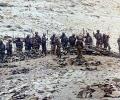
Sources said the Chinese had come heavily prepared but did not expect the Indian side to be well prepared.

The Chinese Army troops try to enter these areas every year and try to patrol out their claim line which India does not allow.

'We have to be prepared on the borders to withstand Chinese expansionist designs.'
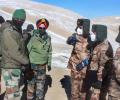
Sources said the Indian troops resolutely confronted the Chinese PLA soldiers.
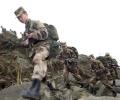
The Indian Army has been slow to react. Indian troops have deployed in the vicinity of PLA incursions, but there are no attempts to outflank Chinese positions.

India should watch the emergence of the situation and then see how others react, he said adding that Russia has stood by India in very difficult times.

'The Chinese are retaining geostrategic pressure on India by keeping troops there and building infrastructure continually.'

'He is psychologically preparing the PLA and the Chinese public to avoid a loss of face.'

A weaker Russia, a sobered China at a time when Xi Jinping is manoeuvring to protect his third term prospects, a reunited West, a chaotic Pakistan. This is a perfect set of strategic circumstances. It is for India now to consummate this historic opportunity, argues Shekhar Gupta.

'The wish is that 2022, if not bring us into happier times, at least sees some easing of the pain,' hopes Aakar Patel.
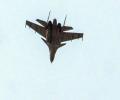
In the last couple of weeks, the Chinese forces have brought in heavy air superiority aircraft like the Sukhoi-30 and its strategic bombers to the rear locations which have been detected flying near the Indian territory maintaining the 10 km plus distance from the boundary.

New Delhi must clearly demonstrate to Beijing that China will pay a price for its relentless strategic undermining of India, says Ajai Shukla.

'The PLA has continued to do exercises and drills and recently carried out air exercises with fighter jets.'

'Galwan has turned everything.' 'The casualties on both sides alerted the Chinese to the fact that Indians are not going to take it lying down.'

'The military advantage the Indian Army had gained by the Special Frontier Force occupying the heights of the Rezang La-Rechin La ridge on the Kailash Range is lost without the PLA withdrawing to east of the Khurnak Fort line.'
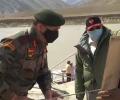
'We should not minimise the seriousness of Chinese encroachments because their perception is different.' 'Nor should we fall into the trap of accepting so-called 'buffer zones' in areas of overlapping claims. We cannot have buffer zones in our own territory,' asserts Ambassador Shyam Saran, a former foreign secretary.
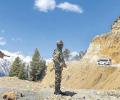
This is the third round of Corps Commander-level talks being held. The first two rounds had taken place in Moldo on the Chinese side of the LAC.

Sibal asked Modi to stop doing the politics of "illusion and delusion" and showing "red eyes" to China, and protect Indian territory.

The marathon fourth round of Lt Gen-level talks also focussed on steps for pulling back large number of troops and weapons from rear bases along the Line of Actual Control in eastern Ladakh.

'The Chinese can't be trusted hence the need to verify and re-verify.'
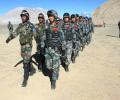
During the course of the intense and complex negotiations between senior commanders of the two armies that ended at 2 am on Wednesday, the Indian delegation also apprised the Chinese PLA about the "red lines" and conveyed that the onus was largely on China to improve the overall situation in the region, the sources said.

China has chosen to keep New Delhi guessing, while retaining for itself the option of constantly changing facts on the ground and shifting the LAC westwards -- the strategy called 'salami slicing', notes Ajai Shukla.
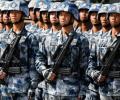
With the Indian Army having blocked the PLA several kilometres inside India, hundreds of soldiers from both sides remain in a tense face-off.
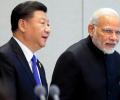
It is apparent that an easing of tensions at the border and a disengagement of troops is on the cards, observes Ambassador M K Bhadrakumar.

'The potential of one such LAC engagement going out of control and leading to heavy casualties cannot be ruled out,' warns Lieutenant General Syed Ata Hasnain (retd).

'When we want to, we will be able to breach it, go across and strike when we need. This was the message we wanted to convey and we did'
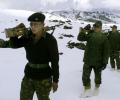
'The situation in Doklam has plateaued; militarily, the Chinese know they can do nothing here,' an Indian general tells Ajai Shukla.
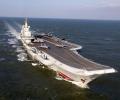
'The Chinese being focussed more seawards is definitely better for India with China being the looming threat along our land borders,' says Brigadier S K Chatterji (retd).

'The Panchsheel Agreement is unique in the annals of international relations as it stands out as a bizarre illustration of a prime minister trading his country's crucial national interests solely to buffer his personal international image,' feels R N Ravi.
