
The BSF troops retaliated, resulting in exchange of fire, which was still going on when last reports came in.

An eight-member Pakistani judicial commission team crossed into India from the Wagah border check post in Punjab on Saturday to conduct the much-delayed cross-examination of witnesses in the 2008 Mumbai attacks, which claimed 166 lives.

Amid growing strain in India-Pakistan ties, the government is planning to fast-track four projects in Indus river basin to increase irrigation area in Jammu and Kashmir by nearly 2.05 lakh acres, weeks after India decided to "exploit to the maximum" the water of Pakistan-controlled rivers, including Jhelum, as per Indus Water Treaty.

Aziz said unilateral revocation of the treaty can pose a threat to Pakistan and its economy.

Because of the treaty, no big dams or power projects can be built by India on Jhelum, Indus or Chenab.
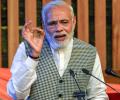
Speaking for the first time after the government announced an halt to anti-militancy operations in the state during the holy month of Ramzan, the prime minister said there is no alternative to peace and stability.

Of India's sacred rivers, she is the holiest. It is believed that even the Ganga comes in the form of a cow for a purifying bath in the Narmada, says Geetanjali Krishna.

Last week's heavy snowfall seems to have affected electioneering in Kashmir. South Kashmir's Anantnag and the prestigious Srinagar constituencies go to polls on April 24 and April 30 in the five phased Lok Sabha polls in the state.

Experts say the treaty needs a review to address the ongoing and the likely impact of climate change on river-flow

He regretted that whatever measures governments in the state and Centre should be taking for normalisation of situation were being taken by the opposition parties.
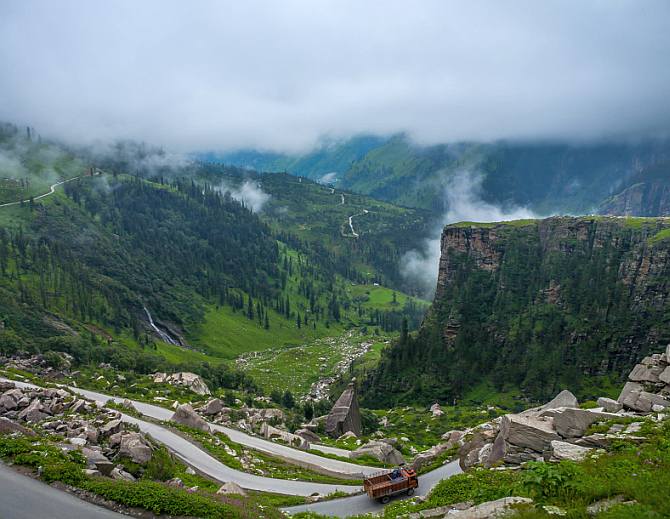
Go, live your life in Leh for as long as you want.

A veteran of anti-insurgency operations, Head Constable Sanjewan Singh was martyred with Colonel M N Rai in Kashmir. He leaves behind a pregnant wife and a three-year-old son.

Vikas Swarup says India unlikely to give Pathankot-like offer to Pak in Uri attack probe.

'Tying somebody to the jeep is not the military way, but the officer was able to come out of the situation without any bloodshed.' 'I am not supporting him, but I am also not criticising him.' 'He had to use some mechanism to save the uniformed personnel, many of whom were Kashmiri boys of the J&K police,' points out Lieutenant General D B Shekatkar (retd), who was instrumental in the surrender of a record 1,267 terrorists in Kashmir.
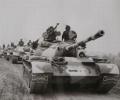
The 1965 war teaches us that war by escalation is a real possibility. Despite clear threats, Pakistan never believed that India will ever cross the international border. In the age of nuclear deterrence, this failure to deter Pakistan is the central lesson of 1965, says Colonel Anil Athale (retd).

50 years after the 1965 War, India still thinks we can have a 'limited war' when our opponent has time and again shown it does not believe in a limited war, says Colonel Anil A Athale (retd).

'For lakhs of people in the flood-afflicted state, battling against the elements is taking a huge toll. This is the time of the year that apples ripen, rice starts being harvested and preparations start in full swing to put aside some of the food stocks for the long winter months ahead. At this moment, though, people there believe if they can succeed in coming out of this calamity in one piece they will have won the war,' says Rashme Sehgal.

'We don't know what the reasons were that we gave back the Haji Pir Pass which was strategically very important. Today the entire infiltration into Kashmir takes place from that area. If we had retained that post that we had captured, things could have been different.' 'A lesson we need to learn is if you start losing the gains of war at the negotiating table, they become a disincentive for future wars,' says Lieutenant General D B Shekatkar (retd), reviewing the lessons from the 1965 War.

'As the night wore on, we could hear insects, see fireflies and slowly, the stars took over the naked sky.' 'For those of us who spend the largest part of our lives in a cement jungle and wake up to machine sounds, this was music.'
 © 2026 Rediff.com - Advertise with us - Disclaimer - Privacy Policy - Sitemap - Feedback - About us - Terms of use - Grievances