
The bench refused to entertain the plea filed by NGO Association for Democratic Reforms and dismissed it.
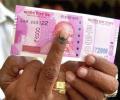
The electoral bonds scheme for funding political parties should not become a tool for "legitimisation of quid pro quo" between power centres and people who are benefactors of that power, the Supreme Court said on Thursday as it underscored the need for reducing the cash component in the electoral process.
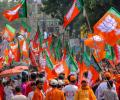
The BJP declared a total income of Rs 1917.12 crore during 2021-22 and spent Rs 854.467 crore or 44.57 per cent of it.

The BJP and Congress are the top two beneficiaries of the electoral bonds, followed by the Trinamool Congress.

A bench comprising Chief Justice Uday Umesh Lalit and Justice Bela M Trivedi said a representation may be made by petitioner Ashwini Upadhyay to the poll panel or other authorities for consideration.
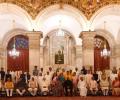
About 24 or 31 per cent ministers have declared serious criminal cases including cases related to murder, attempt to murder, robbery etc.

Uttar Pradesh Election Watch and the ADR have analysed the self-sworn affidavits of 45 of the total 53 ministers, including the chief minister.
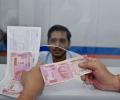
The "opaque" electoral bonds scheme for funding political parties will "destroy democracy" as it promotes corruption and does not allow a level playing field between the ruling and opposition parties, the petitioners challenging the validity of the scheme told the Supreme Court, which on Tuesday observed election funding was a "complicated issue".

The Association for Democratic Reforms, in its report, analysed the candidates contesting the fourth phase of elections in Uttar Pradesh. Vicky Nanjappa outlines the interesting findings

About 40 per cent of sitting MPs have criminal cases registered against them out of which 25 per cent have declared serious criminal cases under charges of murder, attempt to murder, kidnapping and crimes against women, according to poll rights body Association for Democratic Reforms (ADR).

The total income of national and regional parties from unknown sources for 2020-21 stands at Rs 690.67 crore.

Chief Minister Nitish Kumar and Deputy Chief Minister Tejashwi Yadav also have cases registered against them.

The Aam Aadmi Party tops the list with 61 such candidates.
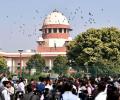
A bench of justices S Abdul Nazeer and V Ramasubramanian said the Kerala Police Act was the successor legislation of certain police enactments of the colonial era which aimed at scuttling the democratic aspirations of the indigenous population.

The Association for Democratic Reforms has complained against six major political parties for not appointing Public Information Officers.
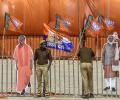
Electoral trust is a non-profit organisation formed in India for orderly receiving of contributions from corporate entities and individuals to political parties.

The common man in India is bogged down by corruption and there is a need to fix accountability at all levels, the Supreme Court observed on Friday as it dealt with a petition seeking debarment of those against whom charges have been framed in criminal cases from contesting elections.

The Bahujan Samaj Party declared that it did not receive any donation above Rs 20,000 during 2021-22 as it has been declaring for the past 16 years, the ADR claimed.

The Supreme Court on Tuesday said it will consider whether the pleas challenging the validity of the electoral bond scheme for political funding of parties can be referred to a Constitution bench for an "authoritative pronouncement".
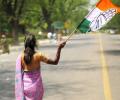
Only 18 Bharatiya Janata Party legislators switched parties to contest the polls in this period
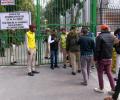
The stage is set for the high-stakes civic polls in Delhi on Sunday, with poll authorities and security forces all geared up for the elections, largely being seen as a three-way contest among the Aam Aadmi Party, the Bharatiya Janata Party and the Congress.

According to the analysis, 37 of the 40 BJP MLAs and 29 of the 31 Congress legislators are crorepatis.
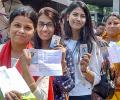
As many as 1,500, or 19 per cent, of all candidates contesting the Lok Sabha polls, face criminal cases, according to an analysis by election watchdog Association for Democratic Reforms (ADR).

The bench said the petition has relied on a March 2 verdict of the apex court which had ruled that the appointment of the Chief Election Commissioner and ECs will be done by the President on the recommendation of a committee, comprising the prime minister, Leader of the Opposition in Lok Sabha and the CJI, to maintain the "purity of election".
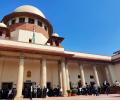
Electoral bonds have been pitched as an alternative to cash donations made to political parties as part of efforts to bring transparency in political funding.

Of the 788 candidates contesting 89 seats in the first phase of Gujarat Assembly polls, 211 are 'crorepatis', with the ruling Bharatiya Janata Party accounting for 79 such nominees, the Association for Democratic Reforms (ADR) said in a report on Thursday.
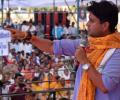
Total of 59 seats spread across 6 states and one Union Territory will go to polls in the sixth phase on May 12.
Donations from corporates to the national parties increased by 109 per cent between FY 2017-18 and 2018-19, said an analysis by the Association for Democratic Reforms (ADR), an NGO working for bringing in transparency in electoral politics.

'Justice B V Nagarathna has excellent human qualities and is a stickler for the law.'

The Congress raised Rs 918.03 crore, of which 383.26 crore came through the debt instrument, which can be purchased from select branches of State Bank of India and donated to any political party.

The Aam Aadmi Party (AAP), which is contesting 88 seats out of the total 89, tops this list among major political parties in the fray with 36 per cent of its candidates having criminal cases. Thirty per cent of its candidates are facing serious cases such as murder, rape, assault, kidnapping, among others, the ADR said in its report. The number of candidates having criminal cases fielded by the AAP is 32.

The richest candidate in the first phase is from Chevella. The poorest candidate is also contesting from the same constituency in Telengana!
A breakdown of candidates in the first five stages of the election by the Association for Democratic Reforms and National Election Watch offers a fascinating insight into the declarations made by this year's Lok Sabha hopefuls.

The Supreme Court on Wednesday delivered a landmark verdict with regard to convicted MPs and MLAs. The judgment has ruled that a convicted elected representative cannot continue in office and the conviction will lead to instant disqualification of the elected representative. The judgement is important considering the fact that India has 1,460 sitting MP's and MLA's with a criminal background.
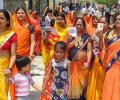
59 constituencies across 7 states and one Union Territory will go to polls in the seventh phase on May 19.
Professor Sastry says in this interview with rediff.com's Vicky Nanjappa that every political party appears to be taking a shortcut and hence there is so much criminlisation in politics.
About 42 per cent ministers in Karnataka self-declared criminal cases pending against them in their affidavits filed during the last held assembly elections in 2008.

As many as 13 (93%) are crorepatis with their average assets pegged at Rs 3.93 crores, the report said.

943 candidates are contesting 71 seats spread across 9 states.
Only three of the 188 candidates analysed by the Association for Democratic Reforms and the Nagaland Election Watch have criminal cases pending against them. This is a refreshing change as elections in India often witness hordes of tainted politicians contesting for the coveted seats.
