
Cartoonist Aseem Trivedi, who was recently arrested under sedition charges as well as Sec 66A of the Information Technology Act for his controversial cartoons, on Saturday ended his eight-day fast demanding immediate scrapping of the "unconstitutional" law.
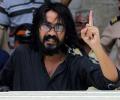
Justice Markandey Katju, chairman of the Press Council of India, has defended cartoonist Aseem Trivedi, who has been arrested on sedition charges for 'mocking the Constitution'.

'Journalists must ask the Mumbai police why are they sending notices via X to cartoonists.' 'The Mumbai police must come clean. Who is giving them such orders?'

The problem with the debate on freedom of speech and expression in India is that we don't debate what is "reasonable restriction" and what is censorship. We examine every cartoon, painting, film and book through our ideological prism, says Shivam Vij
Arvind Kejriwal-led India Against Corruption on Monday came out in support of Koodankulam protesters and jailed cartoonist Aseem Trivedi, accusing the government of using charges of sedition to muzzle voices of dissent. Addressing a press conference, Kejriwal, Prashant Bhushan and Yogendra Yadav condemned the police action against locals protesting against a nuclear plant in Tamil Nadu's Koodankulam and slapping sedition charges on Trivedi.
The sixth edition of Bigg Boss had its first brush with controversy on Thursday as suspected Republican Party of India activists attacked the office of Colors TV channel in Mumbai over demands to eliminate contestant Aseem Trivedi from the reality show.
Chastened by the outrage caused by arrest of cartoonist Aseem Trivedi for "sedition", the Maharashtra government has now ordered an inquiry into how he came to be booked for the serious offense.
The Bombay high court on Friday slammed the Mumbai police for arresting cartoonist Aseem Trivedi on "frivolous" grounds and "without application of mind", saying its action breached his freedom of speech and expression.

Bowing to public pressure and criticism from the court, the Maharashtra government on Friday informed the Bombay high court that it has decided to drop sedition charge against cartoonist Aseem Trivedi for allegedly insulting national symbols.
We list a few cases where individuals were charged with sedition resulting in a fierce public debate.
Cartoonist Aseem Trivedi, facing the charge of sedition among others, on Wednesday walked out of jail a day after the Bombay high court ordered his release on bail and vowed to intensify his campaign for scrapping of the sedition law.
Senior Bharatiya Janata Party leader L K Advani on Wednesday drew parallels with Emergency while hitting out at the Congress over the arrest of cartoonist Aseem Trivedi charged with sedition, but the comparison was dismissed as a "hyperbole" by key National Democratic Alliance ally Janata Dal-United.
A day after nephew and Maharashtra Navnirman Sena chief Raj Thackeray backed cartoonist Aseem Trivedi who was arrested on charges of sedition, Shiv Sena patriarch Bal Thackeray on Wednesday came out in his support and opposed the sedition law.
Cartoonist Aseem Trivedi, facing sedition charges, was granted bail by the Bombay high court and his associate said he will walk out of the Arthur Road jail on Wednesday.
Maharashtra Home Minister R R Patil on Tuesday said a decision on withdrawing charges against cartoonist Aseem Trivedi will be taken only after the investigation was over. Patil told reporters that he had asked the Mumbai police commissioner to find out what action could be taken against the cartoonist, who was arrested for allegedly objectionable cartoons of the national emblem and the Parliament.
The Congress on Monday disapproved of the arrest of cartoonist Aseem Trivedi on the charge of sedition, saying the action was a bit "over-stretched" and "not called for". At the same time, the All India Congress Committee advocated for "reasonable restrictions" on freedom of speech and called for respecting the national emblems.
Speaking on the phone from Mumbai just before his arrest, Aseem Trivedi explained that the cartoons intended to display the insult to the nation that is being done by politicians, and do not seek to insult national symbols in any way
The latest housemate to be evicted, Aseem Trivedi, vents out.
Freedom of expression cannot be constrained when it comes to books and encouraged when it comes to violence, says Mitali Saran
Chairman of the Press Council of India, Justice Markandey Katju, on Friday said that he was personally in favour of scrapping the sedition law. He also alleged that those who had slapped sedition charges had indulged in a serious offence and were liable to face criminal proceedings.
Maharashtra Navnirman Sena chief Raj Thackeray on Tuesday supported cartoonist Aseem Trivedi and demanded that he be set free and the sedition charge against him be dropped.
Charged with sedition, Cartoonist Aseem Trivedi was on Monday sent to jail for two weeks by a Mumbai court after police said it did not require his custody anymore two days after his arrest that has sparked an outrage.
Speaking on the phone from Mumbai just before his arrest, Aseem Trivedi explained that the cartoons intended to display the insult to the nation that is being done by politicians, and do not seek to insult national symbols in any way
The Bombay high court on Tuesday granted bail to cartoonist Aseem Trivedi, who is facing a sedition case, saying if drawing cartoons was the only allegation against him then his custody was not required. A division bench of Chief Justice Mohit Shah and Justice Nitin Jamdar directed Trivedi to be released on execution of a personal bail-bond of Rs 5,000.
In the last ten years, 96 per cent of the sedition cases against 405 individuals pertained to making critical remarks against Prime Minister Narendra Modi and Uttar Pradesh Chief Minister Yogi Adityanath, points out Ramesh Menon, author, Modi Demystified: The Making Of A Prime Minister.
The Maharashtra government has asked it to rule out any ambiguity during invocation of sedition charge and not to invoke it against those trying to bring change through legal means.

One would not think that a Facebook status or a tweet could land you in jail, at least not in India -- the world's largest democracy. However, the reality is a lot more brutal in India, which has a shameful history of locking up its citizens for dissenting viewpoints. According to Mint, at least 50 people have been arrested through 2017 and 2018 for posts on social media. Syed Firdaus Ashraf/Rediff.com presents some of the most prominent cases.

Bengaluru police had slapped sedition charges against Amnesty after an event it had organised on allegations of human rights violations in Jammu and Kashmir.
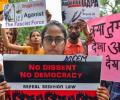
Why should an elected government, any party's government, need a law to protect itself from its people? asks Shekhar Gupta.

'Victims' who bore the brunt of the controversial section 66A of Information Technology Act for posting allegedly "offensive" content online heaved a sigh of relief as the Supreme Court on Tuesday, in its landmark verdict, scrapped the provision dubbing it "unconstitutional".

Before the Supreme Court struck down Sec 66A of the IT Act, it was used with devastating effect against anyone posting critical comments online.
