
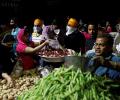
While okra was being sold for Rs 100-120 a kg and cauliflower for Rs 120-140 a kg in Mumbai and its suburbs, all other vegetable prices have increased by almost 100 per cent since July 20.
There have been several instances of traders dumping fruits and vegetables outside mandis. Or of farmers dumping produce outside their villages or feeding them to their animals.

Three union ministers -- Agriculture Minister Narendra Singh Tomar, Food Minister Piyush Goyal and Minister of State for Commerce and Industries Som Prakash -- will hold discussions again with 40 farmer unions' leaders, including the Bharatiya Kisan Union which is spearheading the protests.

The Congress is strongly opposed to the three Central legislations which were signed into laws by President Ram Nath Kovind on Sunday.

A group of 200 farmers will travel to Jantar Mantar from the Singhu border in buses with a police escort and hold protests there from 11 am to 5 pm, sources in the Delhi Police said.

'We will be hoisting the tiranga, but this kind of celebration is uncalled for when the farmers in this country are dying by suicides, their families are ravaged by poverty and farmers are not enjoying any freedom.'

He also said that train services will resume after the state government and protesting farmer unions assure the safety of the tracks. Tomar and Union Food, Commerce and Railways Minister Piyush Goyal held a day-long meeting with representatives of various farmer unions at Vigyan Bhawan in New Delhi.
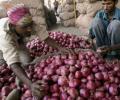
In the retail markets, fresh onion is sold between Rs 10 and Rs 12 a kg. Now, farmers have to sell onion at a loss of Rs 2-3 per kg if transport cost is included.
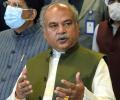
Responding to the NCP leader's remarks, Tomar said Pawar, who is a veteran leader, is also considered well-versed with the issues and solutions relating to agriculture. "Pawar himself tried hard to bring the same agriculture reforms earlier."

Barring stray incidents of violence like stone pelting, the shutdown called by the MVA allies Shiv Sena, the Congress and the Nationalist Congress Party was largely peaceful.

The move comes days after Congress chief Sonia Gandhi asked states under party's rule to enact legislations to bypass Centre's three farm-related laws that have triggered protests by farmers.

The application, filed through advocate AP Singh, said, "The Acts were passed hastily without adequate discussion... Inherent weaknesses of the agricultural sector cannot be addressed by way of monetization of farmers."

The committee has been tasked to come up with policy measures to boost agriculture exports, raise growth in food processing, attract investments in modern market infrastructure, value chains and logistics.

What some of us think are strong, bold and firm decisions are cruel, harsh and unwanted for others. This is what we need to consider when we look at what has happened with the farm laws, asserts Aakar Patel.

'Now that the home minister met us to discuss our demands a hope has definitely been kindled that farmers's demands will be met by this government.'

The Agricultural Produce Marketing Committee law allows mandis to remain in the grip of a middlemen cartel, with clear links to politicians who run the governments.
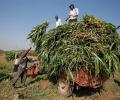
Lauding the farm sector for demonstrating resilience during the pandemic, the Economic Survey on Friday suggested the government to see farm sector as a "modern business enterprise" for which "urgent reforms" are required to enable sustainable and consistent growth. India's agricultural sector has shown its resilience amid the adversities of COVID-19 induced lockdowns, the Survey noted. The agriculture and allied activities were the sole bright spot amid the slide in GDP performance of other sectors, clocking a growth rate of 3.4 per cent at constant prices during 2020-21, it added. According to the Survey, the farm sector has got "renewed thrust" due to various measures on credit, market reforms and food processing under the Aatmanirbhar Bharat announcements.
In most cases, however, retail consumers are paying higher prices in the absence of direct procurement from aggregator or farmers.

In MP, farmers say sales under new 'Sauda Patrak' method below MSP; Haryana mustard farmers wait for their turn to sell. The annual purchases of major rabi crops in North India largely wheat, mustard and also chana to some extent have been delayed as most cereal mandis were closed in the aftermath of the nationwide coronavirus lockdown.
Among the key demands of agitating farmers has been a legal guarantee on minimum support price (MSP). The protest reached a crescendo when thousands of farmers from Punjab and elsewhere marched towards Delhi late last year and decided to block the main entry points once they were denied entry. The Centre, on its part, held 11 rounds of discussions with the protesters and even offered to amend some of the provisions without much success. With now one of their chief demands met, farmers have now moved on to force the government to concede on MSP.

Kiran Vissa, co-convenor of National Alliance for Sustainable Agriculture, said that amendments to the EC Act have nothing to do with farmers' welfare but instead meant to please big players and agriculture companies. This is because small and marginal farmers don't have the storage capacity to attract provisions of the EC Act.

V Singh said that "actual farmers are very happy with what has been done in last six months."

In a communication to the chief secretaries of the states and Union territories, Union Home Secretary Ajay Bhalla said the guidelines for the fourth phase of the lockdown were issued after taking the views of the states, following a video-conference held by Prime Minister Narendra Modi with chief ministers on May 11.

Critics who cannot stop gloating, pronouncing Modi to be a lame-duck prime minister, may be making a huge mistake, predicts Virendra Kapoor.

India's goal of self-reliance has been paramount in the policy and practice of the country. The COVID-19 crisis gave us lessons on how to speed up efforts in that direction, he said.
Onion is currently trading between Rs 70 and Rs 80 in retail markets across the country.

The report admits that converting MSP to a floor price of auction on the eNAM portal will not completely solve the problem as the current data shows that average modal prices in e-NAM mandis is lower than the minimum support price in all commodities except urad.

'Government intervention in agricultural trade is a problem for farmers.'

With a view to reduce wastage of farm produce, Finance Minister Pranab Mukherjee on Monday announced to set up 15 more mega food parks in the country.

According to the ministry's data updated in the evening, the highest number of confirmed cases in the country are from Maharashtra at 1,574, followed by Tamil Nadu at 911 and Delhi at 903.

Most key rabi-producing states of north India, such as Madhya Pradesh and Rajasthan, have staggered their procurement to enable farmers to come in batches, so that there is no overcrowding. The Centre has also set up a call centre to coordinate the inter-state movement of farm commodities.

After government's measures like export ban and import from Pakistan, average wholesale prices of onion in Nashik district's various Agriculture Produce Market Committee (APMC) markets have come down by around 45 per cent to Rs 2,071 a quintal in the last three days.

Price of ladies finger shot up staggering 236% at Vashi wholesale market last month.

With the farmers' protest against the three new laws and in support of legalising the minimum support price (MSP) going strong, state governments have announced a slew of measures in their annual Budgets to placate farmers. The Centre kicked things off in the Union Budget by assuring farmers that the MSP would continue and coming out with a report card to demonstrate its commitment. However, these efforts don't seem to have yielded tangible results. In their respective Budgets, states chose to go a step further by announcing a variety of measures.

Retail prices of tomato had touched almost Rs 80 per kg in major cities owing to short supply and transportation cost over the past few weeks following heavy downpour.

'We need to further catalyse economic growth and the government needs to increase revenue,' says G K Agarwal, BJP's national spokesperson on economic affairs.

'Interestingly in spite of slightly more than half (52%) the respondent farmers opposing the three new agri laws, almost 44% respondent farmers said the Modi government was 'pro-farmer'

'If a company contracts to buy its produce after three or four months, is there any loss in it?'

Releasing the manifesto titled 'Badlav Ka Sankalp' (commitment to change) in the presence of All India Congress Committee (AICC) general secretary Randeep Singh Surjewala and other Mahagathbandhan leaders, Tejashwi Yadav said their government, if elected, would first approve the process for appointments on about 10 lakh jobs in the government.

State Bank of India's house economists on Monday said the recent farm sector reforms reek of parochial thinking and promote lazy farming as they only cater to cereal-producing states. In the recently concluded monsoon session, the government rushed through three legislation to change the way agricultural produce is marketed, sold and stored by dismantling the decades-old APMC (Agricultural Produce Market Committee) mandis.
