
Mullah Akhtar Mansoor, a top Afghan Taliban leader who backed the peace process and a former aviation minister in the pre-2001 Taliban regime, has been appointed as the new chief of the insurgent group, as Taliban confirmed the death of its longtime supremo Mullah Omar.

The US has been in discussions with Pakistan but there has been not a 'sufficient amount of action' from it against terrorists.

Amid growing perception that he is batting for the Pakistani Taliban, cricketer-turned-politician Imran Khan has said he is neither anti-US nor anti-India but was against "their policies".
Pakistan is probably the most dangerous country for the world as it is ripe with the threats of terrorism, a failing economy and the fastest growing nuclear arsenal, a retired CIA official has said.

'Omar Khorsani has called repeatedly for the most barbaric of attacks. He is very adept on social media. He is, in other words, eerily similar to the ISIS leader Baghdadi.' 'The crux of the army's 'strategic asset' policy -- its policy of regarding militants as those that can help Pakistan pursue its regional interests -- is that Pakistan needs help in weakening India or in keeping its presence minimal in the region.' Michael Kugelman reveals what the world can expect next from the Tehreek-e-Taliban Pakistan, the terrorists responsible for the Peshawar school massacre.

Giving economic aid to Kashmir is like giving TB medicine to a patient suffering from cancer and expecting it to work, says Colonel Anil A Athale (retd).

The US also termed the release of Mumbai-terror attack accused Hafiz Saeed as "a step backward" in that direction.
'We are the first government that has started disarming militant groups. This is the first time it's happening. We've taken over their institutes, their seminaries. We have administrators there'

Pakistan's former Ambassador to the US Hussain Haqqani said that in WSJ article.

'Lingering border disputes and fierce geostrategic competition in South Asia between China and India are likely to temper any cooperation Beijing might hope to achieve with New Delhi in the SCO,' says P K Vasudeva.
A disparate global network of violent fundamentalist Islamic groups threatens India's eastern flank as much as the north and west with a real possibility of these spilling over into our borders, says Shyam Saran.

Afghan Taliban chief Mullah Akhtar Mansour, killed in a United States airstrike in Balochistan, was a frequent flyer and used a Pakistani passport for over nine years

The report said India continues to experience attacks by 'Pakistan-based terrorists'.

Prime Minister Narendra Modi's phone call to Trump will help restore a degree of sanity to Indian statecraft and diplomacy, notes Ambassador M K Bhadrakumar.
'Should the new ISIS leadership opt for a consolidation, the Afghan-Pakistan border would be an attractive place,' warns Brigadier S K Chatterji (retd).
All things taken into consideration, the Taliban statement on Kashmir portends trouble ahead. The Taliban is notorious for doublespeak and when it says there is no link between the Kashmir issue and the Afghan settlement, the opposite must be taken into account as well, points out Ambassador M K Bhadrakumar.

Khan's government will be the third consecutive democratic government in Pakistan since 2008.

Security Expert Bruce Riedel, who in an interview with rediff.com shortly after the Pathankot terror attacks began said that the attack underscored the determination of jihadist groups in Pakistan to sabotage any attempt at detente with India, writes in the Daily Beast that despite the US putting the Jaish-e-Mohammad on the terrorist sanctions list years ago, the outfit continues to coddle the Pakistani army.
Bruce Riedel, a former CIA analyst who was one of the key architects of US President Barack Obama's Af-Pak policy during his first term, has called for an offensive strategy against terrorist networks and this includes hitting out at terrorist groups inside Pakistan.

'It is for the first time in 70 years that the US has come out totally in India's favour on the Kashmir issue,' says Colonel Anil A Athale (retd).

'Perhaps the biggest indication was its striking decision in November to delink LeT from its aid certification process.' 'The administration decided that the US, in order to send military aid to Pakistan, would not need to certify that Pakistan is cracking down on LeT.' 'Perhaps the administration was trying to offer a carrot -- in effect, we're backing off on LeT, but in return we expect you (Pakistan) to go after the Haqqanis.' 'Either way, the optics were dreadful for the US given that Hafiz Saeed was released from house arrest a few days after the US move.' 'The US reacted angrily, but eventually it moved on, and refocused on its core concern: The Afghan-focused terror groups.'
The US said that it sees positive indicators in Pakistan, but...

A senate panel has approved a legislation which blocks $300 million United States military aid to Pakistan.

Driven from its self-styled caliphate in Iraq and Syria, Islamic State is down but not out. Where once they confronted armies, the extremist Islamist group's adherents have now staged hit-and-run raids and suicide attacks. In some cases, the group has claimed responsibility for atrocities, including the bombings of churches and hotels in Sri Lanka that killed at least 253 people. Its involvement is not always proven, but even if the link is ideological rather than operational, Islamic State still poses a security threat in many countries.

India on Tuesday supported Afghanistan's reconciliation process with the Taliban, but warned that it must not undermine the legitimacy of the Afghan government and should be within the internationally accepted "red lines".

Operation Radd-ul-Fasaad launched to fight terrorism across country.

'Bolstering India's conventional military capability against China is in America's strategic interest,' says military historian Colonel Anil A Athale (retd).

In a veiled reference to Pakistan, India said perpetrators of violence in Afghanistan must not be allowed safe havens in its neighbourhood, as it slammed the United Nations Security Council's sanctions regime for not designating the leader of Taliban as terrorist, calling such an approach a "mystery."
At least eight persons, including three Haqqani network commanders, were killed on Thursday in a rare United States drone strike outside Pakistan's tribal belt, just a day after a top official said the US had agreed to halt such attacks during negotiations with militants.

'Pakistan should evolve a common narrative. The country should have common position in combating all kinds of terrorism and not fight selectively.' 'The main motive was revenge, of course. But the Nobel Prize to Malala Yousufzai also contributed to the Taliban's anger' Bestselling Pakistani author and foreign policy expert Ahmed Rashid speaks exclusively on the Peshawar school attack with Sheela Bhatt/Rediff.com.

United States President Barack Obama secretly offered Pakistan in 2009 that he would nudge India towards negotiations on Kashmir in lieu of it ending support to terrorist groups like Lashkar-e-Tayiba and Taliban, but much to his disappointment Islamabad rejected the offer.

'China's growing nexus with Pakistan and the two countries' unresolved territorial disputes with India continue to pose a formidable national security threat to India,' says Brigadier Gurmeet Kanwal (retd).

Pak seeks US help to ease tensions with India.

As far as India is concerned, the danger is the potential of the IS to create mischief rather than its actual capability as of now, says Rajiv Kumar

'Parents would do well by the nation if they were to persuade their sons and daughters not to become puppets in the hands of the Islamists,' feels Lieutenant General Ashok Joshi (retd).

The question really is whether the US can be persuaded to embark on a path of calibrated and stronger sanctions on Pakistan.

Afghan President Hamid Karzai is in Pakistan on a day-long visit to mend frayed ties with Pakistan and to seek the release of high-profile Taliban prisoners, including Mullah Barader, to give a fresh impetus to the reconciliation process in his war-torn country.

Pakistan's new Army Chief has begun setting the stage to act against groups like LeT and JeM
'Some Pakistani generals are saying -- a little more so now than before -- that the biggest threat to Pakistan is not external -- not India -- but internal.' 'The proof of that will be their change of policies and that is going to be the challenge,' Rakesh Sood, one of India's most distinguished diplomats, tells Aziz Haniffa/Rediff.com in Washington, DC.
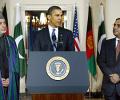
'The real purpose of President Obama writing to President Zardari,' Husain Haqqani tells Rediff.com's Aziz Haniffa, 'was to seek a turnaround on terrorism -- that Pakistan, whatever its grievances, cannot have jihadi groups operating openly on its soil.'
 © 2026 Rediff.com - Advertise with us - Disclaimer - Privacy Policy - Sitemap - Feedback - About us - Terms of use - Grievances