
'We ask Bollywood to see the writing on the wall, acknowledge their responsibility, and get on the right side of history.'

FMCG major Hindustan Unilever on Friday reported 23.43 per cent decline in net profit at Rs 1,019.25 crore (Rs 10.19 billion) for the first quarter ended June 30, 2013.

Tata Steel (then Tata Iron and Steel), the most valuable index company in 1991, is now the least valuable.
While HUL's Fair & Lovely was launched in 1975, Emami's Fair & Handsome was unveiled in 2005. Both companies now straddle both the men's and women's fairness categories in the country.

HUL global CEO, Paul Polman, on his third visit to India in little over a year, said his company's 170,000 employees across the globe and he were fast learning "how to climb mountains, as the market place was no longer a smooth surface".

An interview with HUL's managing director and CEO Sanjiv Mehta.

Banga has hung up his Unilever boots and moved on to private equity firm Clayton Dubilier & Rice (CD&R) as an operating partner.

Sebamed's campaign for its cleansing bar of the same name, released across print, television, digital and outdoor, has also named Santoor, a popular soap brand from Wipro Consumer Care.

Ajit Mishra, vice president, research, Religare Broking, answers your queries.

Personal care products, the firm's most profitable segment, has been losing market share consistently over the past several quarters. The first quarter of this financial year hasn't been too exciting either. Domestic sales grew by 12.8 per cent, with underlying volume growth of about 2 per cent.

"If at all Godrej plans to buy out the global household business of Sara Lee, there will be strong competition from multinationals like Unilever and P&G. So, it is unlikely that GCPL will go ahead with it," a research analyst from Religare Capital Markets said.

After the hit of the pandemic, India Inc is now worried about the adverse impact of inflation and higher commodity prices on their revenues and margins. The inflation scare is the strongest among manufacturers of consumer goods such as automobiles, consumer durables, and fast-moving capital goods (FMCG). Companies across sectors fear they will not be able to pass on the hike in input costs to their consumers due to weak demand, which, in turn, would lead to a hit on margins and profitability in the forthcoming quarters.

Equity investors grew richer by Rs 32.49 lakh crore in 2020 on the back of smart returns in the stock market which had a roller-coaster ride during the year hit by the coronavirus pandemic. The COVID-19 outbreak ravaged lives and livelihoods on a global scale, shuttering businesses and jolting world equities. But amid all the gloom, Indian stock indices gave hope of returning to winning ways towards the latter part of the year.

The market valuation of Reliance Industries, the country's most valued firm, is fast nearing the Rs 10 lakh crore mark, surpassing British energy major BP Plc.

Stock markets squandered early gains but managed to end in the green on Friday, propped up by heavyweight Reliance Industries which announced another stake sale deal for its digital platform. A strengthening rupee and firm global cues also supported the domestic bourses, traders said.

The Sensex ended up 98 points at 19,927 and the Nifty gained 18 points to end at 5,973.

Investors became richer by over Rs 6.34 lakh crore on Monday as markets gave a big shout-out to the Budget 2021-22, which analysts termed as 'unprecedented' against the backdrop of the pandemic-induced slowdown. Cheering the Budget proposals, the BSE benchmark Sensex zoomed 2,314.84 points or 5 per cent to close at 48,600.61. During the day, it jumped 2,478.63 points to 48,764.40. This was the best Budget-day gain for the markets since 1997, analysts said. Following the extremely positive market sentiment, the market capitalisation of BSE-listed companies rallied Rs 6,34,069.67 crore to Rs 1,92,46,713.70 crore.
Hindustan Unilever has many firsts to its credit. Now, it adds one more. India's largest fast-moving consumer goods company has found a new way of keeping in touch with its employees -- present and former.
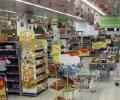
Experts point to the higher contribution of rural from the north for the growth reported by the region, a point endorsed by companies who've been pushing their presence aggressively there.
After a gap of five years, Hindustan Unilever has bagged slot zero position on B-school campuses. In 2007, the company had slipped to number 14 on the recruiters' list of B-schools. "It's an improvement of our brand value and affirmation of our employer brand," says Leena Nair, executive director HR, Hindustan Unilever.

The 50-share NSE Nifty stayed in the positive zone and retook the 9,900-mark to hit a high of 9,905.05 as buying paced up towards the fag end. It settled higher by 72.45 points, or 0.74 per cent, at 9,899.60.
HUL is all set to cut down on its managerial positions, with as many as 50 surplus managers losing their jobs.
Let's take a look at per capita consumption of ice cream around the world, including India.
HUL has recently developed a new process of manufacturing soap based on 'Plough Share Mixer' technology which eliminates the need for steam in soap making. The new technology cuts carbon emissions by 15,000 tons per year and HUL has been awarded carbon credits for this under the Clean Development Mechanism scheme operated by the United Nations Framework Convention on Climate Change.

The liquidity-fuelled rally will continue for some time, however, fundamentals are getting stretched.
While a merger means HUL taking over GSK Consumer's assets, including its employees, any mention of retention of employees beyond the merger is missing in the deal.

Ajit Mishra, vice president, Research, Religare Broking, answers your queries.
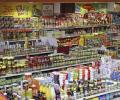
While sales momentum from rural areas may last another three to six months, sales growth in urban areas could stage a comeback by next year's June quarter as people learn to live with the coronavirus and economic activity gradually improves in the cities.

Wrapped in blue and orange wax paper, it's a familiar sight on the shelves of kirana stores across the country. Given how well travelled and mobile it is - starting its journey in Chennai, then turning to Singapore and now landing in Mexico - you could say it lives up to its name: Modern. Modern Food Enterprises, the company that manufactures and sells the bread in question as well as other bakery products under the "Modern" brand name, has recently been sold to the world's largest baking company, Grupo Bimbo, for an undisclosed amount. This latest transaction is the second change of guard at Modern within five years and third since the government divested the company at the turn of the century. At a time, when the National Democratic Alliance government has decided to privatise, or shut down, public sector enterprises except for those deemed strategic, Modern makes for a promising case study of how divestment led to the brand's growth, both in revenue and reach.
The haircare brand, acquired for Rs 330 crore, fetches HUL around Rs 400 cr of revenue annually.

T Thomas, former chairman of Hindustan Unilever, passed away March 2.
Larsen & Toubro, Hindustan Unilever, Infosys, Tata Consultancy and Sun Pharma -- have made it to the list
Second-ranked L&T has been rated highest on leadership

After 42 years at Hindustan Unilever (HUL) and different roles across Unilever's global operations, Harish Munwani, 65, retired as HUL's non-executive chairman. A day before Manwani bid adieu at HUL's 85th annual general meeting on Friday, he spoke to Viveat Susan Pinto & Vishal Chhabria on what kept him going at the firm and the challenges that await HUL.
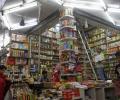
The first to see price hikes will be soaps. In the past six months, domestic palm oil prices have increased by 46 per cent. Palm oil is a key input going into soaps.

Mondelez has tied up with Warner Bros for its latest film Batman v/s Superman.
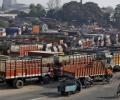
The possibility of harassment by cops and fear of the unknown have forced a large number of truck drivers to abandon vehicles at the transport centres and flee home. Transport of goods remains badly hit as confusion remains among various stakeholders and road transport becomes the victim of disconnect between policy makers and local authorities.
Employees of some top Indian companies were in for a pleasant surprise when they received a mail from their HR team announcing a hike in salaries and bonuses. Led by IT firms and start-ups, HR managers say that while some have offered cash and stock options, others are in a wait-and-watch mode and add the trend will pick up in other sectors. For example, IT giant Cognizant - which had an attrition rate of 19 per cent in the December quarter - has established a $30-million employee retention fund in order to bring down the high attrition rate.

147 domestic and international recruiters -- including Ola, Amazon, Flipkart and Xiaomi -- hired all 460 graduates.

About 50,000 truckers, most of whom are single-truck owners, could be thrown off their businesses due to the recent fuel price hike. "Already the vehicle supply on the road is higher than the requirement. "With the fuel price hike, fleet owners will look to cut down fleet size wherever needed and due to this, small single-truck owners could be at the receiving end," Ashok Goyal, managing director at BLR Logistiks (I) Ltd said. The company has a fleet of 500 vehicles of all types-small, medium and large with pan-India presence.
