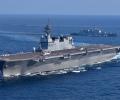
Here are some of the glimpses of the exercise held in the North Arabian Sea.

The 19th edition of the Malabar naval exercise saw the Indian, US and Japanese maritime forces participated jointly in the routine.
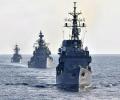
The Indian Navy is also ramping up its operational cooperation with various friendly naval forces like the United States Navy and Japan Maritime Self Defense Force in view of the fast evolving regional security landscape, they said.

The India-Japan joint naval exercises are a strategic signal for China, observes Dr Rajaram Panda.

Curtains will fall on the Rim of the Pacific 2016, the world's largest international maritime exercise, on August 4.

Malabar 2016 -- a trilateral maritime exercise involving the Indian Navy, the Japan Maritime Self-Defense Force and the US naval forces in the Indo-Asia-Pacific -- concluded on June 17.

The purge in Washington does not pause the war. Strikes continue, Hormuz remains closed, and Brent crude is still dancing around $109 a barrel. For India, the command chaos in the Pentagon is another layer of uncertainty piled on five weeks of conflict that was already straining every buffer Delhi has.

The navy has significantly expanded its deployment in the Indian Ocean Region deploying a plethora of warships and submarines to create pressure points on China as the maritime space around the Malacca Strait is very critical for its supply chain through sea routes.

The trigger that led Japan and the Philippines to ink the deal was because of the deteriorating security situation in the South China Sea. China's coast guard increased the frequency and intensity of incursions into Philippine waters, provoking the Philippines to take countermeasures to deter China, explains Dr Rajaram Panda.
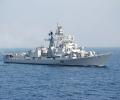
The Indian ships' participation in MALABAR-16, a maritime exercise with the US Navy and Japan Maritime Self-Defense Force, reflects the vital strategic importance of the region to India.
National Security Advisor Ajit Doval on Thursday called for seamless coordination among various agencies involved in protecting India's maritime interests in the face of emerging security challenges and increasing rivalries and competitions in the Indian Ocean.

New Delhi's growing defence partnership with Tokyo could take wing with the US-2 (Utility Seaplane Mark 2), a one-of-a-kind amphibious aircraft that has Indian naval planners goggle-eyed.

The agreement provides for creation of an enabling framework for closer cooperation and interoperability, besides allowing militaries of the two countries to use each other's bases and facilities for repair and replenishment of supplies, the official said.
"Relevant countries should abandon the obsolete Cold War mentality and narrow-minded geopolitical rivalry concept and view correctly and respect people's aspiration in the region and do more things conducive to regional solidarity and cooperation," Chinese foreign ministry spokesman Zhao Lijian said.

The compulsion behind India and Japan to deepen security cooperation is in response to China's growing political and economic clout and its assertive behaviour in disputed areas. This has been the key driver for bringing both India and Japan closer in the domain of security cooperation, explains Dr Rajaram Panda.

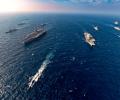
95 aircraft, 16 ships and 2 submarines from 3 countries are taking part in Malabar exercise.
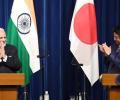
During the 13th annual summit, the two prime ministers reviewed developments in bilateral relations and explored new areas of cooperation, focusing on shared vision for peace and prosperity in the Indo-Pacific, where China is flexing its muscles.

When a Chinese warship entered Japanese waters, the Indian commander called on China to maintain discipline at sea. Dr Rajaram Panda explains the significance of the Malabar exercises between India, Japan and the US.

Shigeru Ishiba is expected to prioritise strengthening Japan's military capabilities and fostering deeper international partnerships, particularly with India, with whom Japan shares significant strategic interests, explains Dr Rajaram Panda.
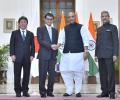
The India-Japan 2+2 dialogue added strategic heft to the special relationship in the wake of growing Chinese assertiveness on regional affairs, points out Dr Rajaram Panda.
China's behaviour in the post-pandemic geopolitical landscape which may determine the Quad's future trajectory, notes former foreign secretary Shyam Saran.

'Singh apprised the Japanese leaders about Islamabad's 'evil design' on Kashmir at a time when Pakistan has decided to internationalise the issue.'

Reports (not denied by India) that the USA had 'for the first time provided real-time details to their Indian counterparts on the Chinese positions and force strength in advance of a PLA incursion' into Tawang at the LAC in December 2022, helping India thwart China's expansionist designs, show how operationally effective the USA-India friendship has become on the ground. A engaging excerpt from Sreeram Chaulia's must-read new book, Friends: India's Closest Strategic Partners.

Although the pact would focus mainly on the Pacific and the South China Sea region, any action designed to deter China with or without New Delhi's active participation is a welcome move, notes Commodore Venugopal Menon (retd).

The agreement would divert China's attention and keep them busy in the Pacific theatre, probably resulting in a reduction in threat perception in our area of interest in the Indian Ocean, notes Commodore Venugopal Menon (retd).
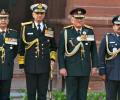
As India's international role expands, so must our capabilities, says Brigadier Gurmeet Kanwal (retd).

'The military aim in a future conflict, if it can't be avoided, should be to cause maximum damage to the adversary's war waging capability and capture limited amount of territory as a bargaining counter,' says Brigadier Gurmeet Kanwal (retd).

In anticipation of a verdict to be delivered by the International Tribunal of the Permanent Court of Arbitration in The Hague on Tuesday, China has orchestrated a worldwide campaign to defuse its findings.
 © 2026 Rediff.com - Advertise with us - Disclaimer - Privacy Policy - Sitemap - Feedback - About us - Terms of use - Grievances