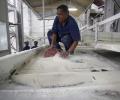
Record sugar output has also yielded molasses production way beyond market demand and plant capacity of state distilleries and country made liquor units

The state government has formed two committees under the chief secretary and the cane commissioner on the matter.

The business of volume can be a win or a loss for a sugar mill as India's sugar market is heavily controlled by the government.

Amid the political push and pull, the Centre's decision to allow sugar exports and remove the 50 per cent duty on molasses exports has rekindled hope in the industry that more relief may follow.
Presently director at the Indian Council of Agricultural Research's Sugarcane Breeding Centre in Coimbatore, Bakshi Ram's next target is to improve both cane yields and sucrose content in cane varieties cultivated beyond the Vindhyas in Tamil Nadu and Karnataka, as also Maharashtra.

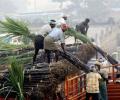
With the cane crushing season set to commence on November 15, lakhs of cutters from various districts have already migrated to the sugarcane belts in western Maharashtra and many other states, according to the Maharashtra Sugarcane Cutters and Transport Association.

A close associate of Maharashtra Deputy Chief Minister Ajit Pawar claims that Pawar was actively pursuing a merger of the two Nationalist Congress Party (NCP) factions before his death. The associate, Kiran Gujar, stated that Pawar had indicated the merger was imminent just days before a fatal plane crash.

Uttar Pradesh Chief Minister Yogi Adityanath asserted that Uttar Pradesh enjoys a clean environment, unlike Delhi, which he likened to a 'gas chamber' due to its pollution levels.

The demand growth in the low-income category is expected to be driven mainly by packaged branded sugar as well as traditionally consumed gur (jaggery) and khandsari.
Sugar prices in October were Rs 36-37 a kg, from where they fell by Rs 8-9 per kg.

The benchmark M-30 variety of sugar has declined by over 3 per cent in November to trade now at Rs 3,694 per quintal

'The government is of the view that distilleries around Hapur and Bijnor would pollute groundwater in the vicinity and its spill over into the sacred Ganga. Hence, we are looking to close these distilleries to prevent them from discharging water into the open area,' said a senior UP government official.

The production in Maharashtra is pegged higher at 11-11.5 million tonnes against 10.71 million tonnes
The country has exported about 5 lakh tonnes of raw sugar so far availing the benefit of the subsidy, according to the Indian Sugar Mills Association (ISMA).

Poor rain threatens recovery in production this season, sugar prices at three-month high

A projected drop in production in the 2016-17 sugar season (October-September) has kept domestic prices firm, reflecting in improved profitability and stock prices of companies.

UP's mills, dominated by the private sector's 94 units, have already expressed their inability to participate in the next crushing season
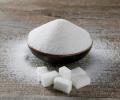
The subsidy will be credited to bank accounts of farmers against cane price dues and are compliant with WTO norms. This will benefit millions of farmers in Uttar Pradesh, Maharashtra and Karnataka.

Last year, the country produced about 77.52 million tonnes of fruits, 149.6 million tonnes of vegetables, 104.32 million tonnes of rice and 93.90 million tonnes of wheat.

Factories, shops closed for four days; list of dead now 38.

This has spelt trouble for the mills. Most of them are unable to pay the farmers.
Maharashtra, the country's largest cane and sugar producer after Uttar Pradesh, had, over the past few years, weathered adverse market dynamics brought about by a domestic and global sugar glut, mounting arrears and muted exports.
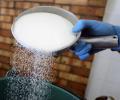
The last few years have been uncharacteristically good for the Indian sugar sector for a variety of reasons. While on the one hand, the weather supported good crop production; on the other hand, the programme to blend ethanol with petrol took off in a big way. The long-pending problem of burgeoning sugarcane arrears almost came down to nil and exports boomed to record highs.
Three million tonnes of buffer stock, where the government bears the interest and insurance cost, was announced by the Centre only for a year and that period is ending in June.


Maharashtra Deputy Chief Minister Ajit Pawar on Friday said he did not have any connection with Guru Commodity Services Pvt Ltd which is under the Enforcement Directorate's (ED) scanner, though a sugar mill owned by the company is being run by one of his relatives.
ugar mills in UP owe thousands of crores to cane farmers.

India is the world's second-biggest sugar producer after Brazil and has been looking to offload a surplus in an already well-supplied world market.

The ethanol vehicles will have the flexibility to switch to other fuels
India's plan to produce ethanol from second-generation (2G) sources -- mainly farm waste -- is taking time to materialise even as the government is set to dedicate to the nation on Wednesday a Rs 900-crore plant set up by Indian Oil Corporation (IOC) in Panipat. Though state-run oil companies had decided to set up at least 12 plants in 2016-17 with an investment of around Rs 10,000 crore, this will be the first unit coming on track while others are stuck in various stages owing to issues like capital expenditure, lack of feedstock, and high rates of finished products compared to traditional ethanol units. According to industry sources, three more second-generation plants are coming up.

'India is there to stay as it has always been a consumer.' 'Its consumption has been huge, mainly due to demographics.'

The sugar industry clamouring for control and intervention should set the alarm bells ringing in the corridors of power.

In the early part of 1800, a 30-acre plot next to Fort Gloster on the banks of river Hooghly in Howrah district of Bengal was the nerve centre of industrial activity; it housed India's first steam-powered cotton mill, Bowreah Mills, which was set up by a British merchant and went on to become a hub of factories - a rum distillery, foundry, cotton yarn factory, an oil mill and a paper mill, et al. Spearheaded by Dwarkanath Tagore, the industrialist grandfather of Rabindranath Tagore, the commercial complex was possibly the first of its kind in the country. Close to 200 years later, after much ebb and flow of history, the hub is set for a resurgence of sorts.

The RBI said recently that the upsurge in inflation in April was led by food and commodity prices.

Though Muslims have been trusted allies of Jats since the days of former Prime Minister Charan Singh, experts feel the alliance has had its share of strains following his death in 1987
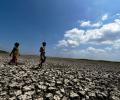
Lush agricultural lands have turned parch as groundwater levels deplete to new lows, and wells and water reservoirs go dry. While the administration points to deficient rainfall as a reason, experts and activists say the drought is mostly man-made.

This is the first time the fight is between mother and son. Both sides don't look in the mood to relent: Advisors and spin doctors have been hired, lawyers have been consulted.
The storage of water in the six major reservoirs in the state was just 6.2 per cent of capacity as of April 27, 2017, reports T E Narasimhan and Gireesh Babu.

How bridge keeps corporate India sharp and quick-witted.

Now we need to fight back to reclaim our food and our habits. The only way to do so is to rediscover food as pleasure and be thrilled, not just by its smells and tastes, but also by the knowledge it embodies, says Sunita Narain.
 © 2026 Rediff.com - Advertise with us - Disclaimer - Privacy Policy - Sitemap - Feedback - About us - Terms of use - Grievances