
US President Donald Trump said on Thursday that a news conference on reciprocal tariffs will be made later on Thursday.

The US did not accept India's request for consultations under an agreement of the World Trade Organisation (WTO) concerning American tariffs on steel, aluminium, and related derivative products, Parliament was informed on Tuesday. The US has maintained that these measures were introduced on the grounds of national security, Minister of State for Commerce and Industry Jitin Prasada said in a written reply to the Lok Sabha.
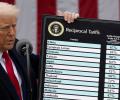
The move by the US President came following a retaliatory move by China, where it increased its tariff on US goods from 34 per cent to 84 per cent starting April 10.

European wines are set to enter the Indian market at lower prices under the bilateral free trade agreement as India will provide import duty concessions under the pact, an official said. Under the pact, the duty on EU wines would fall from 150 per cent to 20 per cent (for expensive ones).

Despite India's electric passenger vehicle market experiencing an 83.6% year-on-year surge in FY26, new foreign entrants VinFast and BYD have significantly outpaced Tesla, which struggles with high import duties, a limited retail footprint, and a lack of local manufacturing commitment.

Amid the ongoing global tariff war, Commerce and Industry Minister Piyush Goyal on Wednesday asked exporters not to panic and assured them that India is working on the "right mix and right balance" in its proposed trade agreement with the US.
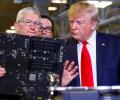
US President Donald Trump has threatened to impose tariffs on Apple products if the tech giant does not shift iPhone production from India to the United States. Trump said he expects iPhones sold in the US to be manufactured in America and not India, or anyplace else. He also said that he had a "little problem" with Apple CEO Tim Cook for building manufacturing facilities in India. Cook had previously said that the majority of iPhones sold in the US would have India as their country of origin. Experts say that shifting production to the US would be more expensive than assembling iPhones in India.
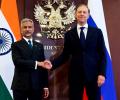
External Affairs Minister S Jaishankar has called for India and Russia to adopt a creative and innovative approach to address complex geopolitical challenges, emphasizing diversification and expansion of cooperation.

Civil unrest in Iran has started impacting India's basmati rice exports to the country, leading to a sharp fall in domestic prices, as exporters face payment delays and mounting uncertainties, an industry body said on Tuesday. The Indian Rice Exporters Federation (IREF) urged exporters to reassess risks on Iranian contracts and adopt secured payment mechanisms, warning against over-leveraging inventories meant for the Iranian market.

The Congress attacked the Modi government, saying it now seems to be routine that India learns about its government's actions only from Trump or his appointees.

State Bank of India, Tech Mahindra, Larsen & Toubro, Tata Steel, Sun Pharma, Infosys, HCL Tech, Axis Bank, Tata Consultancy Services and NTPC were among the biggest laggards among Sensex shares. Nestle, Hindustan Unilever, Titan, Power Grid, UltraTech Cement and ITC were among the gainers.

Lavrov said that the US has set itself the objective of 'achieving economic domination', adding further to it that Americans want to control the routes to leading countries to provide its energy sources to them.
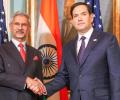
This will be the first face-to-face meeting between Rubio and Jaishankar following President Donald Trump's imposition of an additional 25 per cent tariff on India for Delhi's purchases of Russian oil, taking the total levies imposed on India by the Trump White House to 50 per cent.

From the 30-Sensex firms, Trent, Larsen & Toubro, Reliance Industries, InterGlobe Aviation, Maruti, ITC, Adani Ports and Bharat Electronics were among the biggest laggards. In contrast, Eternal, ICICI Bank, Tech Mahindra, State Bank of India and Tata Consultancy Services were among the gainers.
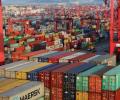
Imposition of high tariffs on China, Mexico, and Canada by the US is expected to help Indian exporters in increasing their shipments to the American market, experts say.

With US President Donald Trump "temporarily suspending" country-specific reciprocal tariffs until July 9, India sees the three-month window as an opportunity to renew its push for a proposed bilateral trade agreement (BTA) with the US and expedite finalisation of the first tranche of the trade deal.

Equity benchmark indices Sensex and Nifty ended lower on Thursday after US President Donald Trump announced the imposition of a 25 per cent tariff on all goods coming from India starting August 1 and an unspecified penalty for buying Russian crude oil and military equipment.
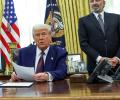
S&P Global Ratings on Monday said several Asia-Pacific economies could face higher tariffs under the Trump administration, while India, South Korea, and Thailand could be most vulnerable to trade retaliation. In its report titled 'Asia-Pacific Economies Likely To Be Hit By US Trade Tariffs', S&P said economies like Vietnam, Taiwan, Thailand, and South Korea have relatively greater economic exposure to the US, meaning that tariffs, if imposed, would have the largest economic impact.

Uncertainties over the impact of the United States' (US') tariffs on India, along with the ongoing transmission of past rate cuts, prompted the members of the Reserve Bank of India's Monetary Policy Committee (MPC) to maintain the status quo during the August meeting, the minutes showed. While some of the external members highlighted their concern over growth, the internal members cited the one-year headline inflation rate overshooting the 4 per cent target.
An hour before his bilateral meeting with Prime Minister Narendra Modi, Trump again commented on India's tariff structure, saying 'they have the highest tariffs' and 'it is a hard place to do business'.
From the 30-Sensex firms, Larsen & Toubro, Tech Mahindra, Tata Consultancy Services, Reliance Industries, Tata Steel, and Trent were among the biggest laggards. On the other hand, Eternal, ICICI Bank, Bajaj Finance, and Bharat Electronics were the gainers.

Real GDP growth surprised on the upside in 2025, but weaker nominal growth, trade uncertainty, and soft demand signal a bumpier road ahead.
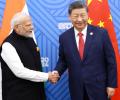
Chinese President Xi Jinping on Wednesday pledged to strengthen the strategic relationships with neighbouring countries by 'appropriately' managing differences and enhancing supply chain ties as China's tariff war with the United States escalated.

Foreign investors have remained cautious ahead of the Union Budget amid expectations of limited policy changes.

Congress leader Rahul Gandhi on Tuesday alleged that Prime Minister Narendra Modi buckled under United States pressure to finalise a trade deal and 'sold off' the hard work of Indian farmers through the agreement.

After three consecutive months of heavy selling, foreign portfolio investors (FPIs) turned net buyers in the first week of February, infusing more than Rs 8,100 crore in Indian equities, aided by improving risk sentiment, along with a trade deal with the US.

China's Ministry of Commerce announced Tuesday it will impose counter tariffs on multiple American products, including a 15 per cent tariff on coal and liquefied natural gas, and a 10 per cent tariff on crude oil, agricultural machinery, and large-displacement vehicles.

EU leaders convened an emergency summit in Brussels to address transatlantic tensions as President Trump threatened new tariffs on member States linked to his Greenland acquisition demands.

Macroeconomic data, global geopolitical developments and rising concerns over AI-related disruptions are likely to dictate sentiment in the stock market next week, even as investors may remain cautious amid ongoing volatility, according to analysts.

Piyush Goyal on Friday rejected reports suggesting that India is planning to hold off trade deal with the United States for several months.

Do not exit in panic or buy falling stocks without reassessing fundamentals; instead, build a watchlist and invest gradually with a disciplined, long-term approach.
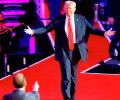
Trump on February 1 had announced tariffs on major US trading partners Canada, Mexico and China. He imposed a 25 per cent tariff on Canadian and Mexican imports and a 10 per cent on goods from China.

Export-led Indian IT sector is not directly hit by Trump's tariff order on goods, but there could be worrisome indirect bearings on it arising out of possible slowdown in decision-making and GDP growth in America over higher tariffs, which may then cloud demand from specific verticals, according to some analysts.
The US has temporarily permitted India to accept Russian oil already on ships to ensure energy supplies amid the conflict with Iran. This short-term measure is not expected to significantly benefit Russia financially.
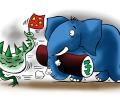
American sourcing firms and exporters in China are approaching Indian companies to supply goods to the US as high tariffs imposed by Washington are making it difficult for them to ship directly to America, apex exporters' body FIEO said on Monday. The US has imposed 145 per cent tariffs on Chinese goods entering the American market. For India, the duty is just 10 per cent.

United States President Donald Trump held a New Year bash at his Florida resort on Thursday and when he was quizzed about his wish for the New Year he said he wanted peace on Earth, reported Fox News.
From the 30-Sensex firms, NTPC, ICICI Bank, Adani Ports, Bharti Airtel, Sun Pharma and Bajaj Finance were among the biggest laggards. However, Asian Paints, HCL Tech, Bharat Electronics and Reliance Industries were among the gainers.

The US retaliatory tariffs are a major setback for the Indian gems and jewellery exports, apex industry body GJEPC said on Thursday as it urged the government to take steps to secure the long-term interest of the sector. The US has announced 27 per cent reciprocal tariffs on India saying New Delhi imposes high import duties on American goods, as the Donald Trump administration aims to reduce US' trade deficit and boost manufacturing.

The delegations from the US and Iran head to Islamabad on Friday, carrying a ceasefire that is already fraying, a Strait that is technically open and practically closed, and a negotiating agenda that would challenge even parties actually negotiating in good faith, which these groups are not. Prem Panicker continues his must read blog on the Iran War.

'After the Galwan clash, the rules of engagement changed with the army commanders allowed to use any means at their disposal as they deem fit for tactical operations.'
