
Tanmaya Nanda provides a quick guide to questions about the Mars mission you always wanted to ask but were afraid to

Around 600 scientists and engineers are hoping for the best as they forge ahead with plans of making an indigenous version of a space shuttle.
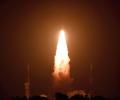
A S Kiran Kumar, chief of ISRO, said the mission was unsuccessful because the satellite housed within the heat sink could not be injected.

The prompt approval to set up a radar station on the Andaman and Nicobar Islands signalled the Modi government's intent to deal with China on its own terms.

Global analysts say a successful launch of operational GSLV MkII rocket will reduce dependency for ISRO on foreign launchers.

It also carries equipment for meteorological data relay and satellite based search and rescue services being provided by earlier INSAT satellites.
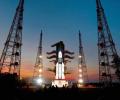
'If Chandrayaan 1 had a launch with GSLV, we need not have an orbiter for Chandrayaan 2.' 'We could have gone straight round the moon and landed on the moon.'

The rocket is almost 49 meters high -- as much as a 17-floor building. It weighs 415 tons -- as much as the combined weight of 80 full grown elephants.

India's Polar Satellite Launch Vehicle will lift off from Sriharikota on July 10 taking five foreign satellites into orbit, including three earth observation spacecraft whose imagery will be utilised by a Beijing-based company as well as an experimental nano-satellite that will deploy a large, light-weight sail in order to hasten its descent back to earth.

Ahead of India's Mars orbiter's scheduled rendezvous with the red planet on September 24, ISRO is all set for the crucial fourth trajectory correction manoeuvre and test fire of the main liquid engine on the spacecraft on Monday.
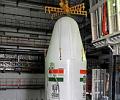
The launch of a Geosynchronous Satellite Launch Vehicle was called off by the Indian Space Reasearch Organisation at the eleventh hour on Monday due to a fuel leak in its second stage -- in a setback to the mission to test its homegrown cryogenic engine -- after its failure three years ago.

The feat is the second one for the Indian Space Research Organisation scientists in using the indigenously made cryogenic stage after the January 5, 2014 launch of GSLV-D5.

After having successfully completed three orbit raising manoeuvres, ISRO's Mars Orbiter mission on Monday suffered a glitch as it failed to achieve the targeted apogee (farthest distance from Earth) of one lakh km during the fourth orbit raising operation in the early hours.
And the first Indian to go into space from 'Indian soil' could well be a woman.

India is set to operationalise its own navigational system with the successful launch of IRNSS-1D, the fourth in the series of seven navigational satellites, onboard PSLV-C27 from Sriharikota on Saturday.

The first Trajectory Correction Manoeuvre of India's maiden mission to Mars was on Wednesday carried out successfully by Indian Space Research Organisation scientists on the spacecraft, which is presently travelling some 2.9 million km away from Earth.

We sorted through countless photographs taken around the world to come up with the top photos of 2019. Together these images tell the story of the year -- capturing moments of hope and heartbreak, triumph and tragedy.

ISRO chief K Radhakrishnan spoke with rediff.com briefly before the launch of India's mission to Mars

India successfully placed its spacecraft in orbit around Mars, becoming the first country in the world to succeed in such an inter-planetary mission in the maiden attempt itself.

While the Mars mission got wide praise, there were voices which questioned the need for spending Rs 450-500 crore on it when the country is facing hunger and poverty.

A truly 'made in India' satellite that will empower a digital India.

A nation that aspires to be a superpower and wants to join the ranks of global leaders in knowledge, science and technology should declare an all out war on ills like superstition and black magic at all levels, says Dinesh C Sharma.

This is ISRO's new record of launching 20 satellites, including those from the US, Germany, Canada and Indonesia.

Thirty-four years after he traveled to space, Wing Commander Rakesh Sharma tells Rediff.com's Archana Masih that he looks forward to Gaganyan, India's first manned space mission in 2022.

With the launch of GSLV-MK III, slated for April, it will be able to cater to bigger satellites as well.

The success of the PSLV-C34 mission is a result of ISRO's professionalism and the hard work put in by their scientists over the last many decades., says Ajay Lele.

On Monday, ISRO scientists will run a test of the Mars orbiter satellite's main engine and make a small course correction. This is crucial because the engine has been idle for nearly 10 months. T E Narasimhan reports

'Well begun is half done, today there are more hits than misses by the Modi government in its support towards science in India,' says Pallava Bagla.
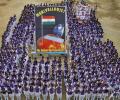
Godrej and some other firms are frustrated at what they say is the slow execution of projects and lack of government support, which are hampering India's efforts to compete with China and Russia as a cheaper option for launching satellites.

With the Indian Space Research Organisation set to launch the Mars Mission on November 5, Chairman K Radhakrishnan, in an interview with Praveen Bose, talks about the complexities, the challenges and the benefits of the Rs 450-crore mission.

State government announced ex gratia for kin of those who lost lives.
'I will say all this happened because of ignorance coupled with arrogance,' says G Madhavan Nair.

'What we are trying for is to make space travel easier like air travel.' 'We have already established ourselves... the fact that other countries are coming to seek our help shows our technology is mature.'

A clear aim, knowledge, hard work and perseverance spells success: President Dr A P J Abdul Kalam.

ISRO's expedition to Mars is yet another breathtaking adventure for an organisation created by Dr Vikram Sarabhai and carefully nurtured by scientists like A P J Abdul Kalam and R Aravamudan.

Rediff.com takes a look at spacecraft that have successfully made it to Mars.

Rajeev Srinivasan on the disastrous after-effects of a made-up spying incident
