
The flight took off from Sriharikota in the Bay of Bengal on schedule.

Starting on Monday, the country's low-cost Mars mission that is in a rendezvous with the red planet for an extended period will enter the "blackout" phase snapping communication with the satellite.

Chandrayaan-3's success is a must for India's space ambitions; we can't afford to lose out. And for realising our space dreams, the Indian private sector must be encouraged because if we lose this race, the moon, Mars, and mineral-rich asteroids will already be crowded before we reach there.
The indigenous rocket will carry the second technology experiment satellite GSAT-2.

The Mars Orbiter Mission, or MOM, India's first planetary mission to explore Mars, has successfully completed one year around the Red planet on Thursday.

"First orbit raising operation of GSAT-6 was successfully completed by firing the Apogee Motor for 3385 seconds at 8:35 pm IST on August 28," the ISRO said.

India's Mars orbiter has sent a picture of regional dust storm activities over the northern hemisphere of the red planet, Indian Space Research Organisation said on Monday.

Other than the Cartosat-2 series satellite, the PSLV is carrying 29 nano satellites from 14 countries - Austria, Belgium, Chile, Czech Republic, Finland, France, Germany, Italy, Japan, Latvia, Lithuania, Slovakia, the United Kingdom and the United States of America besides a nano satellite from India.

Why did ISRO's workhorse Polar Satellite Launch Vehicle rocket fail during its 41st flight?

GSLV Mark-III will be India's most powerful launch vehicle built to lift the heaviest Indian communications satellites to space.
.jpg)
India's maiden mission to Mars has traversed beyond the sphere of influence of Earth extending about 9,25,000 km in its 10-month long voyage to the red planet.


"Efforts are underway to establish the link with the satellite," it added.

In a technology that can bring down costs significantly of launching satellites, India will test a reusable launch vehicle in September.

India will test a reusable launch vehicle next month, a technology that will bring down costs of launching satellites significantly, government said on Monday.

Mission Shakti 'shows the development within India's military space programme, its desire to be seen as a global space power and its recognition of the potential dangers of China's counterspace programme.'

Indian Space Research Organisation's Mars Orbiter, which was placed in inter-Mars trajectory in the early hours on Sunday, has crossed Moon's orbit and is travelling beyond Earth's natural satellite.

PSLV C-35, carrying India's SCATSAT-1 meant for ocean and weather studies and seven other satellites including from the United States and Canada, on Monday lifted off from the spaceport in Sriharikota.

Six teams of the National Disaster Response Force are being deployed in four coastal districts of Andhra Pradesh as cyclonic storm 'Helen' is expected to cross the Bay of Bengal coast near Kavali on Thursday evening.

A recap of events that occurred in India in the past 24 hours.

The Rs 978 crore mission, which has been rescheduled for Monday after scientists corrected the glitch in the rocket, will be launched at 2.43 p.m from the second launchpad at Satish Dhawan Space Centre, over 100 km from Chennai.

Heralding a new era, India on Friday night launched its heaviest commercial space mission ever with its polar rocket successfully putting five British satellites into the intended orbit after a flawless takeoff.
The mission has been extended by another six months due to surplus fuel
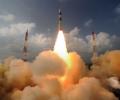
The second orbit raising manoeuvre of India's Mars Orbiter spacecraft was performed in the early hours of Friday, three days after its successful launch by PSLV C-25 into orbit around the Earth.

Top space scientist G Madhavan Nair said it may take ten years for the country to put in place such an operational rocket.

A day after India successfully launched the Mars Orbiter in the Red Planet on its first attempt, it tweeted the first image it took and captioned it, 'the view is nice up here'.

He said India wanted growth, development and peace in the region and was keen to utilise technology to pursue this goal for the shared prosperity.

India's observatory will be the fourth in space, after the Hubble, Russia's Spektr R and Suzaku of Japan.

Crossing a major milestone in the country's space history, ISRO's Mars Orbiter mission ventured out of Earth's sphere of influence for the first time in an attempt to reach the red planet's orbit

The Indian Space Research Organisation has released a series of beautiful images of a canyon named Ophir Chasma and other physical formations on the surface of the Red Planet taken by the country's Mangalyaan Mars Orbiter.
A day after suffering a glitch during the fourth orbit raising operation on its Mars Orbiter Mission, the Indian Space Research Organisation on Tuesday successfully completed the supplementary manoeuvre, raising the spacecraft's apogee (farthest distance from Earth) to over 1,18,000 km.

"We started it by 1.17 am and have successfully completed the first orbit raising manoeuvre of Mars Orbiter Spacecraft. Right now, the computation is going on," an ISRO spokesman told PTI.

"Since its injection into Earth's orbit yesterday, it has been functioning smoothly on the orbit. We are planning to perform orbit raising manoeuvres in the early hours of of Thursday," an Indian Space Research Organisation spokesman told PTI over phone.
Prime Minister Narendra Modi lauded the scientists saying, "with this successful launch, we will determine our own paths powered by our technology".

The ISRO lost communication with the satellite when it attempted to ignite the engine in a third and final move to its desired location.

India's launch preparations for the ambitious Rs 450 crore Mars orbiter mission achieved a major milestone with the successful thermo-vacuum test of the spacecraft with its payloads (scientific instruments).
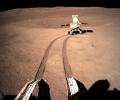
'China pumps in a lot more money than what we do. China's space budget is close to $5 billion while it is hardly $1 billion for us.' 'We manage the programmes within the constraints of our budget. The main difference is we prioritise.'

Contributors to Team Indus project will have names etched on an object going to space.

Noting that the PSLV was a versatile launch vehicle which can do different jobs and put satellites in different orbits, he said streamlining of this operation with improved capabilities is on.

It was a euphoric moment for students of the College of Engineering in Pune as the academic satellite developed by them -- Swayam -- was on Wednesday successfully placed in orbit along with 19 others.
