
The Indian Space Research Organisation will launch ten satellites, including eight from abroad, which will be carried by PSLV-C9, on April 28.The cluster of satellites to be lifted includes the Indian satellite Cartosat-2A, weighing 690 kg. The vehicle would also carry eight nano satellites of 16 to 27 kg from Canada, Netherlands, Denmark and Germany. Of the eight nano satellites, six are form a cluster called NLS-4. These satellites were built to test nano technoloy.
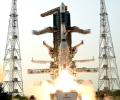
Over 32 missions -- satellites and rockets -- have been planned for the year.
Indian Space Research Organisation's immediate plan was the launch of two more PSLV flights this year and a GSLV launch early next year.
The GSLV will put into orbit the INSAT-4CR, which carries 12 high-power Ku-band transponders for direct-to-home television services, video picture transmission and digital satellite news gathering.
"It will take about five-and-half days for Chandrayaan-1 to get to the moon," officials said, adding that the probe will be in a 100 km polar orbit around the Moon.
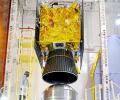
India successfully launched IRNSS 1C on board ISRO's PSLV C26 rocket from the spaceport at 1.32 am on Thursday, moving a step closer to setting up the country's own navigation system on par with Global Positioning System of the US.
India becomes the fifth country after United States, Russia, China and France to enter the launch market.
The ISRO will launch its ambitious and maiden mission to the moon, Chandrayaan-I, from the Satish Dhawan Space Centre at Sriharikota on April 9, 2008. "We are looking for a launch on April 9," Mylswamy Annadurai, head of Chandrayaan-I said.
The satellite has reached its final slot and will be fully operational by the month-end.

The ISRO is strengthening 'eye in the sky', which helped the Indian army carry out surgical strikes last year, with the launch.
India on Monday successfully launched Israeli satellite 'Polaris' from the Satish Dhawan Space Centre in Sriharikota by a homegrown Polar Satellite Launch Vehicle, a spokesman of the Indian Space Research Organisation said. This is the second time that a 'core alone' PSLV configuration had put a satellite into orbit. In April 2007, an Italian satellite Agile was put into the orbit, the space agency spokesman said.
The T-52 hour countdown for the launch of the PSLV-C7 began at 0548 hours on Monday, and it was progessing smoothly.
The 44 metre tall four-stage PSLV placed Italian satellite AGILE into orbit at 550 km above the earth.

The third of the total of five orbit raising manoeuvres of the Mars Orbiter spacecraft was performed early on Saturday, raising its apogee, the farthest point from Earth, to over 71,000 km.
After PLSV-C8, PLSV-C10 carrying Polaris satellite would also be launched either in June or July, officials added.

President Pranab Mukherjee has advised state governors not to undertake official visits outside their states as part of the campaign for the Lok Sabha polls.

The website of Indian Space Research Organisation's commercial arm Antrix Corporation Limited was reportedly hacked on Sunday and the space agency said efforts are on to set it right.
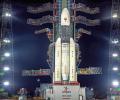
Late on Monday night, in a last-minute revision of schedule, ISRO announced that the launch of India's second lunar mission 'Chandrayaan-2' has been called off due to a technical snag.

In its first multi-orbital launch, India's workhorse PSLV will on Monday inject eight different satellites, including the country's weather satellite SCATSAT-1 and five from other nations, into two different orbits.
India will join an elite group of nations with the launch of a new mission to test re-entry technology, which would be a forerunner to developing reusable vehicles like space shuttles.
The 44.5-metre-tall, 295-tonne PSLV-C7 lifted off from the launch pad at 9.24 am.

India on Wednesday successfully launched a record 104 satellites -- all but three of them foreign--from Sriharikota and put them into orbit in a single mission onboard its most dependable Polar rocket.
This is the first time ISRO was putting into orbit a two-tonne class satellite.\n\n
ISRO's Polar Satellite Launch Vehicle-C6, carrying India's remote sensing satellite CARTOSAT-1 and a micro satellite HAMSAT, blasted off from the Satish Dhawan Space Centre in Sriharikota on Thursday.

The two satellites that PSLV will release in the orbit will help the country's mapmakers and amateur radio operators.
The launch vehicle that lifted off from a newly built launchpad will release two satellites in the earth's orbit.

'We are looking at a joint venture between ISRO and a few companies to assemble the PSLV and launch it from Sriharikota.' 'In a month or two, the vehicle assembly building will be ready.' 'After that, we could see 13, 14 launches a year.'

Except Pakistan, seven SAARC countries are a part of the project.

In a major boost to the Indian scientific community, the Mars Orbiter Mission (Mangalyaan), on its maiden tryst with the red planet, has completed 300 days of its journey in space and is just 23 days away from reaching its intended orbit.
The satellite was placed at 4.18 pm, a little over 17 minutes after the Geosynchronous Satellite Launch Vehicle (GSLV-F-01) carrying it was launched from the Satish Dhawan Space Centre in Sriharikota.

The Indian Space Research Organisation successfully put India's heavy rocket Geosynchronous Satellite Launch Vehicle-Development 5 (GSLV-D5) into orbit from the spaceport at Sriharikota, Andhra Pradesh at 4.18 pm on Sunday.
It is scheduled for lift-off at 1658 IST on Thursday from the space port at Satish Dhawan Space Centre at Sriharikota, about 100 km from Chennai.
Enthused over its successful launch of GSLV D5 with GSAT-14 communication satellite from Satish Dhawan Space Centre in Sriharikota on Sunday, the Indian Space Research Organisation is planning a series of GSLV launches and an experimental launch of the advanced version GSLV Mark III soon from the spaceport.

Massive evacuation has been undertaken in four districts of Andhra Pradesh before a severe cyclone hits the eastern coast on Thursday followed by very heavy rainfall.

The Indian space agency has already begun work on the third generation of the earth observation satellite -- the first of which will be ready by 2018 and boost the capability to generate digital maps.

The ISRO team worked tirelessly to make the Mars mission a success
