
'There will not be very heavy rain.' 'Moderate showers will be there and winds will be, say, somewhere between 20 and 40 km/hr, gusting to 35 km/hr.'

'Usually the average rainfall per day is around 8 mm and India is receiving 10 to 11 mm per day since the last one week.' 'July seems to be very good for the entire country.'

https://www.rediff.com/business/report/quality-control-orders-what-does-this-mean-for-domestic-industry/20240425.htm

This would be the second cyclonic storm in the Arabian Sea this year.

With different agencies showing divergent predictions regarding the southwest monsoon, the central government and states are gearing up to face adversity with various line ministries reportedly being directed to undertake mock drills and hold preparatory meetings. Around 56 per cent of the net cultivable area of the country is rain-fed, accounting for 44 per cent of foodgrain production. The June-September rains contribute around 73 per cent of the annual precipitation.

Cyclone 'Biparjoy', the first storm brewing in the Arabian Sea this year, has rapidly intensified into a severe cyclonic storm, with meteorologists predicting a 'mild' monsoon onset over Kerala and 'weak' progress beyond southern peninsular under its influence.

The Met department blamed the malfunctioning of sensors kept at the Automated Weather Station for the gaffe.

The independent group of scientists and communicators previously said that winters are quickly transitioning into summer-like conditions in north India, shortening the spring season.

A depression over the southeast Arabian Sea, south of Porbandar in Gujarat, is likely to move northwestward and intensify into a cyclonic storm, the India Meteorological Department said on Tuesday.
While weather forecasters remain divided on how the monsoons will play out in India over the next few months, analysts believe the news at the current juncture - at best - can trigger a knee-jerk reaction in the markets. They believe it is too early to say whether the sub-par monsoon on account of El Nino can seriously dent the market sentiment in the short-to-medium term. "These are just initial forecasts and we will have another round / status update from the weather forecasters a month down the line.

The IMD defines a normal monsoon as one which delivers between 96 and 104 per cent of the 50-year average rainfall for the season.

The El Nino impact on the Indian monsoon typically manifests by way of extended break in rainfall.
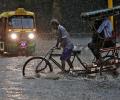
Though early days, meteorologists point towards a neutral La Nina during the initial phase of the four-month monsoon season this year that starts from June. If this holds true, by the time the rains hit the mainland, it could mean there would be one less reason to worry about the prospects of the monsoon this year. Weathermen said making any accurate prediction of how El Nino will behave and what impact it can have on the progress and distribution of rains is difficult to say at this point. A clear picture will emerge around late May or early June.
After becoming active over the rice-growing Indo-Gangetic plains, the southwest monsoon might witness weak phase for the next 3-4 days over the already rain-deficient region. So far, the main deficit states are Uttar Pradesh (-42 per cent), Bihar (-36 per cent), Jharkhand (-48 per cent), and West Bengal (-24 per cent). According to private weather forecasting agency Skymet, rains in west UP, Punjab, Haryana, Bihar, and Jharkhand are expected to be weak in the next 3-4 days before again picking pace.
It's still early days, but the southwest monsoon has been nearly 37 per cent 'below normal' in the first seven days (June 1-7) of this month. According to the data furnished by the India Meteorological Department (IMD), between June 1 and June 7, India received 14.5 millimetres (mm) of rainfall, against a 'normal' 23.1 mm. Among places where rains have arrived, monsoon in Kerala in the first seven days has been 48 per cent 'below normal', while in Puducherry, it has been 56 per cent 'above normal'. In Tamil Nadu, rains were 21 per cent 'above normal' between June 1 and June 7.

It has also predicted a below normal monsoon for the season with a Long Period Average of 93 per cent, subject to the error margin of 5 per cent.

A normal monsoon will augur well for the country's agriculture sector and boost crop yields. However, good rains - and surplus crops - could also depress prices, hurting farm income, unless adequate steps are taken.

The development of private data sources is a hugely positive development. It should serve as a challenge to the government to improve its own record on producing timely and reliable statistics, points out T N Ninan.

The weather department has said that the skies are expected to be partly cloudy for the next few days in Delhi.

The India meteorological department has issued a yellow alert, warning of a fresh heatwave spell in Delhi which may see temperatures soaring to 44 degrees Celsius by Wednesday.

A punishing cold wave swept Delhi on Monday morning with the minimum temperature at the Safdarjung observatory, the city's base station, plunging to 1.4 degrees Celsius, the lowest in the month since January 1, 2021.

Dense to very dense fog prevailed in some parts of the National Capital Region (NCR), Haryana, Punjab, west Uttar Pradesh and north Rajasthan on Tuesday.

Temperatures in March will be critical to determining the impact of any unusual heatwave conditions on this year's wheat crop in North India. It is that time of the year when the crop enters its vital grain-filling stage, say meteorologists and crop experts. So far, the high day temperatures in the North are not believed to have any significant impact on the final yields since the crop hasn't entered a stage where heat affects yields.

'Areas within 100 km of the landfall could suffer catastrophic effect.'

The four-month monsoon season from June to September accounts for 75 per cent of rainfall in the country.

'If because of El Nino, the monsoon is affected adversely in the current year, naturally it will affect income projections and consequently Budget numbers.'

Low temperature -- Delhi recorded a minimum of 13.5 degrees Celsius on Tuesday, the season's lowest so far -- allowed accumulation of pollutants, said Mahesh Palawat, vice president (meteorology and climate change), Skymet Weather.

The India Meteorological Department has issued an 'orange' alert.

"The season averaged maximum temperatures in Himachal Pradesh, West Rajasthan, Konkan, Goa, Coastal Karnataka, Kerala and Arunachal Pradesh are likely to be higher than normal by 0.5-1.0 degree Celsius," the Met department has said in its forecast.

The southwest monsoon might finally start withdrawing from parts of North-West India over the next three days, signaling the end of its four-month journey over the country that started in June, the India Meteorological Department (IMD) said. However, though the retreat might begin from next week, the rains might not descend quickly, as the met department predicted fresh spells of rains in Vidarbha, Chhattisgarh and east MP on September 21-22 and over Odisha, Coastal areas north Andhra Pradesh and Gangetic West Bengal on September 19-21. "Due to anti-cyclonic flows over northwest India at lower tropospheric levels, dry weather is very likely over west Rajasthan, Punjab, Haryana, Chandigarh and Delhi during the next five days. "Hence conditions are becoming favourable for the withdrawal of Southwest Monsoon from parts of northwest India during next three days," the IMD said.

While the experience of summers has been uncomfortable, the actual readings on thermometers may cause wonder about the exaggerated discomfort. This is what meteorologists call 'real feel temperature' or 'real feel heat'. Sanjeeb Mukherjee explains.

SBI was the biggest loser in the Sensex pack, shedding 2.40 per cent, followed by Yes Bank, Bharti Airtel, L&T, Sun Pharma, M&M, ICICI Bank, ONGC, RIL, Asian Paints, Vedanta and HUL, which lost up to 2.37 per cent.

'What we are seeing is some bursts of a cold wave.' 'It comes, troubles you for three-four-five-days and thereafter relaxes for another few days.' 'And then another fresh one (cold wave) comes.'
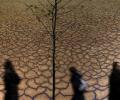
By June 14, the monsoon should have reached central India. But this year it hasn't even covered Karnataka properly or entered the Northeast.

The maximum temperature at the Safdarjung Observatory, Delhi's base station, is likely to rise to 45 degrees Celsius.

Monsoons have had limited effect on market returns for a given year, report Sachin Mampatta and Sundar Sethuraman.

Around 29 trains have been delayed by two to five hours due to foggy weather, a railway official said.

Till Thursday, the country had received 41 per cent less June rainfall than normal -- the scantiest in a decade and one of the rarest occasions when the shortfall in the month was more than 30 per cent -- private weather forecaster Skymet said in its daily weather forecast on Friday.
Agriculture activity, according to recent channel checks by Prabhudas Lilladher, is expected to continue at a strong pace in FY22.

Automobile retail sales in India increased by 37 per cent in April on a low base of COVID-hit April last year, automobile dealers' body FADA said on Thursday. Total sales across categories rose to 16,27,975 units in April, as compared to 11,87,771 units in the year-ago period. On a year-on-year basis, all vehicle categories including passenger vehicles and two-wheelers were up as compared with April last year.
